
Lever 1: the opening second, because nobody clicks in
Shorts autoplay. There is no click, no thumbnail decision, no browsing. The viewer is already mid-scroll when your video starts, so your first frame and your first sentence are the whole audition.
That changes what a good opening looks like. Cut the channel intro. Cut "hey guys". Cut "in this video I'm going to". Start mid-story, on the most surprising true sentence you can write about your topic.
Three hook shapes that hold up:
- A claim that sounds wrong until you explain it.
- A question with something at stake for the viewer.
- An image that begs for an explanation, with the explanation withheld for a beat.
And pace it. Delete any sentence whose only job is setting up the next sentence. If you read your script out loud and get bored anywhere, that is exactly where the swipe happens.
Lever 2: a niche narrow enough for the algorithm to learn
Most stalled channels are not too weird. They are too wide. "Motivation" is not a niche. "Stoic advice for people who just got laid off" is. The recommendation system works by finding a small group of people who finish your videos, then finding more people like them. If every video points at a different audience, there is no group to find.
Pick one lane and stay in it for months, not weeks. Same topic family, same voice, same visual look, same rough length. Boring on purpose. If you genuinely want to test two directions, run two channels rather than mixing them in one feed.
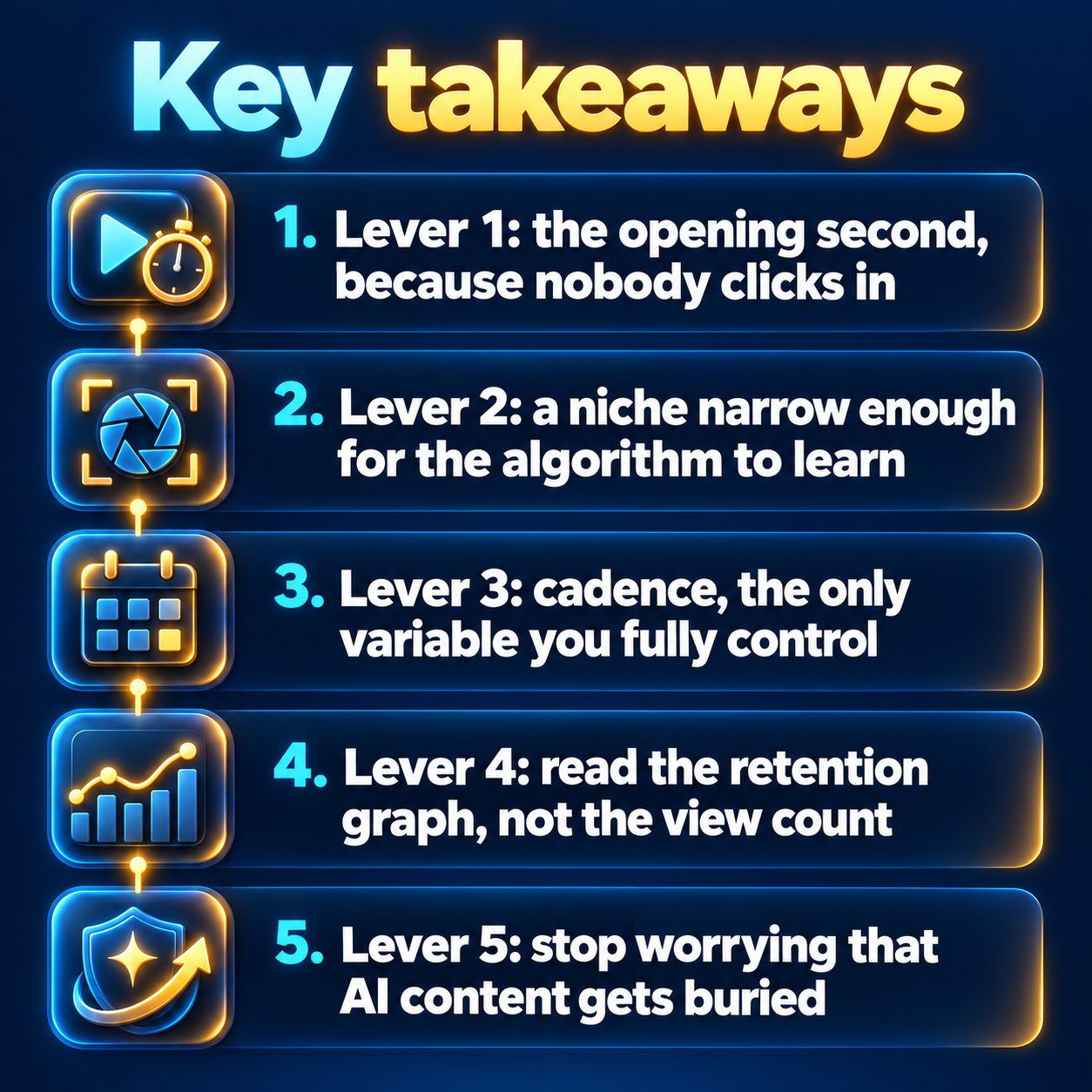
Lever 3: cadence, the only variable you fully control
You cannot control which video pops. You can control how many attempts exist. Every Short is a data point about who your audience is, and the system gets more confident with more of them.
Daily is ideal. Three times a week is fine. Once a week works if the videos are strong. What does not work is the pattern almost everyone falls into: eleven videos in two weeks, then nothing for a month, then a restart from cold.
So build the schedule around your worst week, not your best one. If you can only reliably make three per week, commit to three and hit them. Consistency is not a virtue thing; it is the thing that lets you tell whether your hooks are improving or not.
Lever 4: read the retention graph, not the view count
When a Short flops, the view count tells you nothing. The retention curve in YouTube Studio tells you everything.
- A cliff in the first seconds means the hook failed. The topic might still be great.
- A slow slide from the start means the pacing is too slow, or the payoff is too far away.
- Good retention with low views usually means the video simply did not get pushed yet, or the topic is too narrow even for your own audience. Post again.
- High rewatches with a flat line means you found a loop. Make three more like it immediately.
Do this on every video for a month and you will out-learn most people who have been posting for a year.
Lever 5: stop worrying that AI content gets buried
This is the question people think but rarely type. Here is the straight answer: no platform down-ranks a video just for being made with AI. YouTube, TikTok, and Instagram rank short videos on viewer behavior, watch time, completion, likes, and shares, not on production method. Faceless AI channels pull large audiences every month.
What does hurt you is real, though, and worth saying plainly:
- Spam patterns. Near-identical files posted across several accounts, or mass-posted near-duplicates, get treated as spam because they are.
- Weak openings. AI does not fix a boring first line; it just produces it faster.
- Skipping disclosure. YouTube requires creators to disclose realistic synthetic content when it could be mistaken for real. The label itself does not reduce distribution. Ignoring the rule risks removal.
Honest limit: no tool, AI or otherwise, makes a bad niche work. The tool removes the friction of producing. Views still come from the topic, the hook, and the cadence.
Lever 6: decide early whether Shorts alone is the plan
If the goal is eventually earning, know what you are aiming at. YouTube's Partner Program requires 1,000 subscribers plus either 4,000 valid public watch hours in 12 months or 10 million Shorts views in 90 days. The long-form path is far more reachable for most people, and long-form ad revenue per view is generally much higher.
That argues for a mixed approach once your niche is proven: keep the vertical Shorts as discovery, and add longer 16:9 videos on the same topics. YouTube classifies by shape and length, with vertical videos up to 3 minutes treated as Shorts. Same channel, two jobs.
The practical problem is production volume. Posting daily verticals plus longer pieces is a lot of editing for one person. This is where a tool like MaqtAi earns its place: you give it a niche and a topic, and it writes the hook-first script, narrates it, generates moving visuals, adds animated captions, and hands you a finished vertical, usually in a few minutes. There is a paid Autopilot mode that renders from a topic queue on a schedule and can publish to your connected channels with one-tap approval, so cadence stops depending on your motivation.
What waiting actually costs
Nothing dramatic happens if you start next month. That is the problem. Your channel just does not accumulate the data that makes recommendations work, the hooks do not get better because you are not writing them, and the person in your niche who posts every day this month has a month of learning you do not.
So make the smallest possible move: one video, today, on the narrowest version of your topic you can think of. Watch its retention curve tomorrow. Then make the next one. If you want the production part off your plate for that first test, verifying your email gives you 450 free credits, no card, which is enough for three or four watermarked still-frame Express videos before you decide anything. Browse the niches other faceless creators run if you are still choosing a lane.
Doing this by hand is the part most people quit at. MaqtAi writes the script, narrates it, generates the visuals and captions, and assembles the faceless short for you. Verify your email and you get 450 free credits: about 3 videos on the still-frame tier, or one with AI motion. Free renders carry a watermark.
Try it on your niche freeFrequently asked questions
How many Shorts should I post before judging a channel? Give it a couple of dozen videos at a steady cadence in one niche. Fewer than that and you are reading noise, not signal.
Does deleting flopped Shorts help my channel? No. Old low-performing videos do not drag down new ones. Leave them up and put your energy into the next hook instead.
Should Shorts be as long as possible? No. Make it exactly as long as the payoff needs. Completion rate matters more than duration, and a padded Short loses viewers before the point lands.
Do I have to show my face to grow? No. Faceless formats do well in short-form because the story and the pacing carry the video, not the presenter.
Results vary. Nothing here is a guarantee of views, monetization, or income.