
Isn't the Indian facts space already full?
Partly, yes. Scroll Hindi Shorts for ten minutes and you'll hit the same excited voice reading the same "amazing facts" over the same stock clip. That's exactly why you're not too late. The crowded part is the generic part.
The thin part is a facts channel with a clear identity. Think everyday India explained, the railways, food science in an Indian kitchen, cricket's strange rules, or the history behind city names your viewer grew up saying.
Viewers don't subscribe to "facts." They subscribe to a kind of curiosity they recognise as their own. A channel that answers "why does my country work this way" attracts a different viewer than one shouting about sharks and black holes. Pick a lane narrow enough that someone could describe your channel in one sentence. Then you're not competing with every facts channel in India. You're competing with the few in your lane, and most of them post whenever they feel like it. If you want to see how this niche compares with others, the use cases page lays out the faceless niches side by side.
Pick your language before you pick topics
Most Indian creators skip this decision, and it shapes everything after it. You have three realistic paths.
Hindi has the biggest audience and the most competition. It works when your lane is specific enough to stand out from the generic lists.
A regional language like Tamil, Marathi, Bengali, Kannada, Malayalam, Gujarati or Punjabi often has fewer polished facts channels in the feed. A viewer who rarely sees a clean, well-researched Short in their own language notices when one shows up.
English reaches urban viewers and the diaspora, but it puts you against facts creators everywhere.
Here's the rule that settles it: choose the language you can fact-check in. You'll read every script before it goes out. If you can't spot a wrong word or a clumsy phrase, you can't protect the one thing a facts channel sells, which is being right.
And the voice worry? You might fear people will judge a synthetic narrator or your accent. In practice, a facts audience forgives the voice and punishes the mistake. YouTube ranks Shorts by how people watch, whether they stay and whether they finish, not by how the video was made.
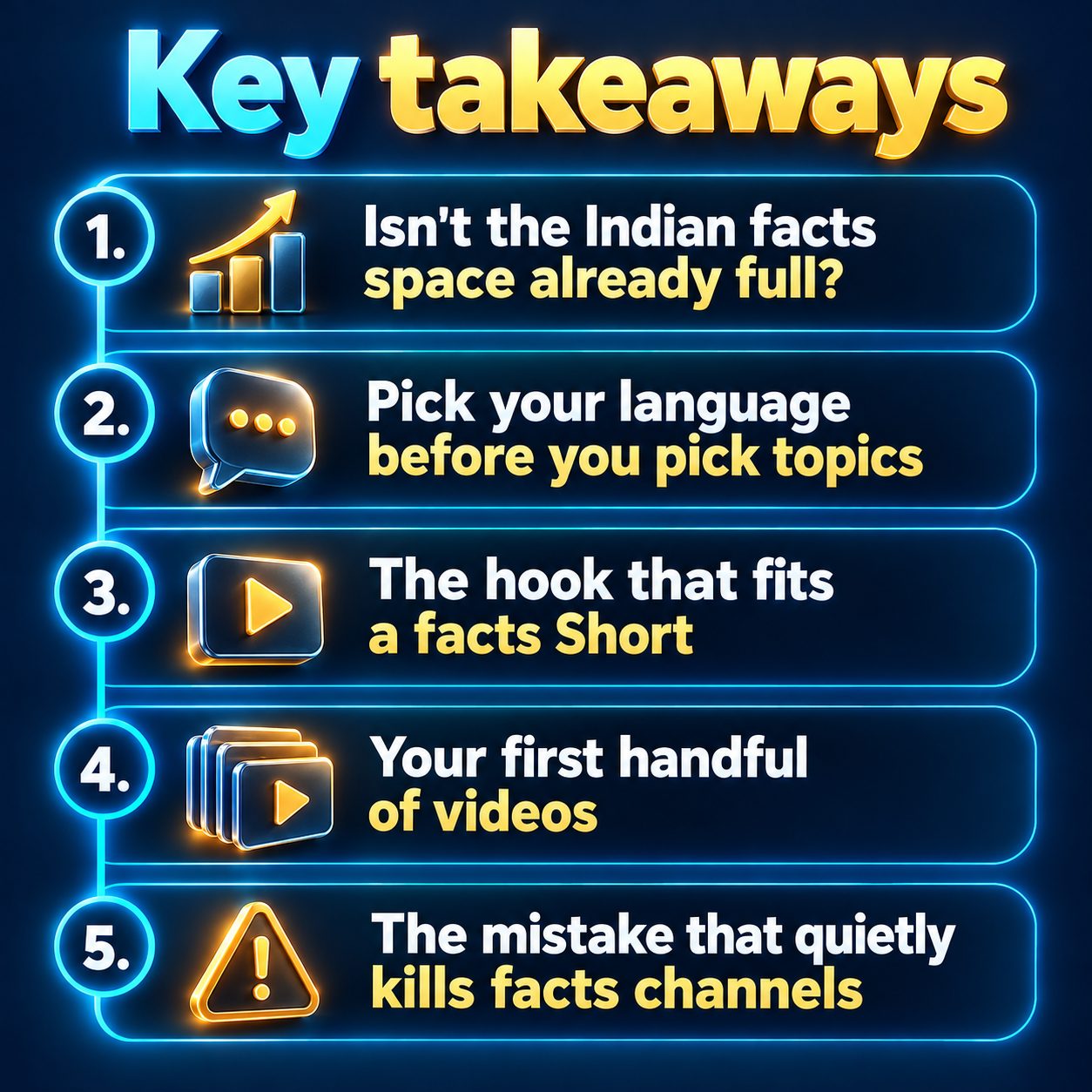
The hook that fits a facts Short
Facts Shorts lose viewers in the first second more than almost any other niche, because your viewer has heard "Did you know" endlessly. Drop that phrase completely.
Open with the surprising claim stated flat, then promise the reason. Compare these:
- Weak: "Did you know India has only one time zone?"
- Strong: "India is wide enough for two sunrises, yet the whole country runs on one clock. Here's why."
The pattern is claim, tension, payoff, then one next step. Keep each video to a single fact explained properly, around 15 to 30 seconds. Lists of five quick facts feel efficient but give the viewer nothing to remember you by.
One honest warning. If your hook promises a shock, the payoff has to deliver it. Facts audiences type "fake" in the comments fast, and that comment section is the first thing new viewers read.
Your first handful of videos
Start with questions your viewer has wondered about but never bothered to search:
- Why does the whole of India run on one time zone?
- Why is the flag hoisted on Independence Day but unfurled on Republic Day?
- Why is Test cricket played with a red ball and white-ball cricket with a white one?
- What is your pressure cooker whistle actually telling you?
- How do Mumbai's dabbawalas get lunchboxes to the right desk?
- Why do some railway coaches carry different coloured stripes?
Same lane, same promise, different hooks. After a couple of dozen uploads, YouTube Studio will show you which kinds of questions hold people to the end. Make more of those and quietly retire the rest.
The mistake that quietly kills facts channels
It's not the hook or the thumbnail. It's posting things that aren't true.
Forwarded facts lists are full of myths copied so often they feel real. Post one and the comments correct you. Post several and your channel reads as junk, to viewers and to anyone reviewing it. An AI script writer can repeat a myth just as confidently as a forwarded message can. No tool removes this job, and anyone who tells you otherwise is selling slop.
Keep a simple sheet: the fact, a source link, the date you checked it. Find two independent sources for anything surprising. If you can't source it, cut it, however good the hook is.
The second trap is sameness. YouTube's monetization rules target mass-produced, repetitive content, and a facts channel that swaps nouns into one template is exactly what that looks like. Real explanation, varied angles and a point of view are your defence. If you ever use realistic visuals that could pass for real footage, use YouTube's label for altered or synthetic content. The label itself doesn't hurt reach, but skipping it can get videos removed.
Keeping it going after the excitement fades
The unspoken question is "what if I stop after two weeks?" Most people do, and not because the niche failed. Production ate their evenings.
So set it up to survive a bad week. Do one research session every weekend: five to seven facts, each with its sources, written as short scripts. Pick a cadence you can actually hold. Post 1/day is great if you can sustain it, three times a week is fine, and steady beats bursts every time.
On money, be patient and clear-eyed. The YouTube Partner Program asks for 1,000 subscribers, plus either 4,000 valid public watch hours in the last 12 months or 10 million valid public Shorts views in the last 90 days. Facts lend themselves to longer horizontal explainers too, and that watch-hours route is often the more reachable one.
This is where production stops being the bottleneck. With MaqtAi, you paste your checked script and it's used word for word, then narrated in Hindi, Tamil, Bengali, Marathi or another language from the picker, with moving visuals and captions. A render typically takes about 6 minutes. If you want the channel running on its own cadence, Autopilot and scheduling handle that, and by default nothing posts until you approve it. What it won't do: verify facts, read trends or choose your lane. That stays your job.
Here's what waiting costs. Every week you don't post, YouTube collects zero data about who your channel is for, and the creator in your lane who posts on schedule collects it instead. You don't need a finished plan. You need one sourced fact turned into one Short so you can see how it feels. Most new accounts get free credits after verifying their email, with no card, and you can check how credits work first. Free renders carry a watermark, so treat the first one as a test, not a launch.
Doing this by hand is the part most people quit at. MaqtAi writes the script, narrates it, generates the visuals and captions, and assembles the faceless short for you. Verify your email and you get 450 free credits: about 3 videos on the still-frame tier, or one with AI motion. Free renders carry a watermark.
Try it on your niche freeFrequently asked questions
Can a Hindi or regional facts channel get monetized? Yes, the Partner Program requirements are the same whatever language you post in. What gets facts channels refused is repetitive, templated content, so real explanation and variety matter more than language.
Do I need to show my face or record my own voice? No. Facts is one of the most natural faceless niches, because viewers care about the explanation, not the presenter.
Is it too late to start a facts channel in India? It's late for generic "amazing facts" lists. It isn't late for a narrow lane done accurately and consistently, which is still rare.
Which language should I pick for my channel? Pick the one you can fact-check comfortably. Hindi has the biggest audience, while a regional language often has fewer polished competitors.
Results vary, and nothing here is a guarantee of views or income.