"But don't brands want a face and a personality?"
This is the fear that keeps most people from even trying, so let's kill it first. Brands do not sponsor faces. They sponsor attention that matches their customer.
When a meditation app looks for a channel, they want people who watch calm, sleep, or stoic content. A faceless bedtime-stories channel is a cleaner fit than some vlogger who happens to mention sleep once. The faceless part is not a weakness in that pitch. It can be the whole reason the deal makes sense.
Think about the huge faceless niches already running ads inside their videos: history explainers, true crime narrations, personal finance breakdowns, tech news, motivation. Nobody clicked away because there was no talking head. They clicked because the topic was theirs.
So the objection flips. A faceless channel with a tight niche is often more pitchable, because the sponsor can see exactly who is watching.
How brands actually find and pick a channel
Sponsorships happen two ways, and neither one requires you to be famous.
The first is inbound. Once your channel has a consistent look and a clear topic, brands and sponsorship agencies search YouTube by niche and email creators directly. Put a business email in your channel's About page. That single line is how a lot of first deals arrive.
The second is outbound. You pitch them. You find companies that sell to your exact audience and send a short, honest email with your niche, your posting cadence, and your recent view numbers. Faceless creators do this constantly through affiliate programs and sponsorship marketplaces.
Either way, here is what a brand looks at before they pay:
- Is the niche a match for what they sell?
- Does the channel post consistently, or did it die three weeks ago?
- Are the views real and steady, not one lucky spike?
- Does the audience actually engage, or just scroll past?
Notice what is missing. Nobody asks to see your face. They ask whether your audience is theirs, and whether you will still be posting next month.
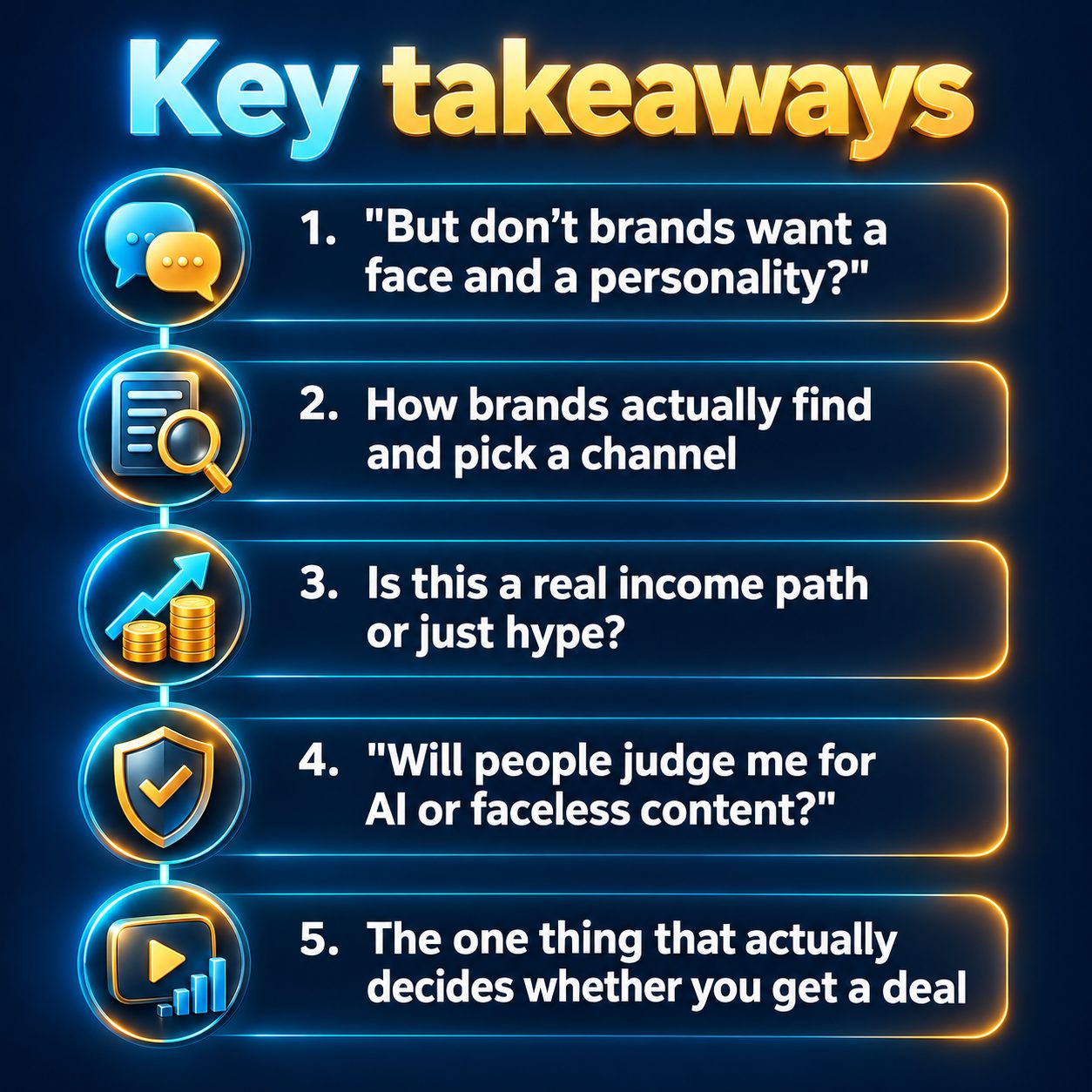
Is this a real income path or just hype?
Honest answer: it is real, but it is not fast, and anyone promising otherwise is selling something.
Brand deals usually come after two other things show up first. One is ad revenue through the YouTube Partner Program, which for Shorts currently needs 1,000 subscribers plus 10 million valid public Shorts views in 90 days, or the long-form threshold of 4,000 watch hours (YouTube Help). The other is affiliate income, which needs no follower minimum at all. You can drop an affiliate link the day you start.
Direct brand deals tend to arrive once you have a body of work and a track record. Not a million subscribers. Just enough proof that you are a stable, on-topic channel a brand can trust with their name.
So the realistic order is: post consistently, turn on affiliate links early, hit monetization, then field or pitch brand deals as your numbers grow. The channels that win are almost never the most talented. They are the ones that kept posting while everyone else quit.
"Will people judge me for AI or faceless content?"
The unspoken worry. Let me be straight with you.
Viewers do not care how a video was made. They care whether it was worth their time. A boring faceless video fails whether a human or a tool made it. A gripping one wins the same way. The quality bar is the story, the pacing, and the hook in the first two seconds.
What viewers and brands do punish is slop: robotic narration over random stock clips, no point, no payoff. That is the real risk, and it has nothing to do with being faceless. Plenty of the most-watched channels on the platform never show a face and never will.
And yes, you own what you make. On your own channels you can post it, monetize it, and run brand deals against it. The faceless format is not a loophole. It is a normal, accepted way to run a channel at scale.
The one thing that actually decides whether you get a deal
Consistency. Above talent, above budget, above luck.
A brand cannot sponsor a channel that posts twice and vanishes. The algorithm cannot learn who to show your videos to if it only gets a sample every couple of weeks. Both the sponsor and the machine reward the same thing: showing up on a schedule, on-topic, over and over.
That is also the exact place most people fail. Writing a script, finding footage, recording voice, editing, exporting, uploading, and captioning every single day is a full-time job. Two weeks in, life happens, and the channel goes quiet.
This is the honest reason tools exist. Not to fake talent, but to remove the daily grind that kills channels before they ever reach the point where brands notice. MaqtAi takes a niche and a topic and builds the whole vertical video: script, AI voiceover, moving visuals, and animated captions, in one pass. You can run it across 19 faceless niches like history, stoic motivation, true crime, and startup stories, on one channel or several at once.
And because posting every day is the part that breaks people, Autopilot renders from a topic queue on a schedule and, only if you opt in, auto-publishes to YouTube. Autopilot needs an active subscription, and you keep a one-tap approval step, so nothing goes out that you have not seen. That is how the consistency a brand deal needs becomes something you can actually sustain past week two.
What waiting actually costs you
Here is the part nobody says out loud. There is no deadline coming. There is no expiring offer. The cost of waiting is quieter than that, and worse.
Every week you spend deciding is a week your channel does not exist. The algorithm collects zero data on you. Your subscriber count stays at zero. And somewhere, a person in your exact niche is posting their fourth video this week, building the track record a brand will eventually reward. You are not competing against the perfect creator. You are competing against the one who started.
The smallest possible first step is one video. Verify your email and you get 450 free credits, about three to four videos on the still-frame Express tier or one with AI motion, no card required, so you can see your niche rendered before you commit to anything (free credits and plans). Free renders carry a watermark and have no talking presenter, but they are enough to judge your niche. Make one. Watch it. Decide from something real instead of from doubt.
Doing this by hand is the part most people quit at. MaqtAi writes the script, narrates it, generates the visuals and captions, and assembles the faceless short for you. Verify your email and you get 450 free credits: about 3 videos on the still-frame tier, or one with AI motion. Free renders carry a watermark.
Try it on your niche freeFrequently asked questions
Do you need a huge subscriber count before brands care? No. Affiliate deals need no minimum at all, and micro-sponsorships happen well before the big numbers. What matters more is a clear niche and steady, recent views a brand can trust.
Can a faceless channel join the YouTube Partner Program? Yes. Monetization rules apply to the channel, not to whether a face appears. You need to meet the standard subscriber and view or watch-hour thresholds like any other channel.
Will brands avoid my channel if the videos are AI-made? Brands care about audience fit, consistency, and whether the content is genuinely watched. A well-made faceless video is judged on its results, not its production method.
How do brands even contact a faceless creator? Most first deals come through a business email on your channel's About page, plus affiliate programs and sponsorship marketplaces you can join yourself. You can also pitch companies directly.
Results vary, and nothing here is a guarantee of income.