
Before the plan: why you doubt this will work for you
Picture who this plan is for: someone with a full-time job, close to zero budget, an hour free in the evening, and no interest in showing their face or recording their voice. That's probably you.
And I know what you're thinking. You've seen the videos promising "your first $1,000 in a month" and it smelled like someone selling a course. You're right to be suspicious. Most of those promises skip over the fact that YouTube doesn't pay you for uploading videos. It pays you for real views, and only after you're in the Partner Program.
So this isn't anyone's success story. It's an illustrative plan: this is how you'd build it if you started today, week by week. You won't find view counts or promised earnings in it, because any number like that would be made up.
Week 1: one niche and a list of titles
Don't start with the channel art or the name. Start with one question: can I write a long list of titles in this niche in an hour without getting stuck? If you get stuck, that niche will wear you out in two weeks.
Niches that work well without a face: history, horror stories, Stoic motivation, startup stories, psychology. You can browse examples of niches and the people running them to see which one actually fits what you care about, not just what looks profitable.
Say you picked history. Your first titles might look like this:
- The decision that ended Mamluk rule in Egypt
- Why did the Abbasids build Baghdad as a circle?
- The man who outwitted Napoleon at Acre
Notice that every title carries a question or a mystery. That's the hook. The first line of the video should put that mystery back on the table, not welcome the viewer to the channel. And in history especially, check every fact. The comments will not forgive you for getting a battle date wrong.
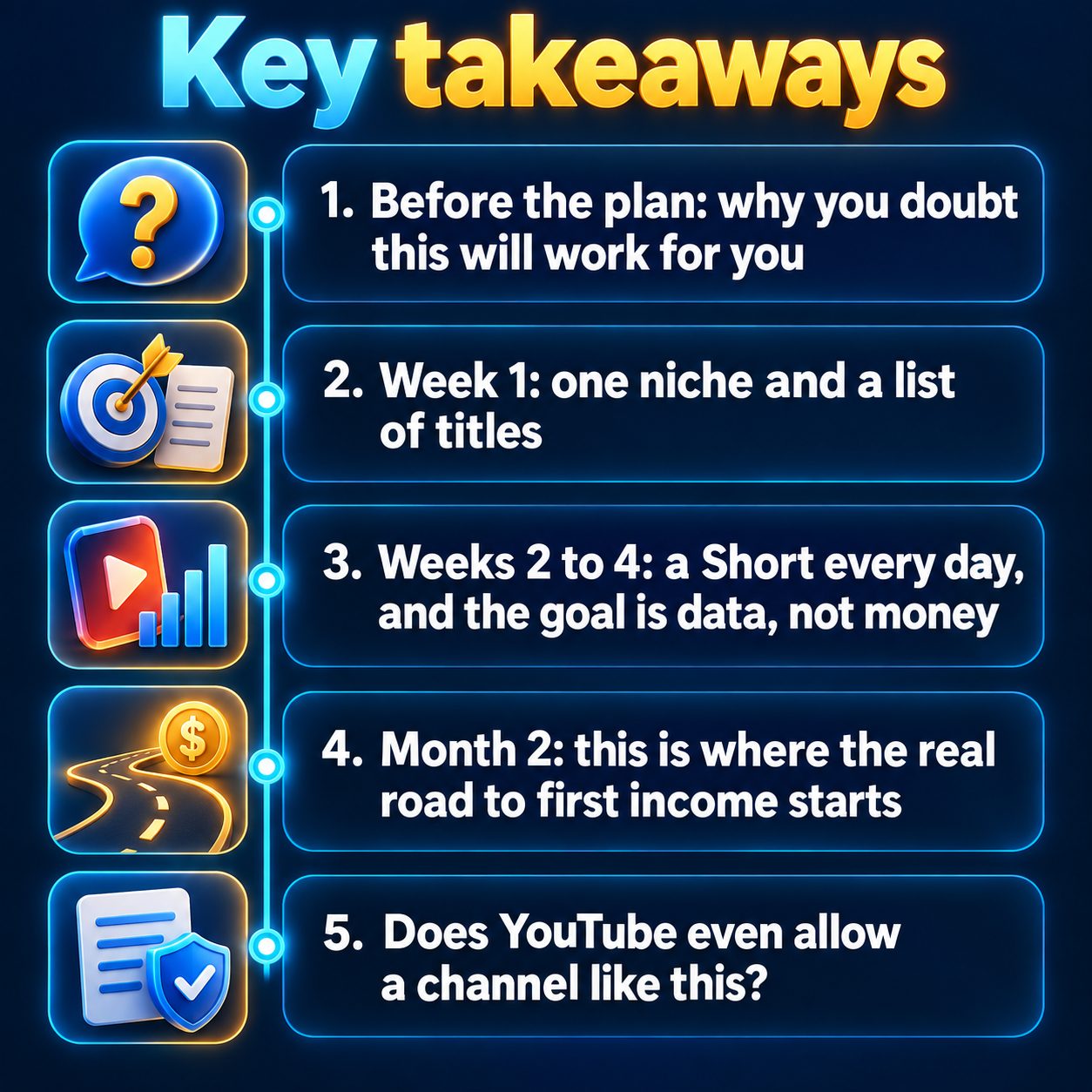
Weeks 2 to 4: a Short every day, and the goal is data, not money
The rule here is simple: post 1/day, Shorts between 30 and 60 seconds long. The goal at this stage isn't income. It's data: which hooks keep people watching, and which topics get watched all the way through.
Open YouTube Studio once a week and look at audience retention in the first few seconds. A video that loses people early is telling you the opening is weak, not that the niche is dead. Fix the opening before you change the niche.
Also keep in mind that Shorts earnings follow their own policy, and regular videos usually earn a lot more per view. So don't build your money plan on Shorts alone.
Month 2: this is where the real road to first income starts
The requirements for the YouTube Partner Program are 1,000 subscribers, plus either 4,000 public watch hours in the last 12 months or 10 million Shorts views in the last 90 days. For a small channel, the watch-hours route is much closer than the millions-of-Shorts-views route.
So in month two you add one long video a week in 16:9, a few minutes long, going deeper on whichever topic did best as a Short. YouTube classifies vertical videos up to 3 minutes as Shorts and horizontal ones as regular videos. That makes the format a money decision, not a style decision.
Your week now looks like this:
- A Short every day to bring in new viewers
- One long video a week to build watch hours
- A quick look at the numbers at the end of each week
Your first dollar might also come from outside ads, like affiliate links for books or tools your niche audience actually uses. Just don't cram them in early. Trust comes before the link.
Does YouTube even allow a channel like this?
Yes. No platform cuts a video's reach just because it was made with AI. Ranking comes down to viewer behavior: watch time, completion, likes, shares.
What actually hurts you is something else. YouTube's inauthentic content policy demonetizes repetitive, mass-produced content. If every video you post is the same video with different words, the problem isn't the tool, it's that your point of view is missing. Edit the lines, add your angle, and pick topics that are worth something. And if your content includes realistic synthetic imagery, follow the platform's disclosure rule. The label itself doesn't reduce reach, but ignoring the rule can get the video taken down.
The questions you don't type into search
Did I miss the boat? Every niche has competition, but the algorithm shows each new video to a test audience no matter how old the channel is. A new channel doesn't start from zero on every upload.
Will people judge me? Viewers judge the video in seconds: did it grab them or not. They rarely ask who made it.
What if I quit after two weeks? This is the real risk, and it's bigger than everything above. Most channels don't fail because the idea is bad. They fail because the creator burned out on daily production. The fix isn't willpower. It's separating writing from publishing: prep a batch of topics in one sitting and let scheduling post for you. This is exactly where a tool like MaqtAi helps. It writes the script, narrates it with an AI voice, and adds visuals and captions, and Autopilot and scheduling takes your topic list and produces videos at whatever pace you pick. It doesn't publish anything without your approval unless you turn on auto-publish yourself. What it doesn't do: pick your niche, read trends for you, or guarantee a video will perform. That part stays your call.
What waiting actually costs you
Every week you put this off is a week with no data on your audience, watch hours you haven't started counting, and a competitor in your niche who posted every day. Putting it off doesn't protect you from failing. It just delays the moment you find out whether the idea works.
The one small step for today: write three titles in a niche you enjoy and make your first video from one of them. When you confirm your email on MaqtAi you get 450 free credits, no card needed. That covers roughly 3 to 4 videos with the default still images, or one video with AI motion. Free-plan videos carry a watermark, so treat it as a test run where you see the result with your own eyes before deciding anything. Details are on the pricing and credits page.
Doing this by hand is the part most people quit at. MaqtAi writes the script, narrates it, generates the visuals and captions, and assembles the faceless short for you. Verify your email and you get 450 free credits: about 3 videos on the still-frame tier, or one with AI motion. Free renders carry a watermark.
Try it on your niche freeFrequently asked questions
How long does it take to earn your first income from a faceless YouTube channel? There's no guaranteed timeline. It depends on your niche, how strong your openings are, and how consistent you stay. The closer path is usually watch hours from long videos, alongside daily Shorts.
Does YouTube demonetize channels that use AI? Not just for using AI. What gets demonetized is repetitive, mass-produced content with no added value, so edit your scripts and add your own angle.
Should I start with Shorts or long videos? Start with daily Shorts in month one to learn quickly what hooks your audience, then add one long 16:9 video a week, since it usually earns more per view.
Do I own the videos I make with an AI tool? Yes. The videos you produce in MaqtAi are yours, and you can publish them, monetize them, and use them commercially on your channels.
Results vary from person to person, and nothing in this article is a guarantee of any income.