
Does YouTube actually allow a faceless channel?
Yes, and there is no hidden catch. YouTube never asks for a face or a real name on screen. Short documentary channels, horror story channels, finance breakdowns, explainer content: all of it runs on voice and visuals alone, and plenty of those channels are enormous.
The real requirement sits somewhere else. YouTube's inauthentic content policy targets mass produced, repetitive uploads: near identical videos with no angle and nothing added. The difference between a faceless channel that grows and one that gets rejected from monetization is not the camera. It is whether the viewer walks away knowing something they did not know thirty seconds ago.
Write this down before you touch anything else: what does my channel give that nobody else gives? If you do not have an answer, equipment is not your problem.
Pick the niche first, because every decision after it hangs on it
Your niche sets the tone of the voice, the type of visuals, the length of the video, even what time you publish. Choose it thinking in months, not in one week.
Three questions are enough:
- Can I write a long list of topics in a single sitting without running dry? If not, the niche is too narrow.
- Is there an audience actively searching for this, or is it just something I happen to like?
- Can I stand reading and following this field for months? Boredom kills more channels than the algorithm does.
The categories that work without a face are well known: horror stories, history, true crime, dark psychology, startup stories, stoic motivation, sleep and relaxation content, and plain language finance explainers. If you want clearer examples of who each type suits, the use cases page breaks them down.
One practical note: pick one niche and stay in it long enough to form a real opinion about how it performs. Hopping across three niches in a month gives you three dead channels instead of one you are actually learning from.
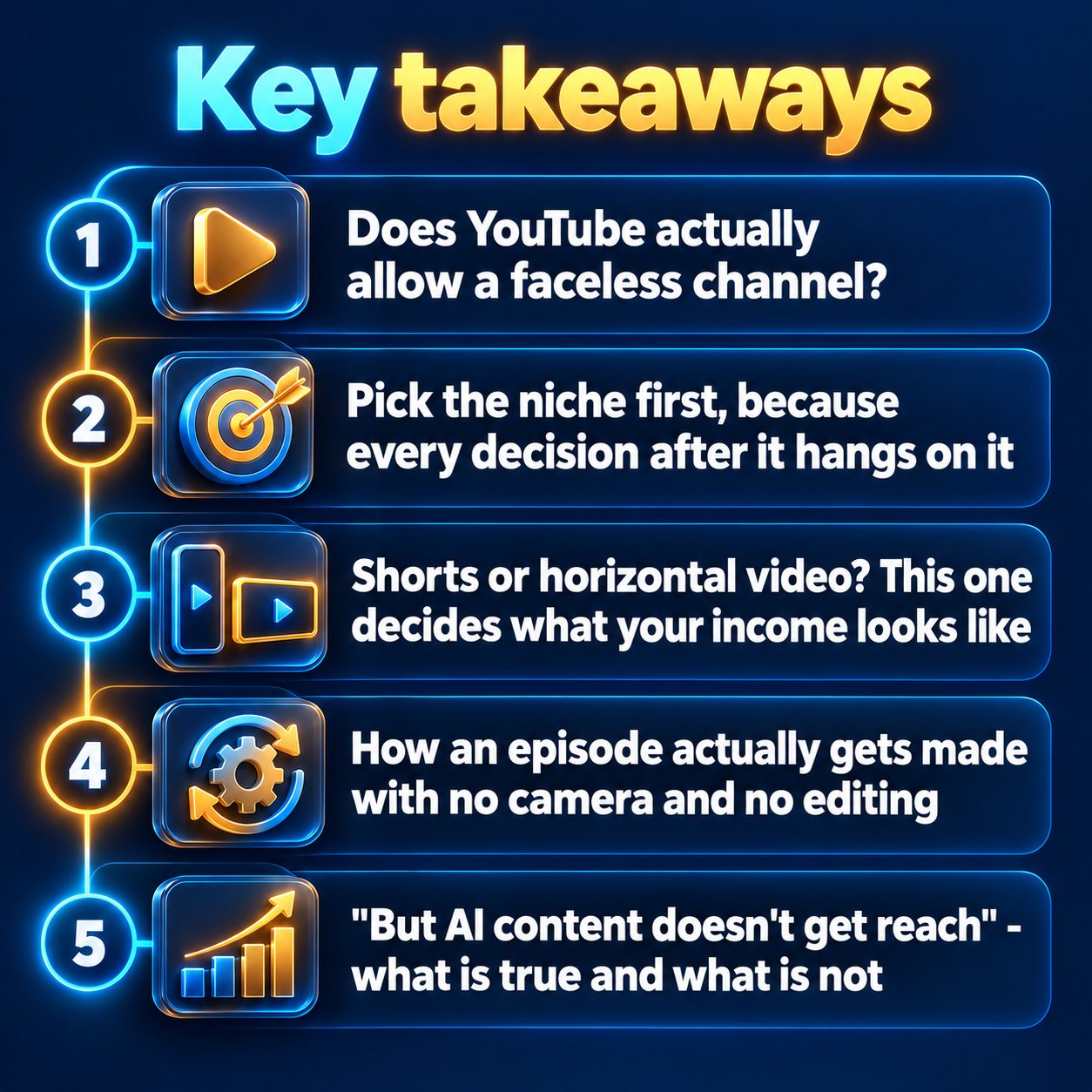
Shorts or horizontal video? This one decides what your income looks like
YouTube sorts your uploads automatically: vertical or square footage up to three minutes becomes a Short, and 16:9 horizontal becomes a regular video. The official Shorts specs live on YouTube's page, and the standard frame is 9:16.
The difference that matters is money. Per the official requirements page, joining the YouTube Partner Program takes 1,000 subscribers, plus either 4,000 valid public watch hours in the last 12 months or 10 million valid Shorts views in the last 90 days. Put those two numbers side by side: the long form path is far more reachable for a beginner than the Shorts path, and horizontal video usually earns more ad revenue per view.
The plan I would hand anyone starting today: use Shorts for discovery and for testing topics fast, and build longer horizontal videos in the same niche in parallel to bank watch hours. One topic can feed both, as long as the short is not just a clipped chunk of the long one.
How an episode actually gets made with no camera and no editing
A faceless episode is five layers and nothing more: a script, a voiceover, moving visuals, on screen captions, and background audio.
The script is ninety percent of the result. Build it like this: the first line is a hook that stops the thumb, the middle names the viewer's problem and then solves it, and the last beat gives them one thing to go do. No intro, no "welcome back to my channel," no thanking people for subscribing at second three.
Voice: a good synthetic voice beats you recording nervously in a room with echo. Pick a tone that fits the niche, calm and slow for sleep content, a little faster for motivation and stories.
Visuals: they have to move. A static slideshow kills completion rate fast, and viewers feel the difference even if they never name it.
This is where MaqtAi comes in: you give it the niche and the topic, and it writes the script, narrates it in a realistic synthetic voice, generates visuals with actual motion, adds animated captions, and hands you a finished vertical video, usually in a few minutes. You can edit any line before you generate, or paste your own script to be used exactly as you wrote it. Length and aspect ratio are a separate step in the wizard, so you decide whether this one is a Short or a horizontal video.
"But AI content doesn't get reach" - what is true and what is not
No platform demotes a video just because AI made it. YouTube, TikTok, and Instagram rank short video on viewer behavior: watch time, completion rate, likes, shares. How it was produced is not a ranking signal.
Three things do hurt you: spam patterns like posting near identical files across a pile of accounts, weak opening seconds, and ignoring the disclosure rules for realistic synthetic content. The disclosure itself does not shrink your reach, but skipping it can get the video pulled.
Now the honest part you need to hear: the tool will not pick your niche, will not know your audience, and will not rescue a boring topic. It will write you a decent hook, but the hook that lands exactly where your audience hurts is still your call. Anyone hunting for a button that makes growth happen on its own is going to be disappointed, tool or no tool. Tools remove friction. Views come from the niche, the hook, and showing up.
And about the question nobody writes down: no, people are not going to judge you. Your audience does not know it is you behind the channel, and does not care. And no, you are not late. Your real competition is not the person who started a year ago, it is the person publishing this week while you are still thinking about it.
The first two weeks: how not to stall out
Most faceless channels do not die from weak videos. They die because someone posted four videos, got busy for a week, and never picked the thread back up.
The fix is not more enthusiasm. It is a smaller system:
- Lock the cadence in advance: daily, or three times a week. Put it in the calendar.
- Batch a whole run in one sitting instead of one video a day. A single session costs far less mentally.
- Freeze the format: same hook structure, same voice, same caption style. Consistency is how a faceless channel builds an identity.
- Review every two weeks: which hook got the highest completion rate? Repeat the pattern, not the topic itself.
If you want the manual publishing load gone later, the Autopilot feature on the features page produces videos from a topic queue you fill yourself, top up with its Suggest topics button, or hand over to AI niche mode, on a schedule you set, and posts them only if you explicitly switch that on. Otherwise every video waits for your one click approval. To be straight with you, that feature needs an active subscription, so it is not your first step.
Start with one video, today
Waiting has a cost that never shows up on a bill. The algorithm knows nothing about you until you publish, and the performance data you will be making decisions from two months out only starts piling up after the first video. Every week you put it off is a week someone else in your niche publishes and learns instead of you.
You do not need a finished channel or a year long plan. You need one published video to know what the whole process feels like. Verifying your email gets you 450 free credits, no card required, which covers one video with AI motion or three to four on the still frame Express tier, watermarked and with no talking presenter, so you can see it with your own eyes instead of imagining it. Details are on the pricing page.
Doing this by hand is the part most people quit at. MaqtAi writes the script, narrates it, generates the visuals and captions, and assembles the faceless short for you. Verify your email and you get 450 free credits: about 3 videos on the still-frame tier, or one with AI motion. Free renders carry a watermark.
Try it on your niche freeFAQ
Do I need to record my own voice? No. Synthetic voiceover covers the whole video, and there are several voices with adjustable speaking speed. Using your own voice later is an option, not a requirement.
Do I actually own the videos I make? Yes. The videos you produce are yours. You can publish them, monetize them, and use them commercially on your own channels.
Should I post Shorts or horizontal videos to get monetized? Per YouTube's official requirements, the 4,000 watch hours path is more reachable for beginners than 10 million Shorts views. Use short form for discovery and long form to bank watch hours.
How many videos a week should I post at the start? Pick a cadence you can hold for months, not two weeks. Three times a week consistently beats a daily video that stops after ten days.
Results vary from channel to channel, and nothing here is a guarantee of income.