
YouTube does not care whether your face is on screen
This is the single most important thing to understand. YouTube's Partner Program eligibility requirements list subscriber counts, watch time, and policy compliance. Nowhere do they mention a webcam, a face, or a "real person" appearing in the video. Cooking channels showing only hands, animation channels, nature footage channels, and meditation music channels have been monetized for years. The platform cares about whether viewers watch and engage, not about what the creator looks like.
So the short answer: yes, a faceless channel can absolutely be monetized in 2026. The longer answer involves understanding what YouTube actually checks before approving you.
The real monetization thresholds (with receipts)
YouTube offers two main paths into the Partner Program. According to YouTube's official eligibility page:
Standard eligibility requires 1,000 subscribers plus either 4,000 public watch hours over the past 12 months or 10 million public Shorts views over the past 90 days.
Expanded eligibility (which opens fan funding and channel memberships but not full ad revenue sharing) requires 500 subscribers plus either 3,000 public watch hours over the past 12 months or 3 million public Shorts views over the past 90 days.
These thresholds are identical for every creator on the platform, faceless or not. You also need to live in a country or region where YPP is available, have no active Community Guidelines strikes, and have 2-Step Verification turned on.
If you are creating Shorts (which is where most faceless creators start), the Shorts view threshold is the path you will likely focus on first. Whether those views come from a channel where someone talks to camera or from a channel using narrated visuals with captions makes zero difference to YouTube's counter.
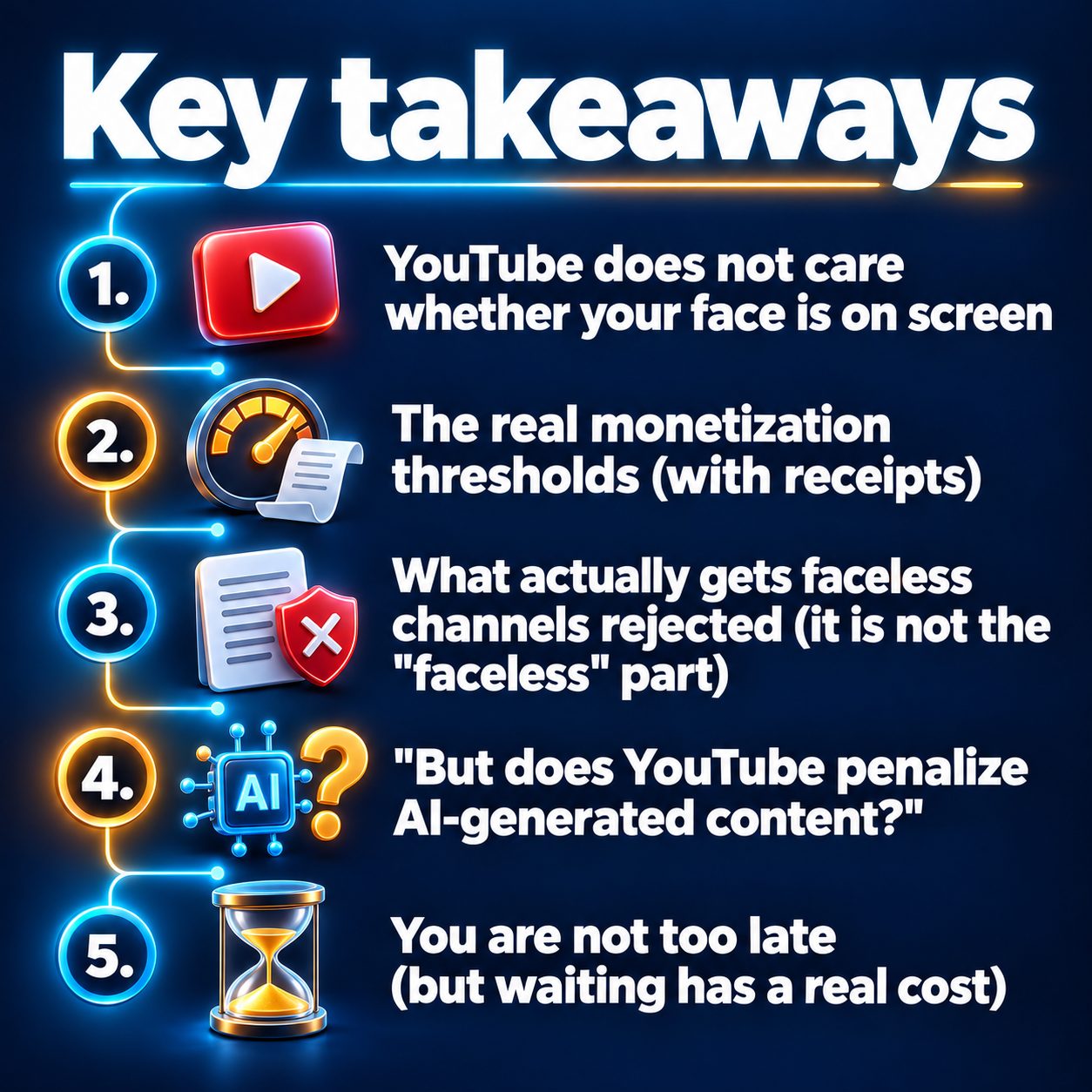
What actually gets faceless channels rejected (it is not the "faceless" part)
Here is where the honest conversation happens. YouTube does reject monetization applications, and some faceless channels do get rejected. But the reason is almost never "no face." It is usually a reused content flag.
YouTube's reused content policy targets channels that upload other people's videos with little or no original value added. Think of reuploaded clips from TV shows, compilations of viral videos with zero commentary, or slideshows of stock photos set to music with no narration.
The channels that pass review consistently share a few traits:
- Original scripts. The narration is not copied from another video or article.
- Unique voiceover. A real or AI-generated voice that belongs to the channel.
- Purposeful editing. Visuals assembled to match the script, not random footage dropped in.
- A clear content identity. The channel has a recognizable niche and style.
If your faceless videos have original narration, custom visuals, and animated captions that add production value, you are giving YouTube exactly what it wants to see: content that could not have been made by simply downloading and re-uploading someone else's work.
"But does YouTube penalize AI-generated content?"
YouTube requires creators to disclose when realistic AI-generated or altered content could be mistaken for real people, places, or events. This disclosure is about transparency, not punishment. YouTube has stated that AI is a tool and that using it does not disqualify you from monetization.
The key distinction: AI as a production tool is fine. AI used to mass-produce low-effort copies of existing content is not. A channel that uses AI voices and AI visuals to tell original scary stories with unique scripts is in a completely different category than one auto-generating hundreds of meaningless videos hoping something sticks.
Quality, originality, and viewer value still matter. They always have.
You are not too late (but waiting has a real cost)
Every week you spend researching whether this works is a week your channel has zero videos, zero subscribers, and zero data about what your audience responds to. YouTube's algorithm starts learning about your content from video one. The creators who are monetized right now did not wait until they had a perfect plan. They posted, watched what happened, adjusted, and posted again.
The faceless niche landscape is more crowded than it was two years ago, sure. But the demand for short-form content across YouTube Shorts, Instagram Reels, and TikTok has also grown. More viewers scrolling means more room for channels that post consistently.
Consistency is the hard part. Writing scripts, generating visuals, editing, adding captions, and publishing daily across multiple platforms is genuinely a lot of work when you do everything manually.
Making consistency possible without burning out
A faceless creator who posts three times a week for six months will almost always outperform someone who posts daily for two weeks and then disappears. The workflow matters more than the idea.
Tools that handle the repetitive production steps (scriptwriting, voiceover, visual assembly, captioning, scheduling) let you stay consistent without spending hours per video. MaqtAi was built specifically for this workflow. You pick a niche and a topic, and it generates the script, AI voiceover, visuals with real motion, and animated captions, then auto-publishes to YouTube Shorts, TikTok, and Instagram Reels on whatever schedule you set. The entire point is removing the production bottleneck so you can focus on choosing good topics and reviewing what the algorithm rewards.
New accounts get free credits after email verification (enough for a few videos, no card required), so you can test whether the output fits your niche before committing anything. You can review and tweak every video before it goes live or let it publish hands-free through Autopilot.
The expensive decision is not picking a tool. It is spending another month reading articles about monetization instead of giving YouTube its first data point about your channel.
Start with one video. Pick a niche that genuinely interests you. Post it. Then make the next one.
Doing this by hand is the part most people quit at. MaqtAi writes the script, narrates it, generates the visuals and captions, and assembles the faceless short for you. Verify your email and you get 450 free credits: about 3 videos on the still-frame tier, or one with AI motion. Free renders carry a watermark.
Try it on your niche freeFrequently asked questions
Can faceless YouTube Shorts earn ad revenue? Yes. YouTube shares ad revenue from Shorts with eligible Partner Program members. The same eligibility thresholds apply whether or not you appear on camera.
Will YouTube demonetize my channel if it finds out I use AI voices or visuals? Using AI as a production tool does not violate YouTube's policies. You should disclose AI-generated content when it depicts realistic scenarios viewers could mistake for real events. Original, valuable content made with AI tools is treated the same as content made with traditional software.
How long does it take a new faceless channel to reach monetization? It varies enormously based on niche, posting frequency, and content quality. There is no fixed timeline. Posting consistently and studying which topics gain traction in your niche will shorten the path, but nobody can promise a specific number of months.
What niches work best for faceless channels in 2026? Niches with strong curiosity hooks tend to perform well: scary stories, true crime, history, psychology, motivation, and startup stories are popular. The best niche for you is one where you can create content consistently without losing interest. Explore a few before you commit, and let your early view counts guide you toward what resonates.
Results vary by niche, content quality, and posting consistency. Nothing in this article is a guarantee of income.