
What showing your face actually gets you
I'll start with the case for the camera, because it's a real one.
A face builds trust quickly. Viewers remember a person much more easily than they remember a voice over stock-style visuals. When they come back, they're coming back for you. That's the base of a personal brand, and it's why coaches, consultants, fitness creators and anyone giving opinions usually do better on camera. If you plan to sell a course, a service or your own judgment later, your face is part of what you're selling.
It also helps with brand deals where the sponsor wants a human endorsing the product. And comments get more personal, which feels good and keeps you going.
The costs are just as real, though. You film, reshoot, light the room, and look presentable on days when you'd rather not. Your face ends up permanently searchable, attached to everything you've said. And the whole channel depends on you being in front of a lens. When you're sick, traveling or burned out, nothing gets posted.
Where faceless wins, and where it doesn't
Faceless channels work when the viewer came for the content and not for a personality. Scary stories, history, true crime, stoic motivation, sleep stories, weird facts: nobody watching a story about a haunted lighthouse is wondering who's narrating it. The hook, the pacing and the payoff do the work. If you're not sure your topic fits, look at the faceless niches that tend to work.
The benefits add up. You keep your privacy. Your boss, your family and your ex never have to find the channel. You can run more than one channel without cloning yourself. And posting every day becomes a production problem you can solve, not a question of whether you feel like being on camera today.
Here's the honest downside. Faceless channels are easier to copy and harder to love. The audience is loyal to the format, not to you, so building a premium offer later is harder. Your niche is also more crowded, because the low barrier works both ways. A faceless channel only wins on quality and consistency. There's no charm to fall back on.
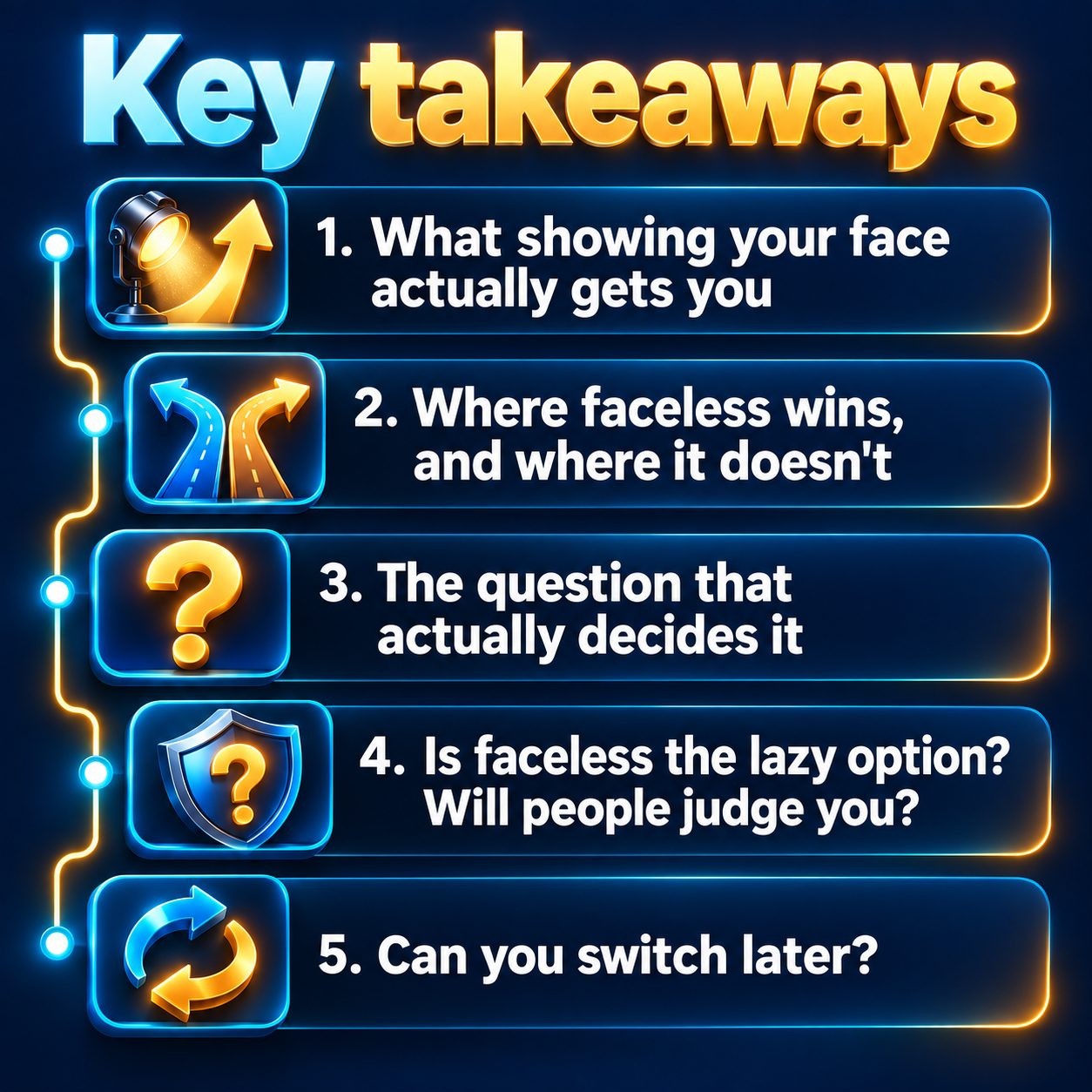
The question that actually decides it
Forget which one looks more legit. Ask yourself which one you'll still be doing in three months.
Most channels die of silence, not bad content. Someone posts with real energy for two weeks, misses a few days, feels guilty, and quietly stops. So be honest about your life:
- If filming energizes you and you have a quiet corner and some time most evenings, go face-first. That consistency will pay you back.
- If filming feels like a chore, if you share your home with other people, or if you have a job where being publicly visible is risky, you'll post more often faceless. More posts means more data about what hooks your audience.
- If your niche is you (your advice, your life, your taste), try the camera even if it's uncomfortable at first.
- If your niche is a subject, faceless is the natural shape, not a compromise.
Is faceless the lazy option? Will people judge you?
This is the worry people rarely say out loud. Viewers scrolling a feed don't judge production method. They judge whether the first two seconds grabbed them. TikTok, Instagram and YouTube rank short videos by viewer behavior like watch time, completion and shares. No platform pushes a video down just because it's faceless or AI-made.
What does get punished is lazy output. That means near-identical videos posted in bulk, the same file pushed to lots of accounts, and dull openings. YouTube's monetization rules specifically exclude mass-produced, repetitive content. And if your visuals are realistic synthetic media, the platforms expect you to use their AI label. The label doesn't reduce reach, but skipping it can get a video removed.
So faceless isn't cheating. Low-effort faceless is, and the algorithm figures that out on its own. Your friends might raise an eyebrow at first. They stop once the channel has a clear identity and a voice that sounds like it knows the topic.
Can you switch later?
Yes, and that should take some pressure off. Plenty of creators start faceless to learn hooks, pacing and posting habits without the self-consciousness. Some bring their face in later, once they know what their audience responds to. Going the other way is harder, because an audience built around a person doesn't always stay for a format.
You're also not too late in either case. Feeds reward what's new and good for each viewer, and they don't care when you joined. A new channel with sharp hooks and steady posting gets tested like any other.
What it costs to find out
Here's the comparison that matters. Testing the face route costs a light, a mic, filming time and a few weeks of getting comfortable on camera before you know whether it works. Testing faceless the traditional way means learning to script, record a voiceover and edit, which is also weeks before you see a finished video.
The cheapest test is to make one faceless video in your niche this afternoon and see how it feels. That's where MaqtAi comes in. You give it a niche and a topic, and it writes the script, narrates it with an AI voice, generates visuals with motion, and adds animated captions in a vertical format. You never appear on camera or record your voice. Verify your email and you get free credits with no card needed. See the credit tiers for exactly what they cover: roughly 3 to 4 videos on the still-frame default, or one with AI motion. Free renders carry a watermark, so treat them as a test, not your launch post.
If faceless fits, the scheduling and Autopilot features take care of the part that usually kills channels, which is keeping up the pace.
Waiting has a real cost. Every week you spend deciding is a week when your channel gathers no data about which hooks work, while someone in your niche posts again today. You don't need to settle faceless versus face forever. You just need one video that shows you which one feels right.
Doing this by hand is the part most people quit at. MaqtAi writes the script, narrates it, generates the visuals and captions, and assembles the faceless short for you. Verify your email and you get 450 free credits: about 3 videos on the still-frame tier, or one with AI motion. Free renders carry a watermark.
Try it on your niche freeFrequently asked questions
Do faceless TikTok accounts grow slower than face accounts? Not by default. TikTok ranks videos by viewer behavior like watch time and completion, not by whether a face appears, so hooks and consistency matter more than the camera.
Can a faceless channel make money? Yes. Faceless videos can be monetized on your own channels as long as they follow each platform's rules, including YouTube's policy against mass-produced, repetitive content.
Is it okay to start faceless and show my face later? Yes, and it's a common path. Starting faceless lets you learn hooks and pacing first, though an audience built on a format may not all stay once a personality takes over.
Which niches work best without a face? Niches where the subject is the star: stories, history, true crime, motivation, sleep content and curiosity facts. Niches built on personal advice or lifestyle usually do better with a face.
Results vary, and nothing here is a guarantee of income.