What a faceless shop account actually looks like
Open the app and watch ten shoppable videos in a row. Count how many show a full face for more than a second. It's fewer than you'd guess, because the formats that move product are mostly these:
- Hands and product. A close-up of the thing doing its job: the drawer organizer filling up, the grime lifting off the stovetop, the cable finally staying put. Voiceover over the top.
- Problem first, product last. Fifteen to twenty seconds about the annoying thing (tangled chargers, dog hair welded to the couch), then the product as the payoff.
- List and comparison. "Three things nobody tells you about this" over product photos and motion, with captions doing half the work.
- A presenter who isn't you. UGC-style delivery straight to camera, using a stock or generated presenter. It's the closest faceless cousin of the classic review video.
None of those need your face, your voice, or a ring light. They need a clear hook and a product whose benefit you can see.
"People buy from faces, not voiceovers"
Partly true, and worth being honest about. If your whole pitch is personality, trust, or "look what it did to my skin," a face helps enormously and you will feel the gap.
But most shop buying isn't that. It's recognition. The viewer sees their own irritation named in the first two seconds, then sees a thing that fixes it, then taps. Nobody pauses to wonder whose hands those were. What loses the sale is a fuzzy opening, a product that looks the same before and after, or a video that takes eight seconds to get to the point.
And no, the platform isn't punishing you for using AI tools. TikTok, Instagram and YouTube rank short video by viewer behaviour: how long people watch, whether they finish, whether they share. Production method isn't a ranking input. What does get punished is spam behaviour, like near-identical files posted across a pile of accounts, and ignoring the AI-disclosure toggle on realistic synthetic media.
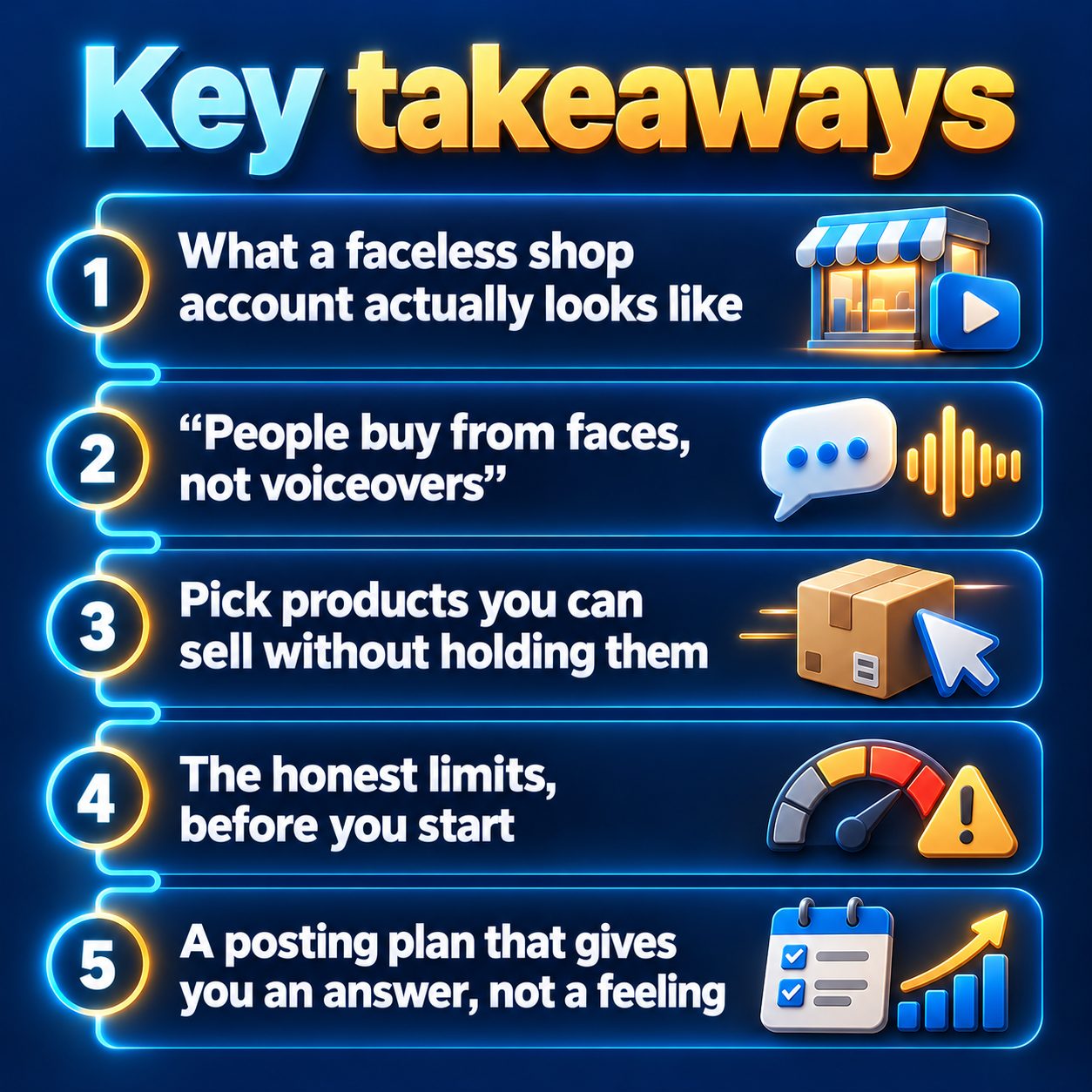
Pick products you can sell without holding them
This is the real decision, and it decides whether faceless works for you.
Good fits are products with a visible mechanism. Cleaning stuff, kitchen gadgets, storage and organisation, car accessories, pet tools, desk and phone gear, anything with a satisfying before and after. You can explain those in a voiceover and show them working.
Bad fits are products whose value lives on a body. Taste, smell, fit, comfort, how a cream sat on someone's skin for six weeks. You can still post about them, but you'll be describing instead of demonstrating, and that converts worse.
Two practical notes. First, some sellers in the affiliate marketplace offer samples, so check the product's listing before you assume you have to buy anything. Second, do not lift other creators' clips and pass them off as your own footage. It's a copyright problem, it's a reused-content problem, and it's the fastest way to lose an account you spent months on.
The honest limits, before you start
A faceless shop account is a real business, not a loophole. Things it cannot do:
It cannot make claims you haven't earned. "This cleared my acne" about a product you've never touched is a lie, and shop affiliate accounts get restricted for misleading claims.
It cannot skip the entry requirements. TikTok gates its affiliate programme behind account eligibility that varies by country and changes over time, so check the current rules in TikTok's own creator and affiliate centre rather than trusting a blog post, including this one.
It cannot make commission from views. You get paid on sales, at whatever percentage the seller set. Low-priced items mean you need a lot of sales, so a video that goes wide and sells nothing is normal and not a sign you failed.
And it cannot rescue a niche you don't care about. If you find the products boring, you'll quit in three weeks, which brings us to the part nobody types into a search bar.
A posting plan that gives you an answer, not a feeling
The unspoken question is usually "what if I do this for two weeks and stop?" Most people do, and it's almost always because each video was a separate act of willpower.
So build in batches and pick a cadence you can hold. Something like this:
- Week 1. Choose three or four products from one theme. Write three different hooks for each. Post one video a day, same product themes, different angles.
- Week 2. Look at watch-through and link taps, not likes. One hook shape will be clearly less bad than the others.
- Weeks 3 and 4. Reuse the winning hook shape across new products. Keep posting daily. Now you're testing products, not formats.
Four weeks of daily posting tells you more than four months of thinking about it. Also worth knowing: on TikTok you attach the product inside the app when you post, so the final tap stays manual no matter how you make the video.
Where to hand off the boring part
The grind isn't the strategy. It's making the twenty-eighth video when you already know what it should say.
That's the part MaqtAi does. You give it a niche and a topic, and it writes the script, narrates it in an AI voice, generates visuals with real motion, adds animated captions, and assembles a vertical video that's ready to post, usually under three minutes long. For shop-style content there's also a presenter ad format: a lip-synced presenter delivering six scenes, and you can upload up to six of your own product photos that play full screen while the presenter keeps talking. You can schedule a cadence and let it publish on its own once your accounts are connected. One honest caveat on pricing: the talking presenter is a paid feature, and free-tier videos use stills with pan and zoom plus a watermark. TikTok posts land in your TikTok inbox as a draft for you to finish in the app, which is convenient here, since that's where the product tag goes anyway.
What waiting actually costs
Nothing dramatic happens if you start next month. That's the problem. The account doesn't exist, so it accumulates no watch data, the algorithm learns nothing about who should see you, and the person who picked the same product category today is on video thirty by the time you open the app.
The cheapest possible version of starting is one video. Not a content plan, not a brand, one video about one product with one hook, posted today so you can see what the numbers look like. Verify your email and you get 450 free credits, which is enough to make that first video without a card, and enough to find out whether you actually enjoy this before you spend anything on it.
Doing this by hand is the part most people quit at. MaqtAi writes the script, narrates it, generates the visuals and captions, and assembles the faceless short for you. Verify your email and you get 450 free credits: about 3 videos on the still-frame tier, or one with AI motion. Free renders carry a watermark.
Try it on your niche freeFrequently asked questions
Do I need to buy the products I promote? Not always. Some sellers offer samples through the affiliate marketplace, and plenty of product categories can be shown with the seller's own approved media. What you should never do is claim personal results you didn't have.
Will TikTok limit my reach because the videos are AI-made? No platform down-ranks a video for being AI-made. Shorts are ranked on viewer behaviour like watch time, completion and shares. Spammy patterns and weak opening seconds are what hurt reach, along with skipping the AI-disclosure label on realistic synthetic media.
How many videos before I know if it's working? Give it four weeks of daily posting on one product theme. That's enough to separate a hook problem from a product problem, which is the only diagnosis that matters early on.
Can I run more than one shop account this way? Yes. You can connect several accounts and run different themes in parallel, which is how most people find the category that actually converts for them. See who it works for if you want examples by niche.
Results vary. Nothing here is a guarantee of income.