
Where the money on a faceless account actually comes from
There are four income lines, and they do not arrive in the order most people expect.
The first is TikTok's own Creator Rewards Program, which pays on qualifying videos longer than a minute. It has eligibility requirements you should read on that page rather than trust a YouTube video about, and it is the slowest line to switch on.
The second is affiliate income: TikTok Shop commissions, or plain affiliate links in your bio. This one does not care how big you are. It cares whether your niche has something to buy.
The third is brand work. A faceless account in a defined niche is a media placement, and brands buy placements. Nobody needs to know who edits it.
The fourth is everything off-platform: your own product, a newsletter, or a YouTube channel that the TikTok feeds. That last one matters more than it sounds. Long-form YouTube pays better per view than shorts do, and YouTube's Partner Program opens at 1,000 subscribers plus either 4,000 valid public watch hours in 12 months or 10 million valid public Shorts views in 90 days. Guess which of those two a small channel reaches first.
No face is not the problem. Unoriginal is
Nothing in TikTok's rules says a human has to be visible. What gets throttled is content the platform considers low value or not original for the For You feed: reuploads of other people's clips, near-identical videos pushed out at volume, watermarked material from somewhere else.
That distinction is the whole game. A faceless video with your script, your angle and your voice track is original. A reposted clip with a caption slapped on it is not, no matter how much work you put into the caption.
The same goes for AI. Platforms rank shorts by viewer behavior: watch time, completion, shares. They do not have a switch that penalizes a video for being made with software. What they do have is a disclosure rule for realistic synthetic media, and TikTok expects you to label it. The label does not shrink your reach. Skipping it can cost you the video.
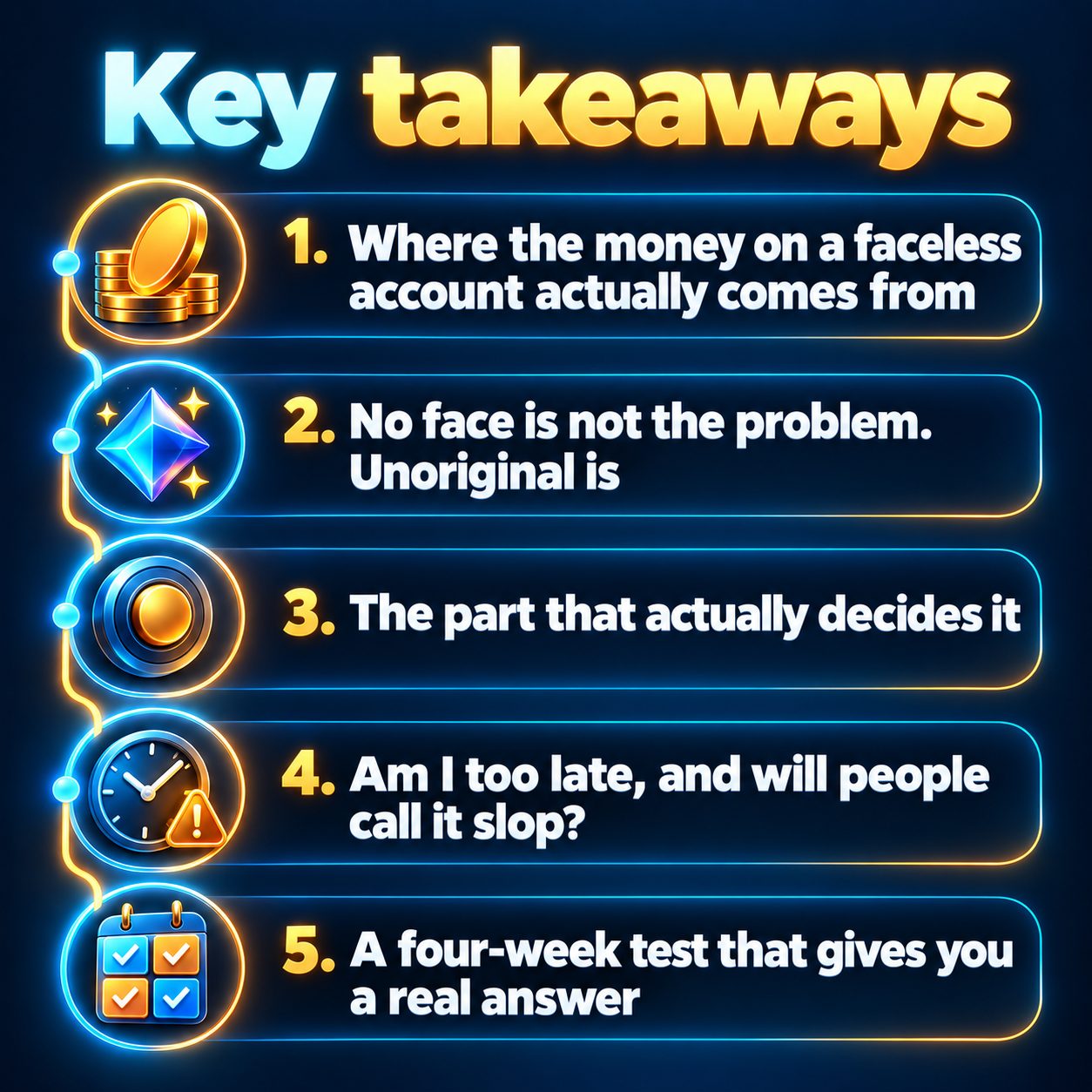
The part that actually decides it
Here is the honest answer to "will this work for me". You cannot know yet, and neither can anyone selling you a course about it.
What you can control is whether you give the question a fair test. An account that posts three videos and stops has not been tested. It has been abandoned. The algorithm needs data about you: which hooks hold people, which topics pull, what time your audience is awake. That data only exists if videos keep landing.
So the real variable is not talent or luck. It is cadence. Posting daily for a month tells you more than posting weekly for six. And the harsh math of faceless content is that most people cannot sustain daily when each video means an hour of scripting, voicing and editing after work.
That is the friction that kills these accounts. Not the niche. Not the rules.
Am I too late, and will people call it slop?
Two things most people think and never type.
Too late: no. Niches are not seats that run out. TikTok's feed is not ranked by seniority, which is why brand-new accounts land big videos every day and old accounts flatline. Being early helps on a platform. It does not help inside a feed that re-decides every video from scratch.
Judgment: viewers are not auditing your production method. They are deciding, in the first second or two, whether the next 30 seconds are worth it. If your scary story is genuinely unsettling or your history clip teaches something real, the audience is happy. If it is thin, they scroll, and they would have scrolled past a filmed version of the same thin idea.
The people who might raise an eyebrow are other creators. They are not your audience.
A four-week test that gives you a real answer
Week 1: pick one niche and stay in it. Stoic motivation, true crime, history, bedtime stories, startup stories, whatever you would genuinely watch. Write a running list of topics so you never open the app wondering what to post.
Week 2: post daily and treat the first sentence as the whole job. Watch retention, not likes. A hook that fails at second two makes the other 28 seconds irrelevant.
Week 3: find your two best videos and make five more like them. Same angle, different topic. This is the step most people skip in favor of chasing a new format.
Week 4: decide. Not "am I rich", but "does anything here hold attention". If yes, keep the niche and add an income line: an affiliate link, a companion YouTube channel, a simple offer.
The production side is where a tool earns its place. MaqtAi takes a niche and a topic and returns a vertical video with script, AI voiceover, animated visuals and animated captions in a few minutes, and its Autopilot and scheduling run a queue of topics on a cadence you set, on a paid plan. One honest note about TikTok specifically: you can publish straight to TikTok and pick the visibility level yourself, but Autopilot cannot post there automatically yet, so a TikTok destination waits in the approval queue. YouTube Shorts publishes directly.
What another month of deciding costs
Nothing dramatic happens if you wait. That is exactly the problem. The account you have not started accumulates no data, no hook learnings, no subscriber base and no audience to ever sell anything to. Meanwhile somebody in your niche posts again today, and their thirtieth video is better than their first because they made twenty-nine in between.
The smallest useful step is one video. Verify your email and you get 450 free credits, no card, which is enough for one video with AI motion, or three to four still-frame Express videos, each watermarked and without a talking presenter, but enough to see whether you would actually watch it.
Doing this by hand is the part most people quit at. MaqtAi writes the script, narrates it, generates the visuals and captions, and assembles the faceless short for you. Verify your email and you get 450 free credits: about 3 videos on the still-frame tier, or one with AI motion. Free renders carry a watermark.
Try it on your niche freeFrequently asked questions
Do I need to show my face to join TikTok's Creator Rewards Program? No. Eligibility is based on account standing, audience and view requirements and video length, not on whether a person appears on camera. Check the official program page for the current requirements in your country.
Can I post the same faceless videos to TikTok and YouTube? Yes, videos you generate are yours to post and monetize on your own channels. What causes trouble is spam patterns, like pushing identical files across many accounts, rather than cross-posting to your own.
Does an AI voice stop a TikTok account from earning? No. Distribution is decided by viewer behavior, not production method. Disclose realistic synthetic media where the platform asks you to, and focus your effort on hooks and topic choice.
How long before I know if a faceless account can earn? Give it a month of daily posting before judging. Fewer videos than that and you are reading noise rather than a result.
Results vary. Nothing here is a guarantee of income.