
Why Arabic short-form content is wide open right now
Most faceless-channel advice online is aimed at English-speaking creators. That makes sense: English dominates YouTube guides and TikTok tutorials. But that is exactly why there is room for you.
Arabic is one of the most spoken languages on earth, and MENA viewers are hungry for quality short-form content in their own language. The demand is enormous. The supply of well-produced, consistent Arabic shorts is still thin compared to English. That gap is your advantage.
You do not need to reinvent the wheel. The same formats that work in English (scary stories, motivation, finance tips, true crime) work just as well in Arabic, often better, because fewer creators are doing them consistently.
Does AI actually produce good Arabic content?
This is the real question. If the voiceover sounds robotic or the captions look broken, nobody is watching past three seconds.
The good news: Arabic AI voices have improved dramatically. Tools that support Arabic voiceover and captions can now produce narration that sounds natural and confident. Captions render correctly in right-to-left script, which matters more than most beginners realize.
The honest limit: not every AI tool handles Arabic well. Before you commit to any platform, test the voice output yourself. Listen for natural pacing, correct pronunciation of common words, and clean caption rendering. If those three things are solid, you are good to go.
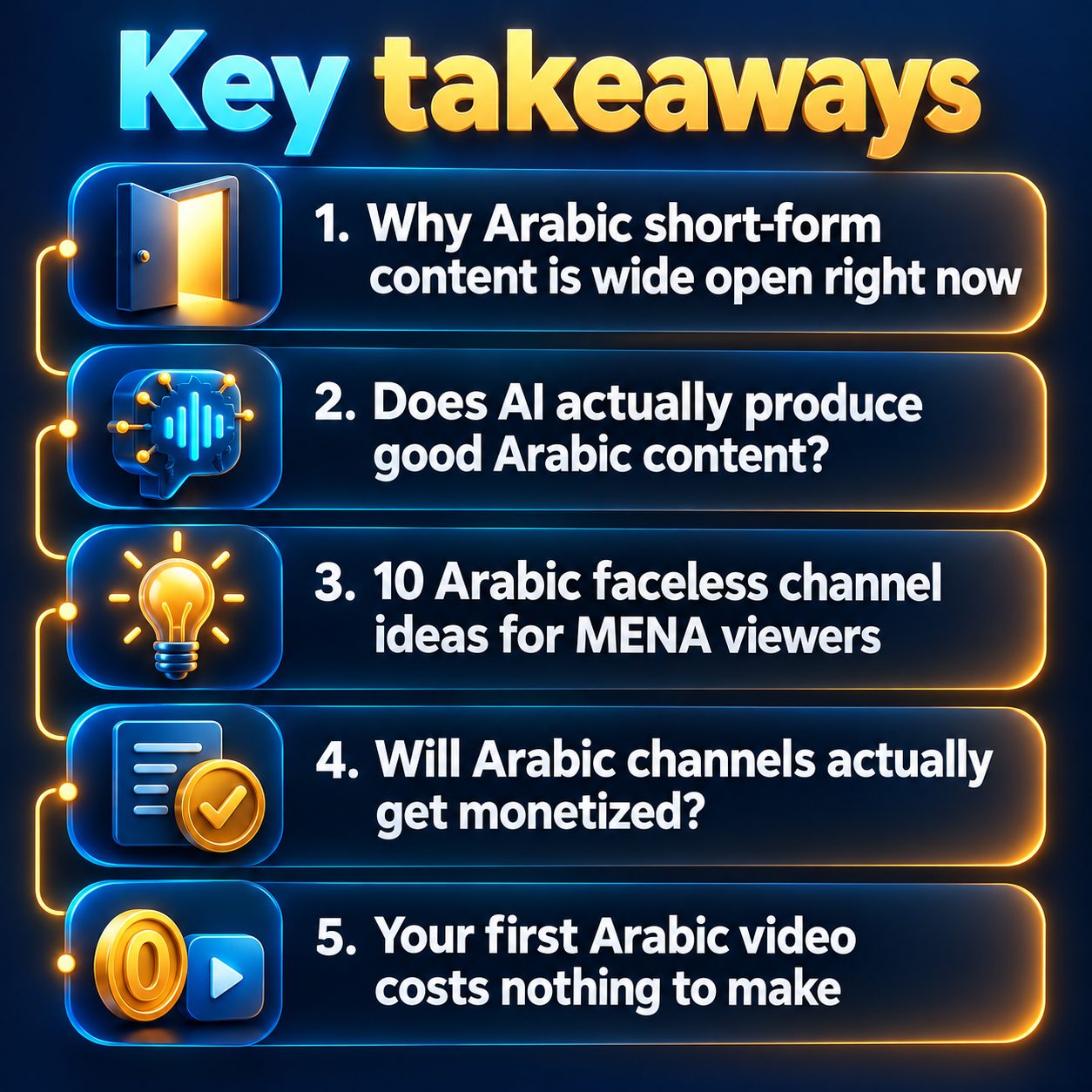
10 Arabic faceless channel ideas for MENA viewers
Here is the list. Each idea is a genuinely different genre, not ten variations of one thing. All of them work without a camera.
1. Jinn stories and Arab horror folklore. The MENA region has centuries of supernatural lore that Western horror channels never touch. Short narrated retellings with atmospheric visuals grab attention immediately because the stories feel personal to the audience. First video: a retelling of a well-known jinn legend from your country. Faceless by nature: AI narration over moody, atmospheric visuals.
2. Stoic wisdom meets Islamic philosophy. Motivational shorts blending Stoic principles with Islamic thought. This crossover is underserved in Arabic, and the clips are highly shareable. First video: "Three ideas Marcus Aurelius and Ibn Khaldun agreed on." Script-driven, no face needed.
3. Gulf startup recaps. The MENA tech scene is booming but barely covered in short-form. Recap a founder's journey in 60 seconds. First video: the origin story of a well-known regional app. Works without filming because the content is narrative storytelling over visuals.
4. Arabic true crime. Unsolved cases, famous trials, historical mysteries from the Arab world. True crime performs well in every language because curiosity is universal. First video: a one-minute recap of a famous regional case.
5. Sleep stories in Arabic. Calm, slow narration over soothing visuals. Bedtime content has massive replay value because people listen every night. The algorithm loves repeat views. First video: a peaceful retelling of a traditional folk tale. All you need is a gentle AI voice and ambient sound.
6. Dark psychology in Arabic. Body language, persuasion tactics, social dynamics. This niche explodes on short-form because every video feels like a personal secret worth sharing. First video: "Five signs someone is not being honest with you."
7. Ancient MENA civilizations. Mesopotamia, Ancient Egypt, the Nabateans, Andalusia. Short history videos with cinematic visuals do extremely well, and MENA history is visually stunning. First video: a surprising fact about a lesser-known ancient city in the region.
8. Arabic product showcases. Trending products available in the Gulf or Levant. UGC-style videos that show what a product does without a human on screen. Great for affiliate links down the road. First video: a gadget or skincare item trending on local marketplaces.
9. Personal finance for young Arabs. Budgeting, saving, basic investing. Financial literacy content in Arabic is severely underserved, especially for viewers in their twenties. First video: "The 50/30/20 rule explained in 45 seconds."
10. Did-you-know trivia about the Arab world. Surprising facts, record-breaking achievements, cultural quirks. Each video is standalone, so you never run out of topics and every short has viral potential. First video: a little-known fact about a famous MENA landmark.
Will Arabic channels actually get monetized?
Platforms do not treat Arabic content differently from English when it comes to reach. TikTok, YouTube, and Instagram rank videos by viewer behavior (watch time, shares, completion rate), not by language.
For YouTube monetization, the requirements are the same globally: 1,000 subscribers plus 4,000 watch hours in 12 months for long-form, or 10 million Shorts views in 90 days. Arabic channels qualify on identical terms. TikTok and Instagram monetization programs also apply regardless of language.
The honest note: YouTube flags mass-produced repetitious AI content for potential demonetization. The key word is "repetitious." Channels that post genuinely varied, well-scripted content on different topics are not the target. Keep your scripts distinct and your topics fresh.
Your first Arabic video costs nothing to make
You do not need to buy a mic, learn editing software, or record a single word. If you already have a niche idea from the list above, the fastest path is to test it.
MaqtAi supports Arabic voiceover, script generation, and right-to-left captions across its 19 faceless niches. You pick a topic, the AI writes and narrates the script in Arabic, generates visuals, and assembles a vertical video that carries a watermark on the free tier. If you want to post daily without touching each one, Autopilot and scheduling handle that on a paid plan.
New accounts get 450 free credits when you verify your email, enough for three or four still-frame test videos on the Express tier with no card required. That is enough to hear the Arabic voice, see your captions, and decide whether this niche is worth continuing.
The real cost of waiting is not money. It is the weeks of algorithm data you are not collecting, the posting streak you are not building, and the fact that the Arabic short-form space gets a little more crowded every month. Pick one idea from the list, make the first video free, and find out.
Doing this by hand is the part most people quit at. MaqtAi writes the script, narrates it, generates the visuals and captions, and assembles the faceless short for you. Verify your email and you get 450 free credits: about 3 videos on the still-frame tier, or one with AI motion. Free renders carry a watermark.
Try it on your niche freeFrequently asked questions
Can I run an Arabic faceless channel if I live outside the MENA region? Absolutely. Your location does not matter. What matters is that your content resonates with Arabic-speaking viewers. Diaspora creators often have a unique angle because they bridge two cultures.
Do I need to write the Arabic script myself? No. With MaqtAi, you pick Arabic as your voiceover language and the script, narration, and captions are all produced in Arabic automatically. You can review and edit before anything publishes.
Is it better to start on TikTok, YouTube, or Instagram for Arabic content? All three have large Arabic-speaking audiences. YouTube Shorts and TikTok are the easiest to grow on because their algorithms surface content to new viewers aggressively. Start with one, then cross-post once your workflow is smooth.
Will people judge me for using AI to make videos? Viewers care about whether a video is interesting, not how it was made. If your script is sharp and your topic is compelling, the production method is invisible. Thousands of faceless channels run this way across every language.
Results vary. Nothing in this article is a guarantee of income or monetization.