
No, and here is what that number actually is
It is not a growth milestone. It is a monetization gate. YouTube's Shorts route into the Partner Program asks for 1,000 subscribers plus 10 million valid public Shorts views in the past 90 days. Read that window again, because it changes the whole question. It is rolling. Views from four months ago stop counting.
So the goal is not "get there eventually." The goal is "be running at that pace right now, and keep running at it for three months straight." Nobody stumbles into that with one lucky video. It is a sustained volume of attention, which means a channel that publishes constantly and lands more often than it misses.
That is the honest answer. It is not impossible, and channels do clear it. But if you are a few weeks in and wondering whether it is around the corner, it is not, and planning around it will make you quit early.
Why one viral Short does not carry you there
Most people picture the path as: one video explodes, the channel gets pulled up, the rest follows. That is not how the Shorts feed behaves.
A big spike is a single event. It decays. The rolling window means it ages out while you are still celebrating it. Meanwhile the feed tests each new upload almost independently of your last one, so a hit does not guarantee the next video gets a bigger push. And subscribers convert poorly from Shorts compared to long-form, because people swipe, they do not commit.
What actually moves a channel toward that kind of volume is boring: a repeatable format, posted on a cadence, in a niche where the audience is already scrolling. Consistency beats spikes, because consistency stacks inside a rolling window and spikes do not.
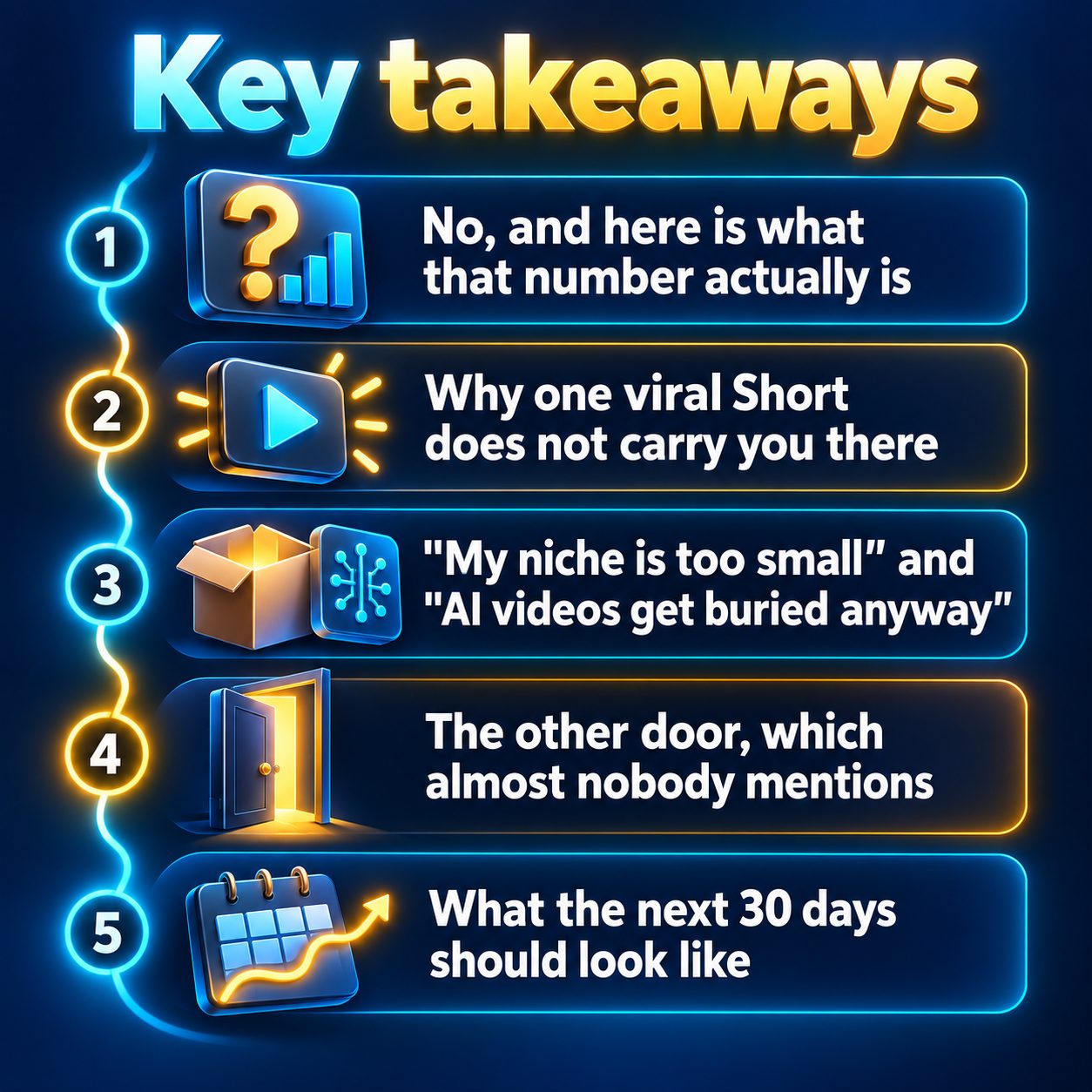
"My niche is too small" and "AI videos get buried anyway"
Two objections, and they deserve straight answers.
On niche size: small is usually an advantage in short-form, because the feed serves interest, not subscriber count. Sleep content, stoic motivation, history, scary stories, dark psychology, startup teardowns. These all have enormous scrolling audiences and none of them require you on camera. A narrow niche also gives the algorithm a clear signal about who to show you to.
On AI: no platform down-ranks a video simply for being AI-made. TikTok, Instagram, YouTube, and Facebook rank shorts by viewer behavior, watch time, completion, likes, shares. Production method is not an input. What does hurt you is spam patterns, like near-duplicate files posted across many accounts, plus weak opening seconds and ignoring YouTube's disclosure requirement for realistic altered or synthetic content. The label itself does not shrink your reach. Skipping it when it applies can get the video removed.
Worth naming too: YouTube's inauthentic content policy targets mass-produced repetitious material. Making videos with AI is fine. Making the same video over and over with the words swapped is what gets flagged.
The other door, which almost nobody mentions
The same Partner Program page lists a second route: 1,000 subscribers plus 4,000 valid public watch hours in 12 months. Twelve months, not ninety days. Watch hours, not raw views. For a faceless channel, that is a dramatically more reachable bar.
It also pays better. Regular long-form videos typically earn far more ad revenue per view than Shorts do, so the easier door happens to open into the better room.
YouTube sorts your uploads automatically. Vertical or square up to 3 minutes gets classified as a Short. 16:9, or anything longer than 3 minutes, is a regular video. That means you decide which door you are walking through at the moment you pick your aspect ratio, before you write a single line.
The smart faceless play is both. Post Shorts daily for discovery, and publish longer 16:9 pieces on the same topics to build watch hours. Same research, two formats, two very different monetization clocks.
What the next 30 days should look like
Forget the big number. Here is the plan that actually compounds.
Pick one niche and hold it for the full month. Switching niches resets the audience signal. Pick something you can talk about for a hundred videos without hating it. If you want a starting map, browse niches that work without filming.
Post daily, or 3 times a week if daily breaks you. Cadence is the variable most beginners get wrong. Ten great videos spread over two months teach the algorithm nothing.
Write the hook first, every time. The opening line decides everything downstream. Not "today we are talking about," but the thing that makes someone's thumb stop.
Read retention, not views. Open the retention graph and find where people leave. That is your edit note for tomorrow's video. Views are the score. Retention is the coaching.
Give it a month before you judge the niche. After a couple of dozen videos you will have a real read on whether the format has legs.
The questions you have not typed
Will people judge you for AI content? Viewers judge boring content. Nobody in a scroll feed is auditing your production pipeline. They are deciding in a second whether to keep watching.
Are you too late? Short-form is not a land grab where the good spots got taken. The feed serves new channels every day because it needs fresh material to test. Late is fine. Inconsistent is not.
What if you stop after two weeks? That is the real risk, and it is almost always a workload problem, not a motivation problem. Scripting, voicing, editing, and uploading one video a day is a job. Most people quit because the process is heavy, not because the idea was wrong.
Make the workload the thing you solve
If the plan above collapses under the editing, the fix is to remove the editing. That is the specific friction MaqtAi exists to clear: you give it a niche and a topic, and it writes the script, narrates it with an AI voice, generates moving visuals, adds animated captions, and assembles a vertical video, usually in a few minutes. You never appear on camera. From there, scheduling and auto-publishing can run the cadence to YouTube and Instagram on a paid plan, with TikTok posts queued for your approval, so posting is not a daily decision you have to win.
Be clear on what that does and does not do. It does not deliver views. Views come from the niche, the hook, and showing up. It removes the reason most channels stop.
Here is the cost of waiting, plainly. The channel you have not started is not accumulating algorithm data. Every week you spend deciding is a week your retention graphs do not exist yet, and someone in your niche is posting today. The first video is the only one that is genuinely hard.
Verify your email and you get 450 free credits, no card, which is enough for one video with AI motion or three to four on the still-frame Express tier, watermarked, so you can see whether the format feels like yours. Check what a video costs before you spend anything.
Doing this by hand is the part most people quit at. MaqtAi writes the script, narrates it, generates the visuals and captions, and assembles the faceless short for you. Verify your email and you get 450 free credits: about 3 videos on the still-frame tier, or one with AI motion. Free renders carry a watermark.
Try it on your niche freeFrequently asked questions
Do the Shorts views have to happen within 90 days? Yes. YouTube's Shorts monetization route counts valid public Shorts views from the past 90 days on a rolling basis, so older views drop out of the total as the window moves.
Is the long-form route really easier for a faceless channel? For most people, yes. The watch-hours path runs over twelve months instead of ninety days, and long-form videos typically earn far more per view than Shorts. Posting both formats is the usual approach.
Can AI-generated Shorts be monetized on YouTube? Yes, provided the content is not mass-produced and repetitious, and you disclose realistic synthetic media where YouTube's policy requires it. Videos you generate are yours to post and monetize commercially.
How many videos should I post before deciding a niche is not working? Give it a month of consistent posting and a couple of dozen videos. Fewer than that, and you are reading noise rather than a pattern.
Results vary. Nothing here is a guarantee of views, monetization, or income.