
How Shorts money actually reaches you
Shorts don't pay the way regular videos do. On a regular video, an ad runs before or during your video, and you get a share of that ad. In the Shorts feed, ads play between videos, so there's no clean way to say which ad belongs to whom.
So YouTube pools it. Ad revenue from the Shorts feed goes into one pot, part of it covers music licensing, and the rest is divided among monetized creators based on their share of views. Then you keep your cut of your slice. The full mechanics are on YouTube's Shorts monetization policy page. Read it once so nothing surprises you later.
Two things follow from that. You're paid on views from the feed, not on a flat rate. And your income moves with how much advertisers spend that month, which you can't control.
Why "Shorts pay pennies" is mostly true, and still misses the point
You've probably seen someone post a screenshot of a viral Short next to a tiny payout. That's real. Per view, Shorts earn far less than regular videos, because the pool is shared across an enormous volume of views.
But judging Shorts by the ad check is like judging a shop by its window display. Most of the money comes in elsewhere. Shorts are the cheapest way to get found by strangers. People who like your Short visit your channel, watch your longer videos, click your link, buy what you recommend. Regular videos typically earn much more per view, and Shorts are often what sends viewers to them.
So here's the honest answer. If your plan is to live off Shorts ad revenue alone, you'll probably be disappointed. If your plan is to use Shorts as the front door of your channel, they pay you in attention, and attention is worth more than the check.
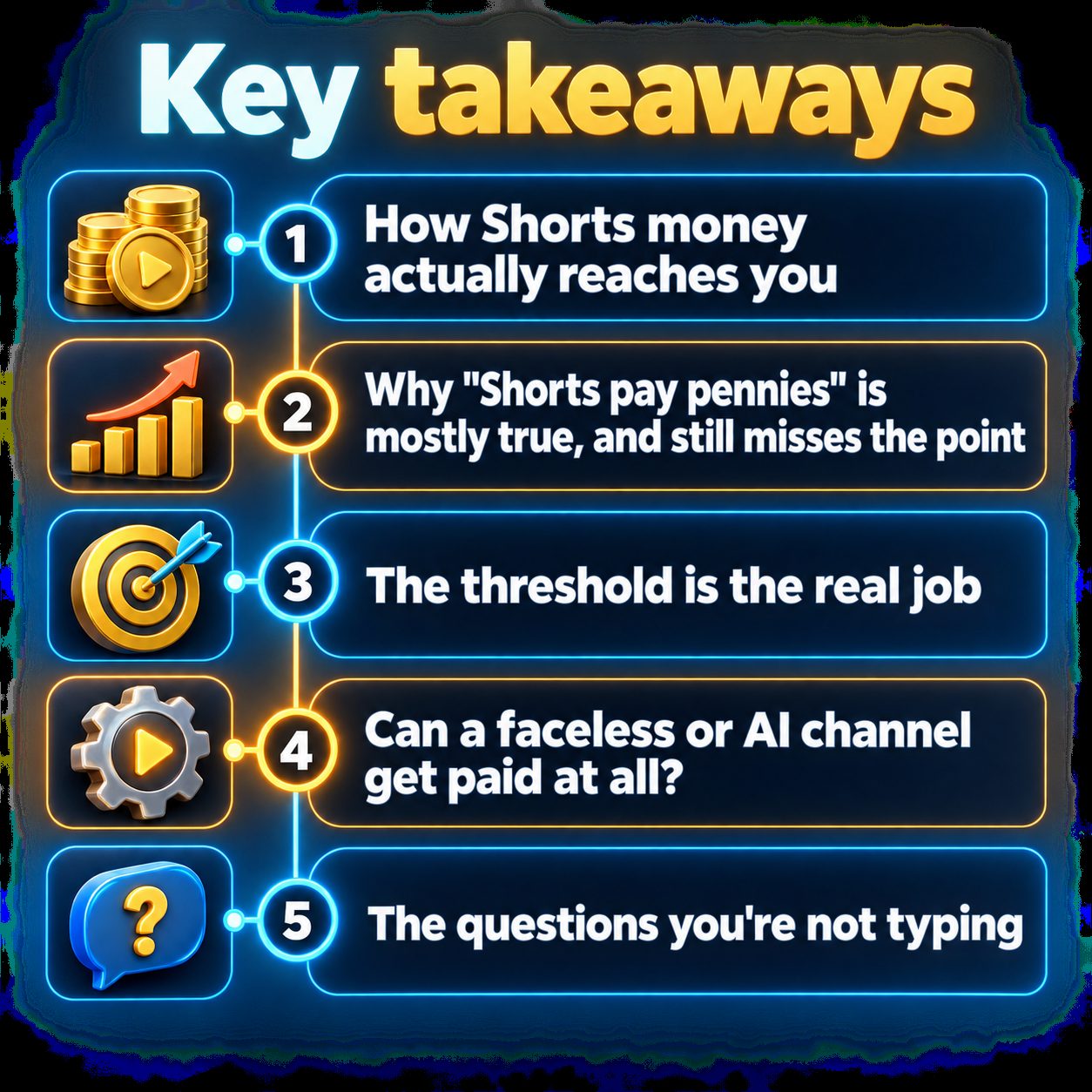
The threshold is the real job
Nothing pays before you're in the YouTube Partner Program. To get in you need 1,000 subscribers plus either 4,000 valid public watch hours in the last 12 months or 10 million valid public Shorts views in the last 90 days.
Look hard at that Shorts route. It's a big target in a short window. The watch-hour route, built on longer videos, is usually easier to reach, and the same YouTube page notes that Shorts feed views don't count toward the 4,000 watch hours. So the two routes really are separate. Plenty of faceless creators run both: Shorts to grow subscribers, a regular video now and then to build watch hours.
As for time, think in months, not weeks. Expect a stretch where you post and the numbers barely move. That stretch isn't wasted. It's how the algorithm learns who your videos are for.
Can a faceless or AI channel get paid at all?
Yes, with one real condition. YouTube doesn't refuse to pay a channel for being faceless, and no platform down-ranks a video just because AI made it. Ranking follows what viewers do: whether they keep watching, finish, share.
What YouTube does refuse to pay for is what it calls inauthentic content: mass-produced, repetitive videos that look like one template with the words swapped. Most AI channels that lose monetization fail on exactly this. If every video has the same structure, the same filler and no point of view, the channel can be demonetized even after it qualifies.
And here's what no tool can do for you. No generator gives people a reason to watch. You still need a niche you understand, a hook that earns the next second, and an angle that makes next week's video different from this week's. Software can handle the filming and editing for you. It can't give you taste. Also follow each platform's disclosure rule for realistic synthetic media. The label itself doesn't hurt reach, but skipping it can get a video removed.
The questions you're not typing
Am I too late? Not if your niche is specific enough. Broad "facts" channels are crowded. Strange laws from medieval Europe is not. A narrow niche matters more than an early start. If you're stuck, browsing niches by audience can help.
Will people judge me for AI content? People judge boring content. If the story is good and the voice fits, most viewers never think about how it was made. What they do notice is lazy repetition, which takes you back to the section above.
What if I quit after a few weeks? That's the actual risk, bigger than any policy. Most channels don't fail. They just stop. A routine you can keep up in a bad week matters more than a perfect first video.
What waiting costs, and the smallest next step
Every week you spend deciding, the channel you'd have started collects no data. YouTube learns who your videos are for one upload at a time, and that only begins once you post. Meanwhile someone in your niche is uploading daily and getting that data instead.
You don't need to decide yet whether Shorts will pay your rent. You need to find out if you can make one video in your niche that you'd actually watch. That's an afternoon, not a commitment.
If filming or editing is what's stopping you, MaqtAi is built for exactly that. Give it a niche and a topic, and it writes the script, narrates it, animates niche-matched visuals and adds captions, so you never appear on camera. Later, when you're ready for a steady schedule, Autopilot and scheduling can run it from a topic queue you control. To test it, verify your email for 450 free credits with no card. That's roughly 3 to 4 videos on the still-frame default, or one with AI motion (see pricing). Free renders carry a watermark, so treat them as a test of your niche, not your launch.
Doing this by hand is the part most people quit at. MaqtAi writes the script, narrates it, generates the visuals and captions, and assembles the faceless short for you. Verify your email and you get 450 free credits: about 3 videos on the still-frame tier, or one with AI motion. Free renders carry a watermark.
Try it on your niche freeFrequently asked questions
How much does YouTube pay per Short view? There's no fixed rate. Shorts get a share of a pooled ad pot divided by views, so earnings per view change from month to month and are generally far below regular videos.
Do Shorts views count toward YouTube monetization? Yes, through their own route: 1,000 subscribers plus 10 million valid public Shorts views in the last 90 days. Shorts feed views don't count toward the watch-hour route.
Can AI-generated Shorts be monetized? Yes, if each video is original and has its own idea. YouTube's inauthentic-content policy demonetizes mass-produced, repetitive videos, so variety and a point of view matter more than how the video was made.
Should I make Shorts or long videos for money? Long videos usually earn far more per view, and the watch-hour route is usually easier to reach. Many faceless creators use Shorts to grow and long videos to earn.
Results vary, and nothing here is a guarantee of income.