
What "pays well" actually depends on
YouTube doesn't pay you for uploading. It pays you a share of ad revenue once you're in the YouTube Partner Program. Getting in takes 1,000 subscribers plus either 4,000 valid public watch hours in the last 12 months or 10 million valid public Shorts views in the last 90 days. Until you cross that line, an automated channel earns nothing from ads, no matter how many videos it posts.
After that, three things decide whether it pays well:
- Format. Regular horizontal videos usually earn far more per view than Shorts, which have their own revenue sharing rules. For most faceless channels the watch hours path is also much easier to reach than the Shorts views path.
- Niche. Advertisers pay more to reach people who are about to spend money. A finance explainer channel and a funny animal channel can get the same views and very different payouts.
- Retention. Views only matter if people stay. A channel that holds viewers grows. A channel that loses them in the first few seconds stalls, however often it posts.
So here's the honest answer to "does it pay well": it can, if the channel is monetized, sits in a decent niche, and makes videos people finish. That's a much smaller group than the ads suggest.
Why the earnings screenshots look so good
If your feed is full of dashboards with big numbers, check who's posting them. A lot of the loudest voices in YouTube automation sell courses, coaching, or done-for-you channels. Their best month is their marketing. You never see the channels that posted for months and went nowhere, because nobody makes a video about those.
That doesn't make the whole idea a scam. Faceless channels really do earn. But look at how the classic "automation" model works. You pay a scriptwriter, a voice actor, and an editor for every video, and you act as the manager. That's a real business with real costs. It only pays well when the channel earns more than the freelancers cost, and plenty of people learn that math the hard way.
Here's a simple legitimacy test. Anyone who promises a timeline or an income figure for your channel is either guessing or selling.
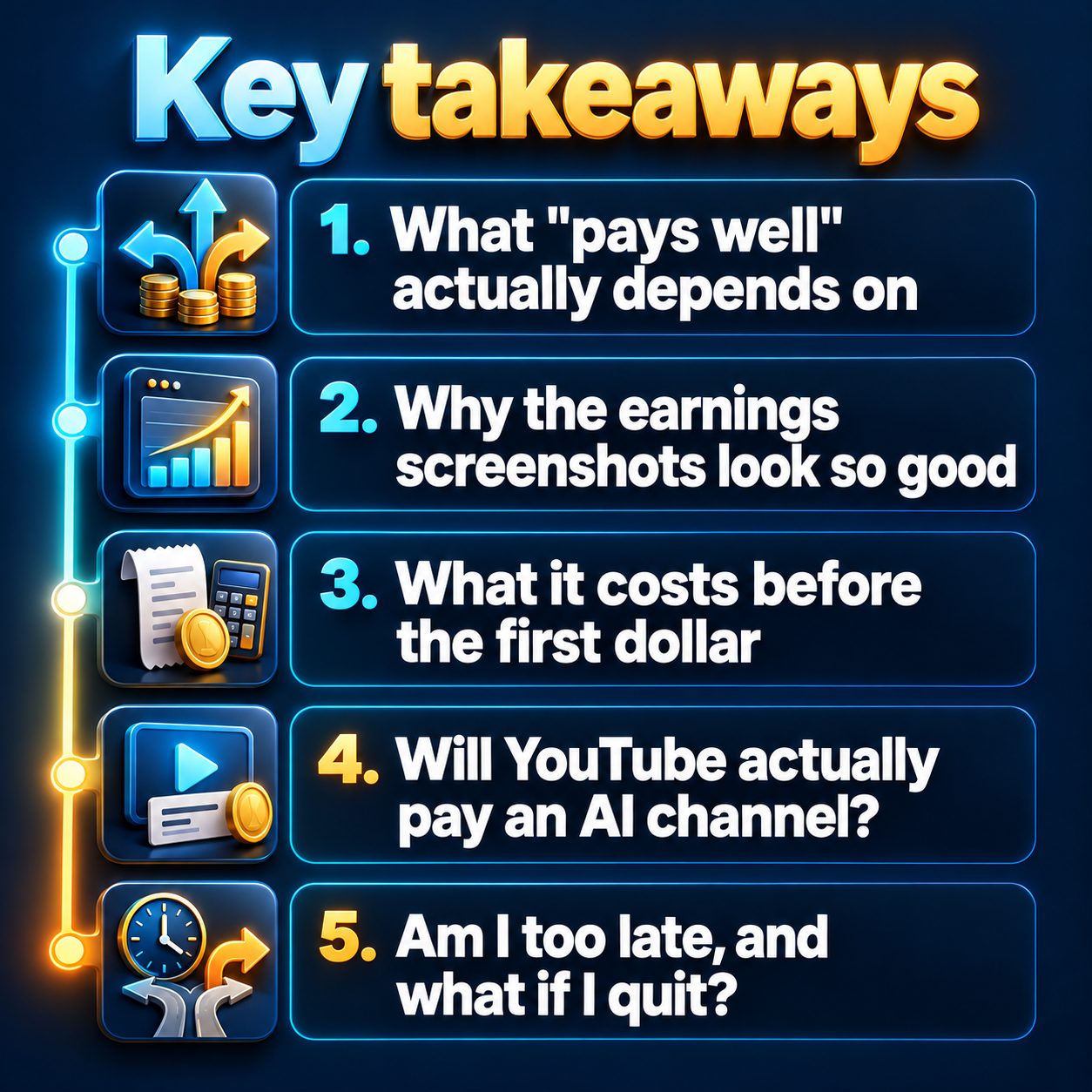
What it costs before the first dollar
This part never makes it into the thumbnail. Before monetization, every video costs you something, either money or hours.
If you outsource, you pay for every video for months with no ad revenue coming back. If you do it yourself, it costs you evenings: scripting, finding visuals, recording or generating a voice, editing, captioning, uploading. Either way, you pay before you know whether your niche works.
That's why most automated channels die. The idea usually wasn't bad. The operator ran out of budget or patience while the channel was still finding its feet. If you're going to try this, the most useful thing you can do is cut the cost of each video so you can survive the slow part.
Will YouTube actually pay an AI channel?
Yes, as long as the channel is original. YouTube won't refuse to monetize a video just because AI helped make it, and no major platform ranks shorts lower for being AI-made. What gets channels rejected or demonetized is the inauthentic content policy. It targets mass-produced, repetitive videos that feel like one template with the nouns swapped.
The channels that get through tend to share a few habits:
- Every video makes one clear point or tells one complete story.
- The script has a real angle, not a rewrite of the top search result.
- The format repeats, but the content doesn't.
- Realistic synthetic people or events get the platform's AI disclosure label.
Automation is fine as a way to produce videos. It doesn't replace having something to say. If you'd be bored watching your own channel, the reviewers will be too.
Am I too late, and what if I quit?
You're not too late. You're just late to the lazy version. Generic motivation clips and recycled Reddit posts are crowded. Specific beats broad: "stoic ideas for people starting a business" has room that plain "motivation" doesn't.
Quitting is the bigger risk, so plan for it. Most people stop after a few weeks, because they're doing everything by hand and nothing is happening yet. Decide up front what a fair shot means for you, like posting on a fixed cadence for a couple of months. Then judge the channel at the end of that stretch, not halfway through the first month.
Will people judge you for running an AI channel? Viewers judge boring videos. Nobody asks how a useful, well-paced short was made.
A cheaper way to find out if it pays for you
The real question isn't whether YouTube automation pays well in general. It's whether your niche holds viewers, and you want to find that out before you've spent much.
That's where a tool like MaqtAi fits. You give it a niche and a topic. It writes the script, narrates it with an AI voice, generates the visuals, adds captions, and puts together the video, typically in about 6 minutes. If you want to try the long-form path, which usually pays more, pick the 16:9 shape at a longer length and the script gets a long-form structure. On a paid plan, Autopilot makes videos from your topic queue daily, three times a week, or weekly. Every video waits for your approval unless you turn on automatic publishing.
Here's what it can't do. It can't pick a niche advertisers pay for, guarantee anyone watches, or get you into the Partner Program. Those still come from your topics, your hooks, and posting consistently. If you're still choosing a direction, the use cases page lists the niches it's built for.
So what does waiting cost you? Every week you spend deciding is a week with no videos and no retention data showing what works. It's also a week of no progress toward that first threshold. Meanwhile, someone in your niche posted again today. You don't have to commit to a whole business to start. Make one video on your best topic idea and see if you'd actually watch it. Verify your email and you get 450 free credits with no card needed. That covers roughly 3 to 4 videos in the default still-frame style, or one with AI motion. Free videos carry a watermark, so treat them as tests. The details are on the pricing page.
Doing this by hand is the part most people quit at. MaqtAi writes the script, narrates it, generates the visuals and captions, and assembles the faceless short for you. Verify your email and you get 450 free credits: about 3 videos on the still-frame tier, or one with AI motion. Free renders carry a watermark.
Try it on your niche freeFrequently asked questions
How long does it take a YouTube automation channel to start earning? There's no reliable timeline. Ad revenue only starts after you meet the Partner Program requirements, and many channels take months to get there while some never do.
Do Shorts or long videos pay better for automation channels? Regular long-form videos usually earn far more ad revenue per view than Shorts. A common approach is to use Shorts to get discovered and long-form videos for income.
Can I monetize AI-generated videos on YouTube? Yes, if they're original and not mass-produced or repetitive. YouTube's inauthentic content policy targets low-effort, templated uploads, not the use of AI itself.
Is YouTube automation a scam? The model is real, but a lot of the hype comes from people selling courses. Treat any promised income or timeline as marketing, and test cheaply before you invest.
Results vary, and nothing here is a guarantee of income.