
What joining actually gets you
The Partner Program is a permission slip for two things, and only two.
First, ad revenue. If you want a share of what advertisers pay to run against your videos, whether that is mid-rolls on a long-form upload or the Shorts feed pool, you need to be in the program, because that money flows through AdSense and AdSense needs the contract.
Second, YouTube's own money tools: channel memberships, Super Thanks, Super Chat, and shopping features. Those live inside YouTube and stay switched off until you are a partner.
That is the whole list. Everything else you might earn from a channel happens outside YouTube's payment system, and YouTube does not gate it.
The money that does not wait for a threshold
This is the part most people miss while they are refreshing their subscriber count.
Sponsorships. Brands do not ask if you are monetized. They ask how many people watch and whether those people are their buyers. A small channel with a tight niche, say personal finance for people in their twenties, or sleep content, is a cleaner buy for the right advertiser than a big general channel. You will have to pitch. Nobody emails a new channel first.
Affiliate links. Description, pinned comment, link in bio. If your niche has products attached, tools, books, apps, gear, you can earn from the first video you post. Disclose it. Most programs require it and so does the FTC.
Your own thing. A template, a short guide, a service, a Patreon. Faceless channels do this constantly: a stoic motivation channel selling a journal, a history channel selling a print. The audience is the asset, not the badge.
Honest caveat so you do not get excited about the wrong thing: pre-threshold income is usually small and it requires you to go ask for it. Ad revenue is passive. This is not. But it is real, and it starts before YouTube says you are allowed.
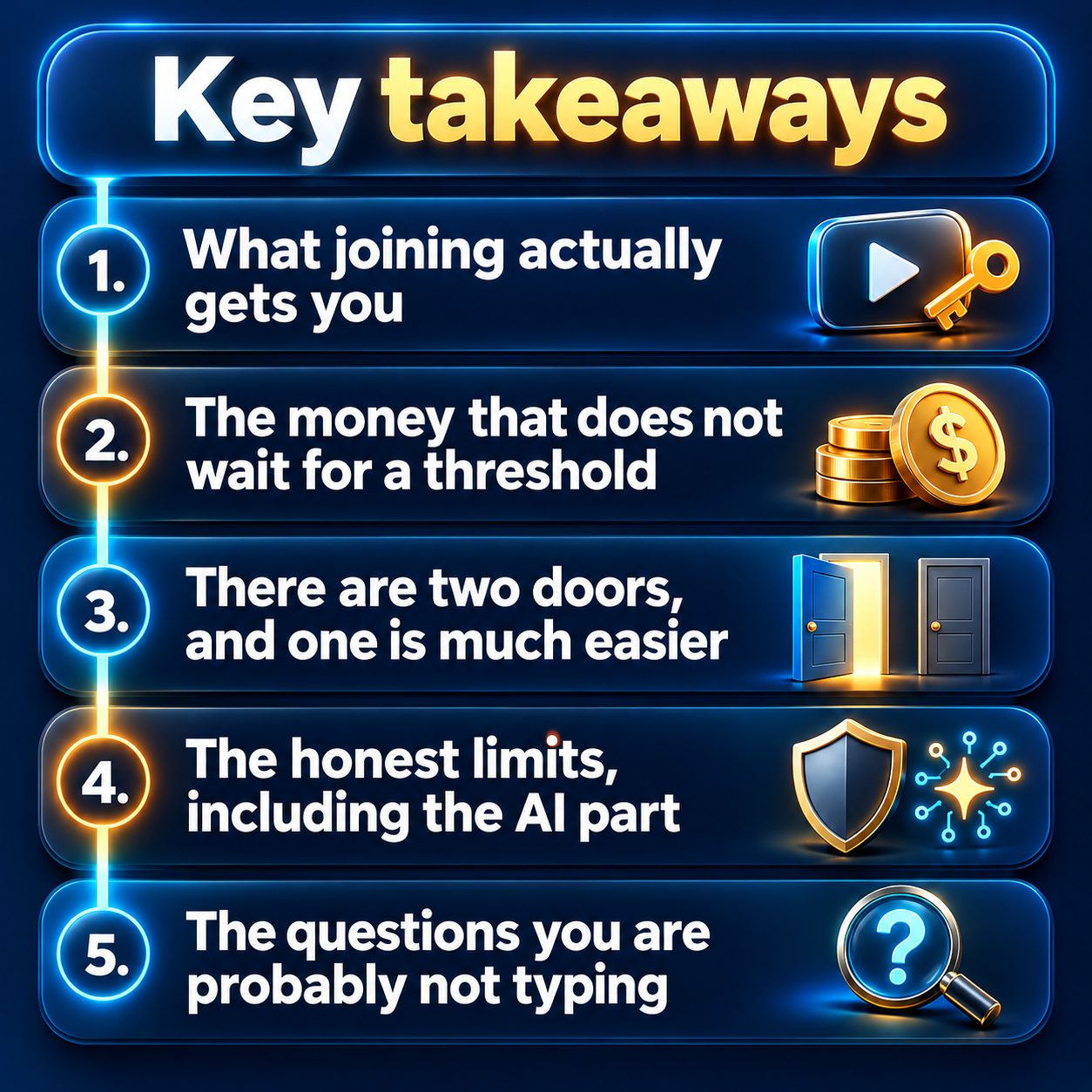
There are two doors, and one is much easier
When you do go for the program, you are not choosing between subscribers and views. YouTube runs two separate qualifying paths, and they are wildly different in difficulty.
The long-form path is 1,000 subscribers plus 4,000 valid public watch hours in 12 months. The Shorts path is 1,000 subscribers plus 10 million public Shorts views in 90 days, both listed on YouTube's requirements page. Read those two numbers again. If you are posting vertical clips only, you are running at the harder target.
There is also a lower tier that gets you fan funding earlier: 500 subscribers, 3 public uploads in the last 90 days, and either 3,000 watch hours in 12 months or 3 million Shorts views in 90 days, same page. That tier does not include ads, but it does open memberships and Super Thanks.
The practical takeaway: if earning from views is the goal, do not post only Shorts. YouTube classifies vertical or square uploads up to 3 minutes as Shorts and 16:9 uploads as regular videos, so the shape you export decides which pile your minutes land in. A mix works. Shorts bring people in, longer videos bank watch hours, and long-form ad revenue per view is generally the better side of the deal.
The honest limits, including the AI part
Being a partner is not the same as being paid. Plenty of monetized channels earn very little, because RPM depends on niche, audience country, and how much of the video people actually watch. The badge changes your permissions, not your economics.
And if you are planning to build this with AI tools, here is the line that matters. No platform down-ranks a video for being AI-made. TikTok, Instagram, YouTube, and Facebook rank shorts by watch time, completion, and shares. What YouTube does act on is inauthentic content: mass-produced, repetitious uploads with nothing added. That policy is real and it will cost you monetization if you churn out near-identical videos across near-identical channels.
So the thing an AI tool cannot do for you: pick a niche worth watching, write a hook that earns second three, or decide what makes your channel different from the other one in the same niche. It removes production friction. It does not supply taste. If you were hoping to skip the judgment part, this will not work for you, and better you hear it now than after two months.
The questions you are probably not typing
"Am I too late?" The threshold has not moved and neither has the mechanic. Niches keep opening because formats keep changing. Late is a feeling, not a metric.
"Will people judge me for AI content?" Some will say so in comments. Far more will watch a well-paced video about something they care about and never think about how it was made. Faceless channels have been normal for years.
"What if I quit after two weeks?" This is the real risk, and it is not a character flaw. It is a workload problem. People stop because posting daily by hand is genuinely exhausting, not because they lacked discipline. Solve the workload, not the willpower.
What actually moves you toward the threshold
Three things, in this order: niche, hook, cadence.
Pick one niche and stay in it long enough for the algorithm to learn who to show you to. Write the first line of every script as a reason to keep watching, not an introduction. Then post on a fixed rhythm, one a day or three a week, and keep it going for months rather than weeks. That is the whole engine. Everything else is decoration.
Cadence is where most people break, which is exactly the friction worth automating. MaqtAi builds faceless vertical videos from a topic, script, AI voiceover, moving visuals, and animated captions, and its Autopilot and scheduling render from a topic queue and publish on the cadence you set, with an approval step if you want to eyeball each one first. Your job stays the part that matters: picking hooks and steering topics, your own or the batch Autopilot suggests, in a niche you can stand for a year.
What waiting actually costs
Nothing bad happens if you wait a month. That is the problem. Nothing happens at all. The watch hours do not accumulate, YouTube gathers no data about who to show your videos to, and the person who started the same niche today is thirty videos ahead of you by the time you decide.
So make one video. Not a channel, not a content calendar. One. New accounts that verify their email get 450 free credits, no card needed, enough for a watermarked still-frame short and an honest look at whether you want to do this every day.
Doing this by hand is the part most people quit at. MaqtAi writes the script, narrates it, generates the visuals and captions, and assembles the faceless short for you. Verify your email and you get 450 free credits: about 3 videos on the still-frame tier, or one with AI motion. Free renders carry a watermark.
Try it on your niche freeFrequently asked questions
Can I put affiliate links on a channel that is not monetized? Yes. Affiliate links live in your description or pinned comment and do not require the Partner Program. You do need to disclose the relationship, and follow the affiliate program's own rules.
Do Shorts count toward the 4,000 watch hours? No. Shorts views and long-form watch hours are counted on separate qualifying paths, so vertical clips build toward the Shorts threshold, not the watch-hour one.
Will AI-made videos get my channel rejected from YPP? Not for being AI-made. YouTube's inauthentic content policy targets mass-produced, repetitious uploads, so original topics, real structure, and a channel that is clearly yours matter more than which tools you used.
Should I apply as soon as I hit the numbers? Yes, applying is free and review takes time. Meeting the threshold does not auto-enroll you, so apply the day you qualify.
Results vary. Nothing here is a guarantee of income.