
The fair doubt: Shorts views feel like empty calories
You've probably seen it happen. A Short takes off, the view counter climbs, and the payout barely moves. You're not imagining that. Shorts ad revenue follows its own policy and payout rules, and regular horizontal videos typically earn far more per view. So if you've heard Shorts don't pay much, that's basically true. It just means you're asking them to do the wrong job.
A second worry sits under the first. Shorts viewers swipe. Plenty of them will never click through to a longer video, and someone who subscribed from a Short may never watch one. That's real too. It doesn't make Shorts useless, though. It tells you what they're for.
What Shorts actually do for a faceless channel
Think of Shorts as your testing lab and your shop window.
- Discovery. A brand-new channel with no audience has almost no way into recommendations. The Shorts feed puts your video in front of strangers who never searched for you. A faceless channel has no personal brand to lean on, so for you that feed is the front door.
- Fast feedback. A Short lives or dies in its first seconds. Post a handful and you'll learn quickly which hooks make people stay and which topics they skip. That lesson carries straight over to your longer videos.
- Cadence without burnout. A tight Short needs 15 to 30 seconds of script. Posting 1/day is far easier with Shorts than with long uploads. Posting consistently is what gives the algorithm enough data to work out who your channel is for.
Are you too late? No. The feed judges each video, not how old the channel is. A new channel with a strong hook gets the same swipe as everyone else.
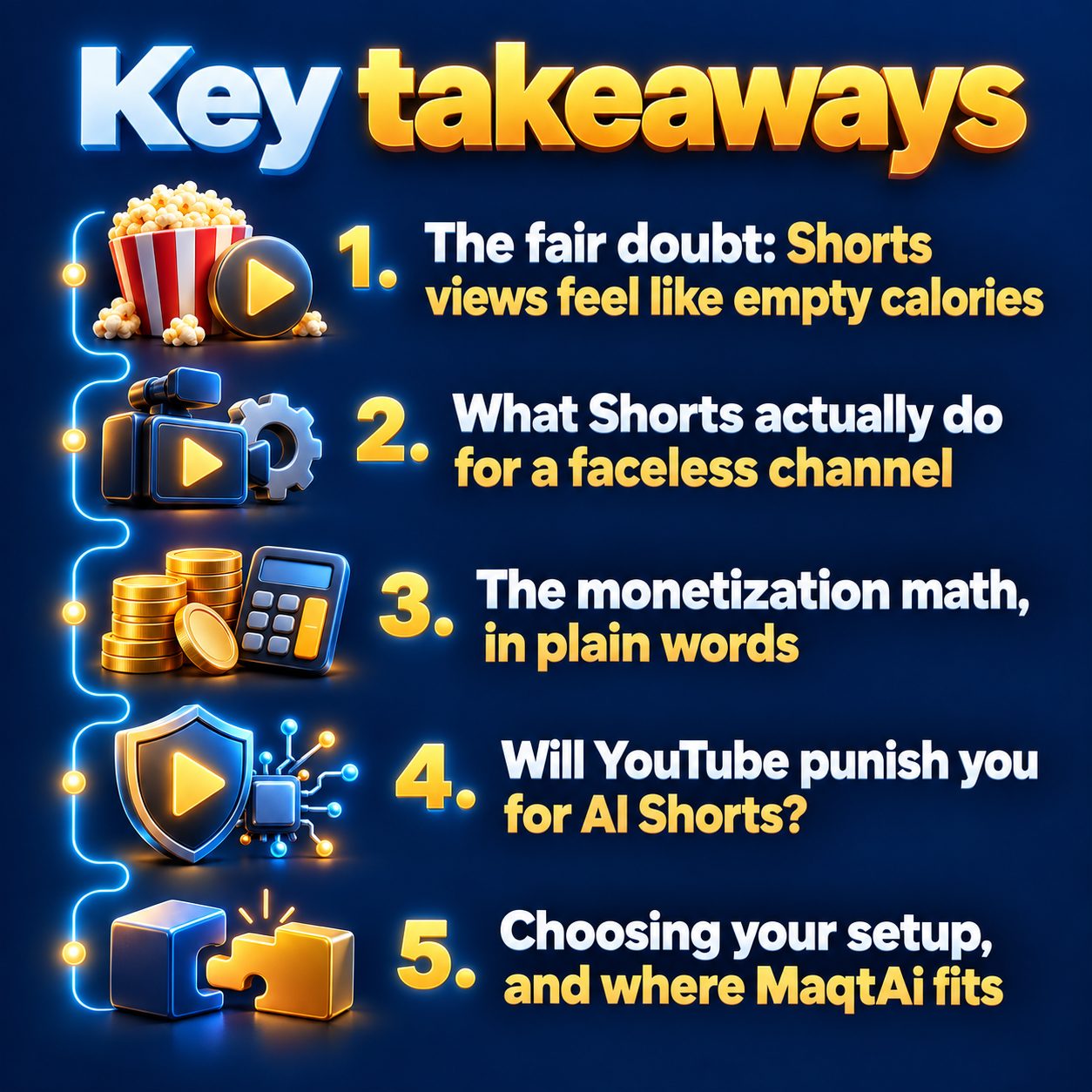
The monetization math, in plain words
This is the part that's hard to judge on your own. The YouTube Partner Program asks for 1,000 subscribers plus either 4,000 valid public watch hours in the last 12 months or 10 million valid public Shorts views in the last 90 days. For a new faceless channel, the Shorts path is a steep climb. The watch-hours path is far more reachable, and watch hours come from regular videos.
In practice it works like this. Shorts help you gather subscribers, and those count on either path. Regular videos build the watch hours. A Shorts-only channel is betting on the harder road. A long-form-only channel gets fewer strangers through the door. Doing both, with a clear job for each, is usually the stronger play.
Will YouTube punish you for AI Shorts?
No platform ranks a video lower just because AI made it. Shorts are ranked on what viewers do: how long they watch, whether they finish, whether they like and share. What does get you in trouble is looking like a content farm. YouTube's inauthentic-content policy demonetizes mass-produced, repetitive AI content, and spam patterns like near-duplicate uploads hurt reach. If a video shows realistic synthetic people or scenes, follow the platform's AI-disclosure rule. The label itself doesn't cut distribution, but skipping it can get the video removed.
Will people judge you for it? Some will, the same way some people judge any faceless channel. Most viewers judge the video. A sharp hook, a real payoff and a topic they care about count for far more than who, or what, did the narrating.
Choosing your setup, and where MaqtAi fits
Here's how I'd decide:
- Shorts only if you're testing a niche, want to learn fast and aren't chasing ad revenue yet. It's cheap, quick and gives you honest feedback.
- Long-form only if your niche lives on depth, like history deep dives or explainers, and your audience searches for it.
- Paired if you want both discovery and a real path to monetization. Every long video gets a Short on the same topic that stands on its own.
The paired setup is where friction usually wins, because every idea now needs two different videos. That's the specific job two MaqtAi features handle. In the wizard's Length & aspect step you pick the shape. Choose vertical for Shorts, since YouTube treats vertical or square videos up to 3 minutes as Shorts, or 16:9 for a regular video. At 2 or 5 minutes in 16:9, the script automatically gets a long-form structure: a hook, themed sections and a recap.
A finished 16:9 video then has a Make a companion Short button. It creates a separate vertical video on the same topic. That Short has its own payoff, so it isn't a teaser clip, and it ends by inviting viewers to the full guide on your channel. It's priced like any other video. Scheduling and auto-publishing are covered in the feature tour.
Where are credits worth spending? On the long video, if it's a topic people will keep searching for over the months ahead. For quick hook tests, the still-frame default is plenty. The pricing page shows what each quality tier costs before you choose.
What the companion Short won't do for you
Know the limits going in. The companion Short isn't linked to the long video, because links in Shorts aren't tappable. The invitation is spoken, and viewers still have to go and find the full video. It won't pick your topics either. Nothing in MaqtAi reads trends, so knowing your niche is still your job. It doesn't make anything go viral: views come from the niche, the hook and the cadence. And if you only plan to post Shorts, with no regular videos at all, you don't need this button. Last thing: publishing straight from MaqtAi needs a paid plan. On the free tier you download the video and upload it yourself, and free renders carry a watermark.
What waiting costs
Every week you spend deciding is a week without data. You haven't tested a hook, you don't know which topics your audience wants, and no subscribers are slowly adding up toward that threshold. Meanwhile someone in your niche posted every day and learned all of it.
You don't have to settle the whole strategy today. Make one Short on your strongest topic and see how people react to its first seconds. When you verify your email, MaqtAi gives you 450 free credits with no card needed. That covers roughly 3 to 4 still-frame videos, or one with AI motion. It's your first test, and it fits in an afternoon.
Doing this by hand is the part most people quit at. MaqtAi writes the script, narrates it, generates the visuals and captions, and assembles the faceless short for you. Verify your email and you get 450 free credits: about 3 videos on the still-frame tier, or one with AI motion. Free renders carry a watermark.
Try it on your niche freeFrequently asked questions
Do Shorts views count toward YouTube monetization? Yes, on the Shorts path of the Partner Program, and subscribers you gain from Shorts count on either path. The watch hours for the long-form path come from regular videos.
Should Shorts and long videos live on the same faceless channel? Usually, yes, so everyone who subscribes from a Short counts toward the same channel. If your Shorts and long videos serve very different audiences, a separate channel keeps the signals cleaner.
Is a companion Short just a cut-down clip of the long video? No. It's a separate vertical video on the same topic with its own payoff, and it ends by inviting viewers to the full guide on your channel.
How long should a faceless Short be? Start at 15 to 30 seconds while you test hooks. YouTube allows Shorts up to 3 minutes, but a short script is easier to keep tight to the end.
Results vary, and nothing here is a guarantee of income.