
What "work" actually means for a faceless channel
Before you sink weekends into this, get specific about the question. "Work" can mean three different things: getting views, getting subscribers, or getting paid. Faceless channels can do all three, and the evidence is everywhere in your own feed. Compilation channels, history explainers, scary-story narrations, stoic quote reels. You have watched dozens without knowing or caring who was behind them.
YouTube's ranking has nothing to do with a face. It watches whether people click, how long they stay, and whether they come back. A well-paced faceless video with a strong hook holds attention as well as any talking head. So the honest answer is yes, the format works. The harder truth is that the format was never the thing standing between you and views.
"But isn't every niche already crowded?"
This is the objection almost everyone brings, and it is half right. Popular niches are crowded. That is also proof they work, because crowds gather where there is demand and money. A niche with no competitors is usually a niche with no audience.
Crowding only beats you when you sound like everyone else. The channels that break through in a full space do one thing differently: a sharper angle, a tighter script, a consistent voice and visual style people start to recognize. You do not need a blue-ocean niche nobody has touched. You need a specific take inside a proven one. "History" is crowded. "Weird deaths of Roman emperors, told like campfire stories" is a lane. There are proven faceless niches to borrow structure from, then twist.
And being early is not required. Being consistent is. Most channels in any niche are dormant after a handful of uploads, which means the real competition is much smaller than the subscriber counts suggest.
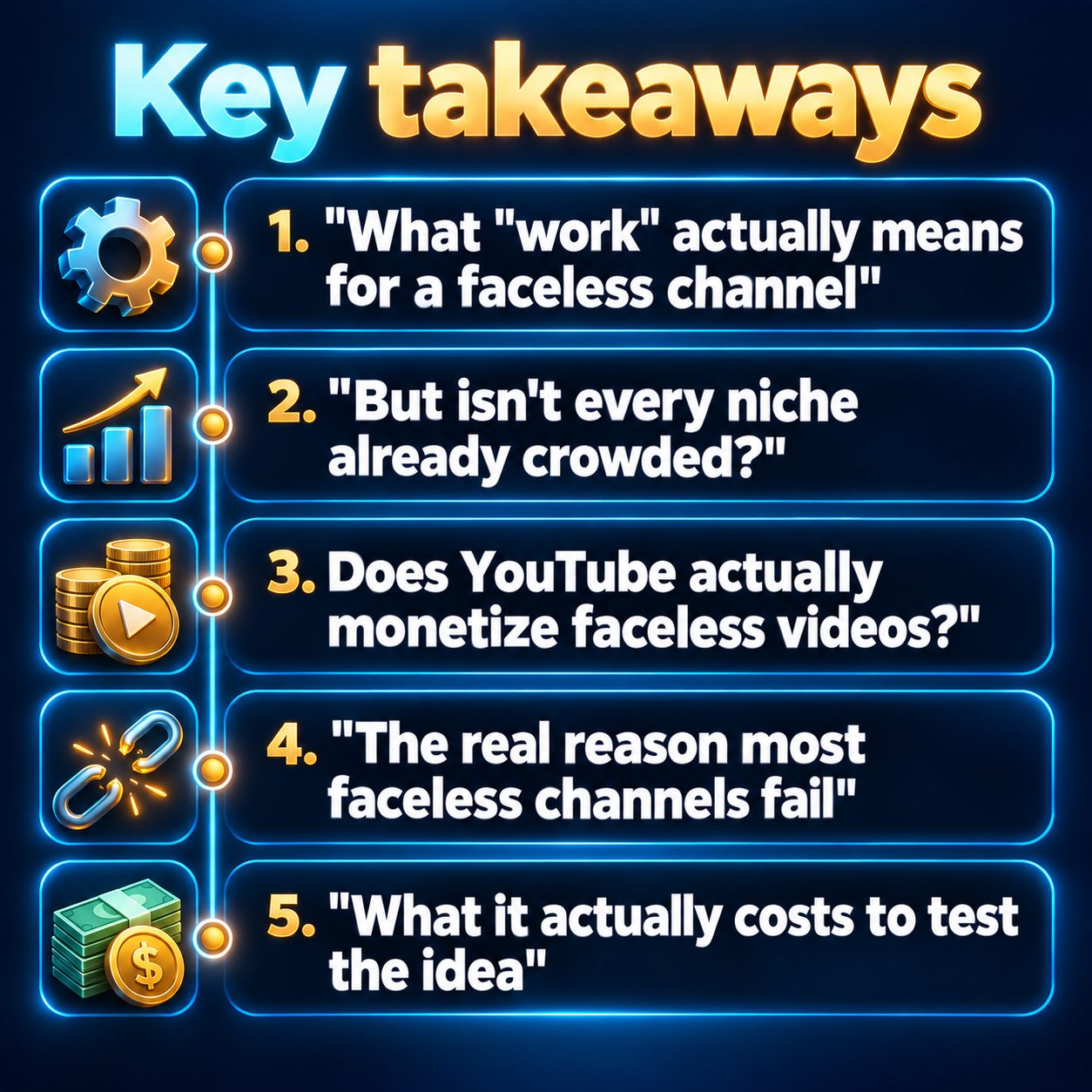
Does YouTube actually monetize faceless videos?
Yes, with one important caveat about how you make them. YouTube pays through the Partner Program, and to join you need at least 1,000 subscribers plus either 4,000 valid public watch hours or 10 million Shorts views in the qualifying window (YouTube's official eligibility page). Nothing in those requirements mentions your face. Faceless channels hit those numbers all the time.
The part people get wrong is the reused-content rule. YouTube can refuse monetization for channels that just re-upload other people's clips with no transformation (YouTube's reused content policy). So a channel that stitches together random stock footage and a robotic read can struggle at the review stage. Original scripts, your own narration choices, and visuals assembled for your specific topic are what keep you on the right side of that line. Faceless is fine. Lazy and duplicative is what gets flagged.
The real reason most faceless channels fail
It is not the niche and it is not the algorithm hating AI. It is that people quit in week two.
Here is the pattern. Someone spends a full weekend on their first video. It gets forty views. The second one takes another whole weekend because editing is slow and miserable. It gets sixty views. By the third weekend the math feels hopeless, and the channel joins the graveyard of accounts with four uploads and a last-posted date from two years ago.
The algorithm needs data to figure out who to show your videos to, and that data only accumulates when you post steadily. Ten videos is not a fair test. Thirty to fifty, posted on a regular cadence, is roughly where you start to see which topics land. The creators who "got lucky" mostly just outlasted the boring middle where nothing seems to be happening.
So the honest question is not "do faceless channels work." It is "can I keep posting long enough to find out." And that comes down to how much time and money each video costs you.
What it actually costs to test the idea
This is where most people quietly give up, because the traditional path is expensive before you know anything. Learning an editor, sourcing footage, recording voiceovers, or paying a freelancer per video means you are spending real money and hours on an experiment that might not pan out. That cost is exactly what makes people stop.
The cheaper way to run the test is to remove the production bottleneck entirely. That is the gap MaqtAi fills: you give it a niche and a topic, and it writes a hook-first script, narrates it in a natural AI voice, generates visuals with real motion, adds animated captions, and assembles a vertical video, usually in a few minutes. You never film and you never record your voice. When you want to run the channel hands-free, Autopilot renders from a topic queue on a schedule and can auto-publish to YouTube once you are on a paid plan and have connected it.
That changes the math on quitting. Instead of a weekend per video, posting daily becomes realistic, which is the exact behavior the algorithm rewards. It does not guarantee views. Bad topics still flop, and a boring script still gets skipped. What it removes is the excuse of not having time, so the only variable left is whether your topics and angles connect.
You do not have to commit blind. New accounts get 450 free credits after email verification, which is enough for three to four watermarked still-frame Express videos with no card required. Make three, post them, watch what happens. That is a real test of your niche for the cost of an afternoon.
The cost of waiting
Every week you spend deciding is a week the channel is not accumulating the data it needs, and a week a competitor in your niche is posting and pulling ahead. The algorithm cannot start learning about a channel that does not exist yet. The most expensive choice here is not picking a niche or a tool. It is staying stuck in research mode while the clock runs.
So make the first one. Pick a niche you would actually watch, generate a single video, and see how it feels to have something posted instead of planned.
Doing this by hand is the part most people quit at. MaqtAi writes the script, narrates it, generates the visuals and captions, and assembles the faceless short for you. Verify your email and you get 450 free credits: about 3 videos on the still-frame tier, or one with AI motion. Free renders carry a watermark.
Try it on your niche freeFrequently asked questions
Will people judge me for not showing my face? Almost nobody notices. Viewers care whether a video is interesting, not whether a creator is on screen. Some of the largest channels on YouTube have never shown a face, and the audience never asked.
Am I too late to start a faceless channel? No. Most channels in any niche stop posting within a few uploads, so the field of active, consistent creators is far smaller than the totals suggest. Consistency beats timing.
Does using AI to make the videos hurt monetization? Not by itself. YouTube's concern is reused, unoriginal content, not the tools you use. Original scripts, deliberate narration, and visuals assembled for your specific topic keep you clear of the reused-content rule.
How many videos before I know if my niche works? Ten is not enough to judge. Aim for thirty to fifty posted on a steady cadence before drawing conclusions, since the algorithm needs that volume to learn who to show your channel to.
Results vary, and nothing here is a guarantee of income.