
First, what people mean by a cash cow channel
"Cash cow" is YouTube slang for a channel where you never appear on camera. The videos are narration, visuals, and captions about a topic people keep looking for, like history, true crime, stoic motivation, scary stories, or money explainers. The idea is that once the channel is running, it keeps earning from videos you made months ago.
That core idea holds up. A video that answers a question people keep asking can pull views for a long time. YouTube doesn't care whose face is in it, and neither do most viewers. They came for the story or the answer, not for you.
The trouble is the version sold in thumbnails: pick a "profitable niche," pump out videos, get paid next month. That version mostly doesn't work. The rest of this article covers the gap between the two.
"Isn't it too saturated by now?"
Almost everyone has this worry, and it's half right. Broad niches are crowded. "Motivation" is crowded. "Facts about space" is crowded.
But viewers don't pick a channel from a category. They pick a video from their feed, and the feed rewards whatever grabs attention in the first couple of seconds and keeps people watching to the end. A new channel with a sharper angle beats an old channel with a lazy one all the time.
So narrow it down. Not "history" but "the strangest jobs in medieval Europe." Not "finance" but "money mistakes people make at their first job." A tight niche gives you a clear audience and topic ideas that come easily. It also gives people a reason to follow you instead of watching once and scrolling on. To get a feel for which faceless niches still have room for a fresh angle, browse a few niche examples and ask where you'd have something specific to say.
You're not too late. You're just too late to be generic.
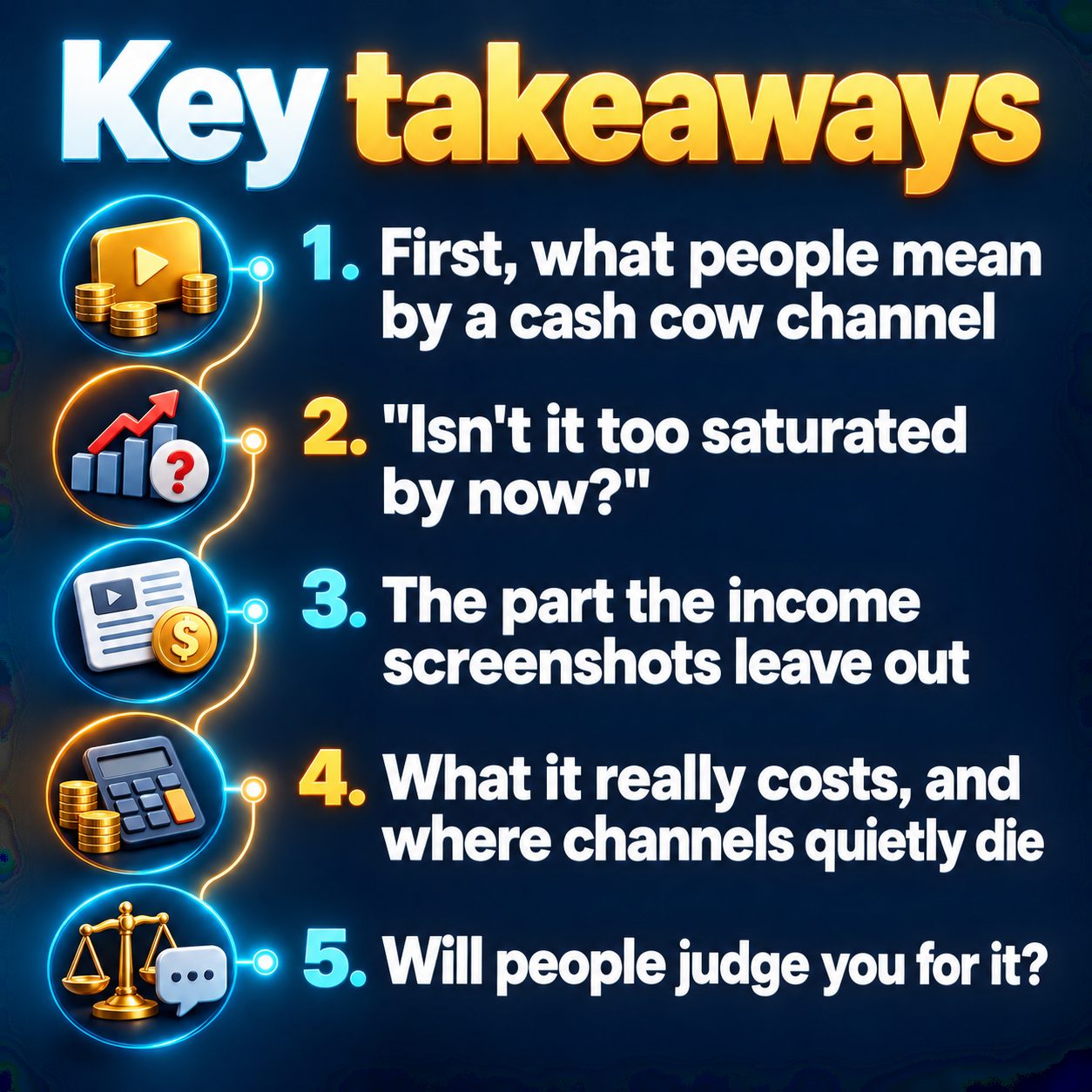
The part the income screenshots leave out
This is the honest part, and it's the reason your scam radar should stay on.
YouTube doesn't pay you from day one. To join the Partner Program you need 1,000 subscribers, plus either 4,000 valid public watch hours in the last 12 months or 10 million valid public Shorts views in the last 90 days, per YouTube's own eligibility page. Most channels need months to get there, and plenty never do.
The same program has rules against inauthentic content. Mass-produced, repetitive videos that look like they came off a template get demonetized, even when the views are there. This is where a lot of "AI cash cow" channels die. They churned out near-identical videos, hit the threshold, and then got rejected.
So what works? Videos that are clearly different from each other and tell a real story or answer a real question, with a script someone actually thought about. AI can handle the production. It can't be the reason the video exists.
One more thing matters when you choose a format. Shorts are the fastest way to find an audience, but the Shorts-views path to monetization is the steep one. Regular horizontal videos usually earn far more per view, and the watch-hours path is easier for a small channel to reach. Many creators use Shorts to get discovered and longer videos to earn.
What it really costs, and where channels quietly die
Money is less of a barrier than it used to be. You don't need a camera, a mic, or an editor. You'll probably pay for a tool or two eventually, so it's smart to find out whether a niche suits you before you pay for anything.
Time is the real cost. You'll research topics, check facts, write hooks, and review each video before it goes out. Even with automation, plan on showing up every week.
Then there's patience. Your first videos will often get very few views. That doesn't mean you've failed. The algorithm is still working out who to show you to. It learns from a steady stream of videos, and it can't learn anything from a channel that posts a couple of times and goes quiet.
That's where most of these channels actually die. Bans and saturation aren't usually the problem. What happens is that a few weeks in, the novelty wears off, the views haven't come, and posting stops.
The fix is boring. Pick a cadence you can keep even on a bad week. Three videos a week that you actually post beats a daily plan you give up on. Batch your topics ahead of time so you never sit down wondering what to make. Check your numbers every couple of weeks, not every hour, and change one thing at a time: the hook, the length, or the angle.
Also ask yourself honestly whether you like this niche enough to think about it for months. If you don't, switch now. That's much cheaper than finding out later.
Will people judge you for it?
Some will. Most won't notice, because they're watching the story, not reading the credits.
No platform down-ranks a video just because it was made with AI. TikTok, Instagram, and YouTube rank short videos by how viewers behave: how long they watch, whether they finish, and whether they share. What does hurt reach is spam behavior, like posting identical files across many accounts, or weak openings. Skipping a platform's AI disclosure label on realistic synthetic footage is also risky. Add the label when the platform asks for it. The label doesn't reduce your reach, but ignoring the rule can get the video removed.
As for friends and family, a faceless channel is a small media business. Plenty of people run one quietly and never mention it.
Finding out if it works for you
The only real way to test a cash cow channel is to make videos in your niche and post them for a while. Reading more guides won't tell you whether you enjoy the work or whether your angle lands.
This is where production stops being the bottleneck. MaqtAi turns a niche and a topic into a finished vertical video: a script with the hook up front, an AI voiceover, visuals that move, and animated captions, typically in about six minutes. You can edit any line before it renders. Once you've found a rhythm, scheduling and auto-publishing keep you posting on schedule without you sitting at a desk every day. It won't pick a winning angle for you or make a weak topic good. That part is still your job.
Waiting has a simple cost. Every week you spend deciding is a week with no videos, no data, and no answer on whether your niche works, while someone else in that niche posts again today. You don't need a plan for the whole year. You need one video. Verify your email and you get 450 free credits with no card, which is enough to make your first videos and see how it feels.
Doing this by hand is the part most people quit at. MaqtAi writes the script, narrates it, generates the visuals and captions, and assembles the faceless short for you. Verify your email and you get 450 free credits: about 3 videos on the still-frame tier, or one with AI motion. Free renders carry a watermark.
Try it on your niche freeFrequently asked questions
How long does a cash cow channel take to make money? There's no fixed timeline. You have to meet the Partner Program thresholds first, and most channels need months of steady posting to get there, if they get there at all.
Can AI-made videos get monetized on YouTube? Yes, if they're original and varied. YouTube demonetizes mass-produced, repetitive content, so each video needs its own story or answer, not a template with the words swapped.
Do I need to show my face or record my voice? No. Faceless channels run on narration, visuals, and captions. An AI voice does the narration, so you never have to record anything.
Should I start with Shorts or long videos? Shorts are faster for getting discovered. Longer videos usually earn more per view and have the easier path to monetization. Many creators do both.
Results vary, and nothing here is a guarantee of income.