What YouTube actually asks for before it pays
Money on YouTube comes through the YouTube Partner Program, and the bar to get in is public. According to YouTube's eligibility page, you need 1,000 subscribers, plus either 4,000 valid public watch hours in the last 12 months or 10 million valid public Shorts views in the last 90 days.
Read that twice, because it shapes everything else. There are two ways in. One is built from watch time on regular videos. The other is built from Shorts views. You don't need both. But you do need to know which one you're aiming for, because a channel built for each looks different.
The same page lists the boring requirements too: follow the monetization policies, live in a region where the program is available, and turn on 2-Step Verification for your Google account. Do those on day one. They're free, and finding out about them later is annoying.
Shorts or regular videos? Decide this first
Here's the honest trade-off. Shorts are easier to get seen. People swipe through them fast, so a brand new channel can pick up views with no history at all. But Shorts ad revenue follows its own policy, and regular videos usually earn a lot more per view. The watch-hours route is also often easier for a small channel to reach. One good video keeps adding hours for months after you post it.
Plenty of creators end up doing both. Regular videos build the watch hours, and Shorts bring new people to the channel. If you go that way, make each Short worth watching on its own. A Short that's only a teaser for a longer video tends to annoy people, and annoyed viewers swipe away.
On format, YouTube sorts it for you. Vertical or square videos up to 3 minutes count as Shorts. Anything widescreen or longer counts as a regular video. So choose the shape on purpose, not by accident.
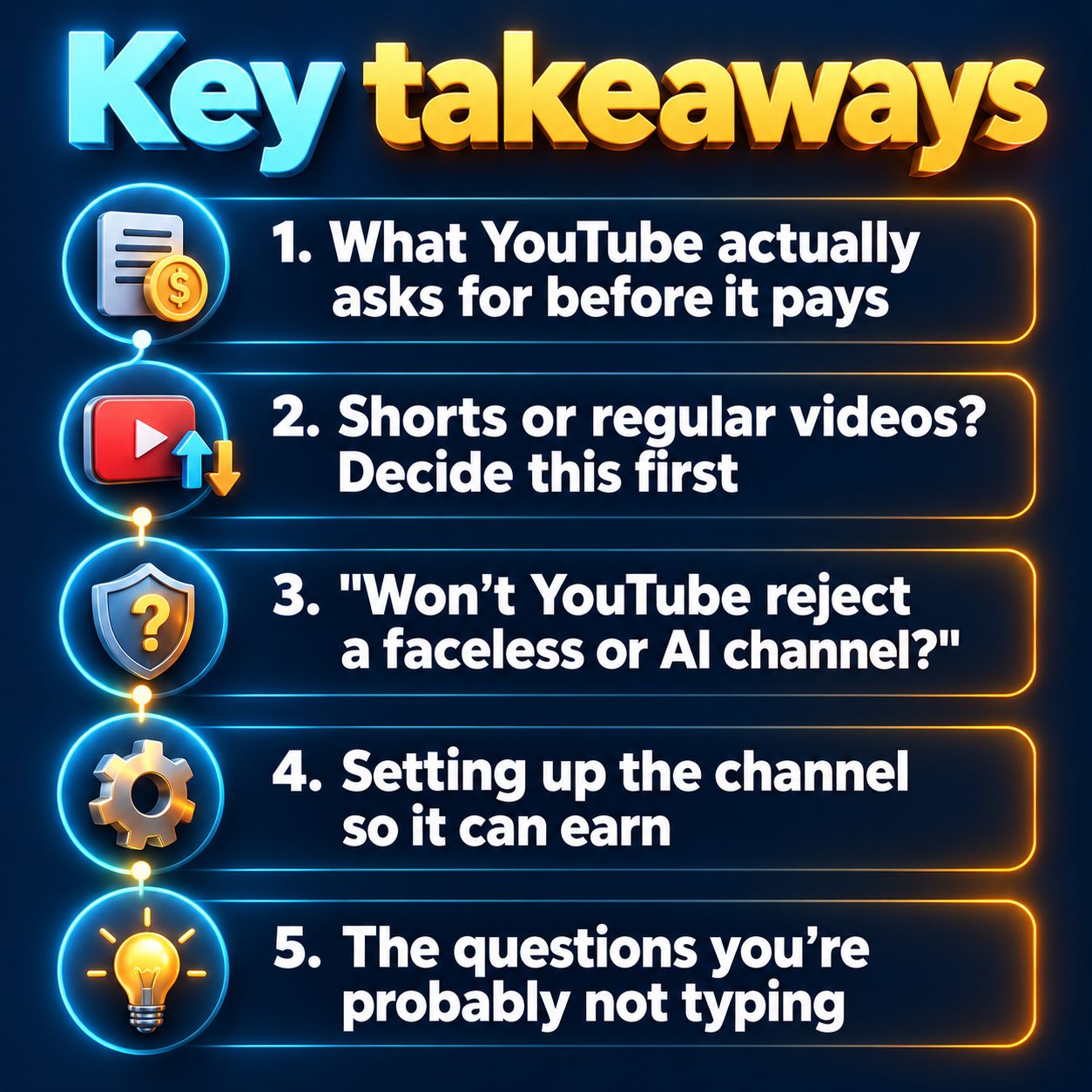
"Won't YouTube reject a faceless or AI channel?"
This is the fear I hear most, so here's a straight answer. No platform pushes a video down just because AI helped make it. YouTube ranks videos by how viewers behave: do they keep watching, finish, like, share? Faceless channels get into the Partner Program all the time.
What gets channels rejected is different. YouTube's inauthentic content policy targets mass-produced, repetitive videos: the same template with a few words swapped, uploaded over and over. When a reviewer looks at your channel, the real question is whether each video gives viewers something the one before it didn't.
Here's what a legit channel looks like:
- Every video has its own angle and its own payoff, not a reworded copy of the last one.
- You bring a point of view: a take, a ranking, a lesson, a story told your way.
- If a video shows realistic synthetic people or events, you turn on YouTube's disclosure setting. The label doesn't hurt reach. Skipping it can get videos removed.
And the honest limit: nobody can guarantee approval. Not a tool, not a course, not a guru. A human reviews your channel and makes the call. What you control is whether your videos look like a real channel or a content farm.
Setting up the channel so it can earn
The practical part is short, but the order matters.
- Pick a niche you could make videos about for a long time. Monetization takes a while, so choose a topic that never runs dry: history, stoic ideas, money basics, scary stories, startup lessons. If you're out of ideas after a handful of videos, it's the wrong niche. These faceless niches are a good place to start looking.
- Name the channel for the viewer, not for yourself. A stranger should be able to tell what they'll get.
- Fill in the About section and the banner. Reviewers look at the whole channel, not just one video.
- Verify your channel with your phone in YouTube Studio. That unlocks custom thumbnails, which matter in search and on your channel page.
- Decide your posting schedule and write it down. Daily Shorts, or three regular videos a week. A pace you can keep beats one that sounds impressive.
- List your first batch of topics before you upload anything. Then you're never stuck in front of a blank page on a tired evening.
One rule for every video: the first sentence has to earn the second. Weak openings sink more channels than bad niches do.
The questions you're probably not typing
Am I too late? No. Every niche keeps getting new viewers, and YouTube keeps showing new channels to people who haven't found a favorite yet. Someone who started last year has a head start. They don't own the niche.
What if I quit after two weeks? That's the real risk, much more than the algorithm. Channels rarely fail in some dramatic way. They just stop. More motivation won't fix it. Making each video take less effort will, until your schedule survives a busy week.
Will people judge me for using AI? People judge boring videos. A clear hook, a useful payoff and a voice they enjoy count for far more than how the video was made. And on a faceless channel, nobody even knows it's you.
Where the time really goes, and how to get it back
If you've tried this before, you know ideas aren't the problem. Production is. Script, voiceover, visuals, captions, editing, upload. Doing all that on a schedule next to a job is where most people give up.
That's the exact part MaqtAi takes off your plate. You give it a niche and a topic. It writes the script (hook first, payoff in the middle, one next step at the end), narrates it, creates moving visuals, adds animated captions and puts the video together. You can choose vertical for Shorts or 16:9 for regular videos, edit any line, publish straight to YouTube, or set a schedule and let it post for you. What it won't do: pick your niche, rescue a weak topic, or get you approved. Those calls are still yours.
Here's what waiting actually costs. Every week you spend deciding is a week with no watch hours adding up, no data on which hooks work, and someone in your niche posting again. The threshold doesn't get any closer while you plan. So take one small step today: pick your niche, write down one topic and make your first video. MaqtAi gives you free credits when you verify your email, no card needed, so trying costs you an afternoon and nothing else.
Doing this by hand is the part most people quit at. MaqtAi writes the script, narrates it, generates the visuals and captions, and assembles the faceless short for you. Verify your email and you get 450 free credits: about 3 videos on the still-frame tier, or one with AI motion. Free renders carry a watermark.
Try it on your niche freeFrequently asked questions
How long does it take to get monetized on YouTube? There's no fixed timeline. It depends on your niche, how consistently you post, and how well your videos hold viewers. Some channels get there in months and many take longer.
Can a faceless channel get monetized? Yes. Faceless channels can join the Partner Program as long as the videos are original and not mass-produced or repetitive. A human reviews every channel, so approval is never guaranteed.
Should I start with Shorts or regular videos? If income is the goal, regular videos usually earn more per view, and the watch-hours route is often easier to reach. Shorts are great for getting discovered, so many creators do both.
Do I need to record my own voice? No. Plenty of channels use AI narration. What matters is that the script is good, the voice is easy to listen to and the video delivers on its hook.
Results vary, and nothing here is a guarantee of income.