
Mistake 1: quitting before the algorithm has enough to work with
This is the big one, and it is quiet. Nobody announces they quit. They just post six videos, see flat numbers, and drift away.
Here is the thing to understand. Short-form platforms learn who your video is for by testing it on small pools of people and watching how they react. A handful of uploads is not enough signal. The account needs a steady stream of videos before the recommendation system can figure out your audience.
So the mistake is not really "bad content." It is stopping right before the data starts to add up. If you only have time to post twice this month, that is the actual problem to solve first, not your editing.
Mistake 2: chasing trends instead of committing to a lane
New creators think the goal is to jump on whatever is hot this week. The better question is whether you can keep producing in a lane for months without hating it.
A channel that posts scary stories one day, gym motivation the next, and finance tips after that confuses both the algorithm and the viewer. Nobody knows why they should follow you. Pick a niche you can go deep on. Scary stories, history, stoic motivation, true crime, bedtime and sleep content, startup stories, and the rest of the 19 niches in the picker all work as durable lanes because there is a near-endless supply of topics inside each one. If you want to see how creators pick and combine these, the use-cases page breaks down the common faceless niches.
Trends still matter. Ride them inside your lane, not across random ones.
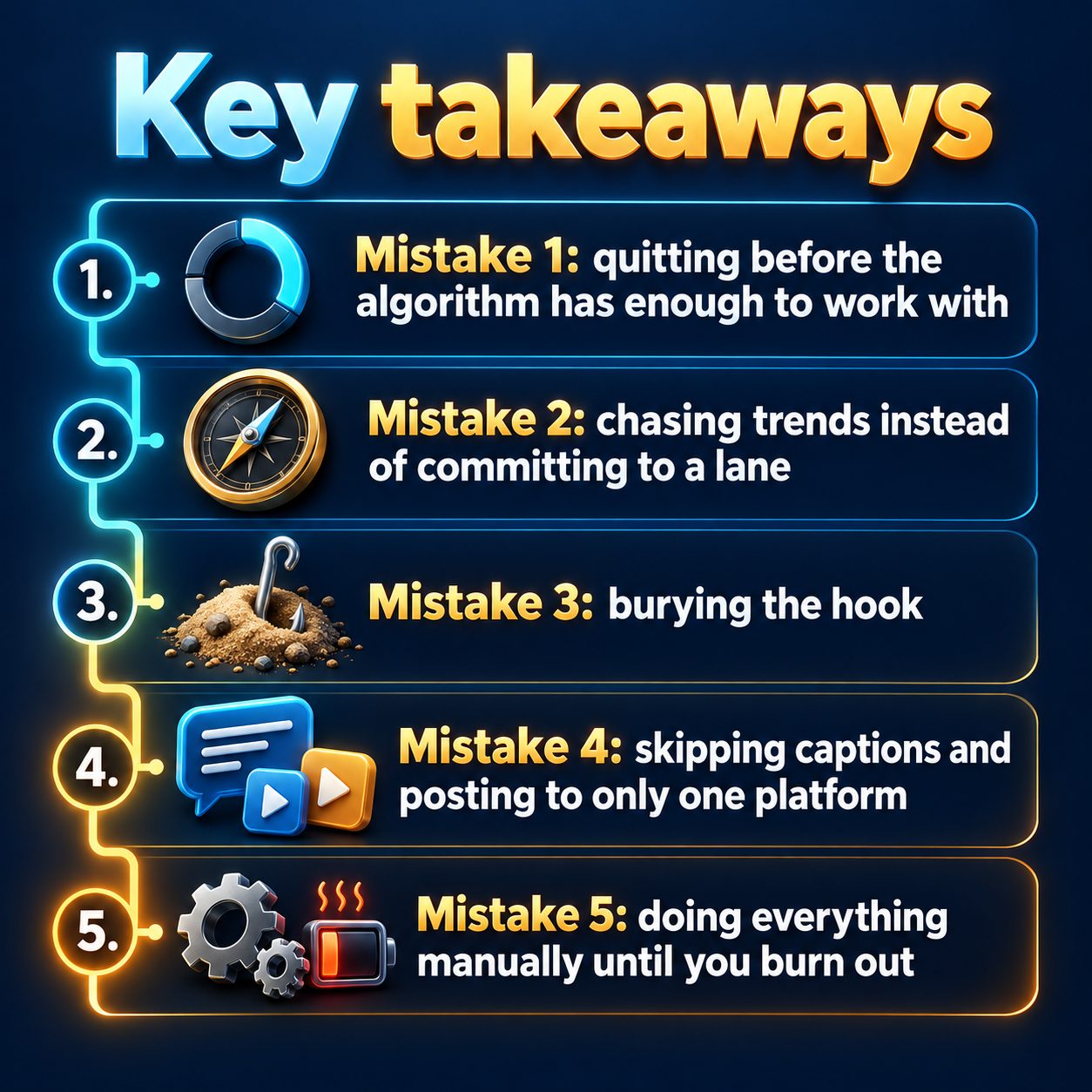
Mistake 3: burying the hook
Most faceless videos die in the first second because they start with a warm-up. "Hey guys, today I want to talk about..." is a scroll trigger.
Open with the payoff. State the wild fact, the disturbing detail, the surprising claim, the question the whole video answers. Then let the rest earn the watch. A good hook is a promise the viewer decides to cash in.
If writing hooks is not your strength, that is normal. It is a specific skill, and it is the single highest-leverage thing to get right. Study the first two seconds of videos that already blew up in your niche, screenshot the openers, and keep a swipe file. Patterns show up fast.
Mistake 4: skipping captions and posting to only one platform
A lot of people watch with the sound off, especially in public. If your video relies on the voiceover alone, you lose them. Animated captions keep silent viewers reading along, and they help the platform understand what your video is about.
The second half of this mistake is posting to one place. The same vertical video works on TikTok, Instagram Reels, and YouTube Shorts. Skipping two of the three throws away free distribution. A note on the real setup so you are not surprised later: Instagram Reels publishing through an API needs a Business or Creator account linked to a Facebook Page (Instagram documents this requirement here), and personal Instagram accounts cannot publish that way. Sort that out early so cross-posting is smooth instead of a Saturday-night headache.
Mistake 5: doing everything manually until you burn out
The honest reason most faceless channels stall is not talent. It is that scripting, finding footage, recording voiceover, editing, adding captions, and uploading is a lot of work for one short video. Do that daily and you will quit around week three. It is not weakness. It is math.
So either shrink the work or automate it. This is where a tool earns its place. MaqtAi takes a niche and a topic and produces the whole vertical video: it writes a hook-first script, narrates it with an AI voice, generates niche-matched visuals with optional AI motion, adds animated animated captions in 50-plus languages, and assembles a finished reel, usually in a few minutes. You review it or let it publish untouched. That turns "I have to make a video today" into a five-minute decision instead of a two-hour project.
The point is not that automation makes you lazy. It is that consistency is the whole game, and consistency is only sustainable when each video is cheap to produce.
Mistake 6: perfectionism before you have any data
New creators obsess over the highest-quality render, the perfect voice, the ideal length, all before a single video has been tested on real viewers. You cannot optimize what you have not shipped.
Start simpler and cheaper, watch which topics actually get watched, then pour effort into the winners. On that note, spending more does not always buy better results. Premium, realistic motion mostly helps people-heavy footage. Stylized art like anime, comic, or watercolor looks nearly identical on lighter settings, so paying up there is often wasted. MaqtAi's pricing and credit tiers show the real cost per option before you commit anything, and simpler videos genuinely cost fewer credits.
Mistake 7: no schedule, so posting depends on motivation
Motivation is unreliable. A schedule is not. The channels that grow are the boring ones that post on a fixed cadence whether the creator feels inspired or not.
Decide on daily, three times a week, or weekly, and build the machine to hit it. You can queue topics ahead of time and let them render and publish on a set rhythm. MaqtAi's Autopilot and scheduling features run a topic queue on the cadence you pick, and by default every finished video waits for your one-tap approval before anything goes out, so hands-free does not mean out of control.
Pick the cadence you can actually sustain. A weekly schedule you keep beats a daily one you abandon.
Doing this by hand is the part most people quit at. MaqtAi writes the script, narrates it, generates the visuals and captions, and assembles the faceless short for you. Verify your email and you get 450 free credits: about 3 videos on the still-frame tier, or one with AI motion. Free renders carry a watermark.
Try it on your niche freeHere is what waiting actually costs. Every week you spend deciding is a week your channel is not accumulating the watch-time data the algorithm needs, and it is a week a competitor in your niche is posting and getting a head start. The fix is not a big commitment. It is one video, shipped, so you can see the whole flow for yourself. Verifying your email gets you 450 free credits, about three or four watermarked videos on the still-frame Express tier, with no card required. Make the first one this afternoon and you will know more than any amount of planning could teach you.
Frequently asked questions
Is it too late to start a faceless channel? No. New niches and new formats keep opening up, and platforms keep pushing short-form. The people who feel "late" are usually comparing themselves to creators who simply started earlier and stayed consistent, which is a copyable advantage, not a closed door.
Will viewers judge me for using AI-generated content? Most viewers care whether the video is interesting, not how it was made. Faceless channels have worked for years without anyone showing a face. Focus on a strong hook and a topic people actually want, and the production method rarely comes up.
How many videos before I know if my channel works? There is no magic number, but a few uploads is not enough for the algorithm to learn your audience. Give it a consistent run over several weeks, watch which topics get watched, and lean into those.
Do I own the videos I make and can I monetize them? Yes. Videos you generate are yours to post, monetize, and use commercially on your own channels.
Results vary. Nothing here is a guarantee of income or growth.