
Why most cash cow channels quietly die
Here's the worry I hear most: "Isn't this saturated? Doesn't YouTube hate AI content?" It's a fair question, and the honest answer is more useful than a yes or a no.
YouTube doesn't punish a video for being faceless or AI-made. Shorts get ranked on how viewers behave: whether they keep watching, finish, like, share. What actually sinks cash cow channels is the lazy version of the model. That means the same template reused with the nouns swapped, near-identical uploads, and videos that feel stamped out of a factory. YouTube's monetization policies, covered in the Partner Program overview, specifically go after inauthentic, mass-produced, repetitive content. Channels built that way can hit the threshold and still get turned down.
So the problem isn't that the model's dead. The problem is that most people copy the shortcut and skip the substance. That's good news for you, because the substance is learnable.
Step 1: Pick a niche with a deep well
A cash cow niche isn't just "something that gets views." It's something you can keep making videos about for months without running dry or repeating yourself.
Try this quick test. Sit down for twenty minutes and list topics. If you fill a page easily and every idea is actually different, you've got a well. If you're scraping by the tenth idea, move on.
Niches that tend to pass: history (every era is a new season), scary stories, stoic motivation, startup stories, bedtime and sleep content. True crime and dark psychology pass too, but they need real sourcing and some taste. Sensationalizing real victims is how you lose both your audience and your standing with advertisers. If you want a broader list of faceless niches that work in short form, this overview of use cases is a good place to browse.
One more thing: pick something you won't be sick of by the second month. You'll be living in it.
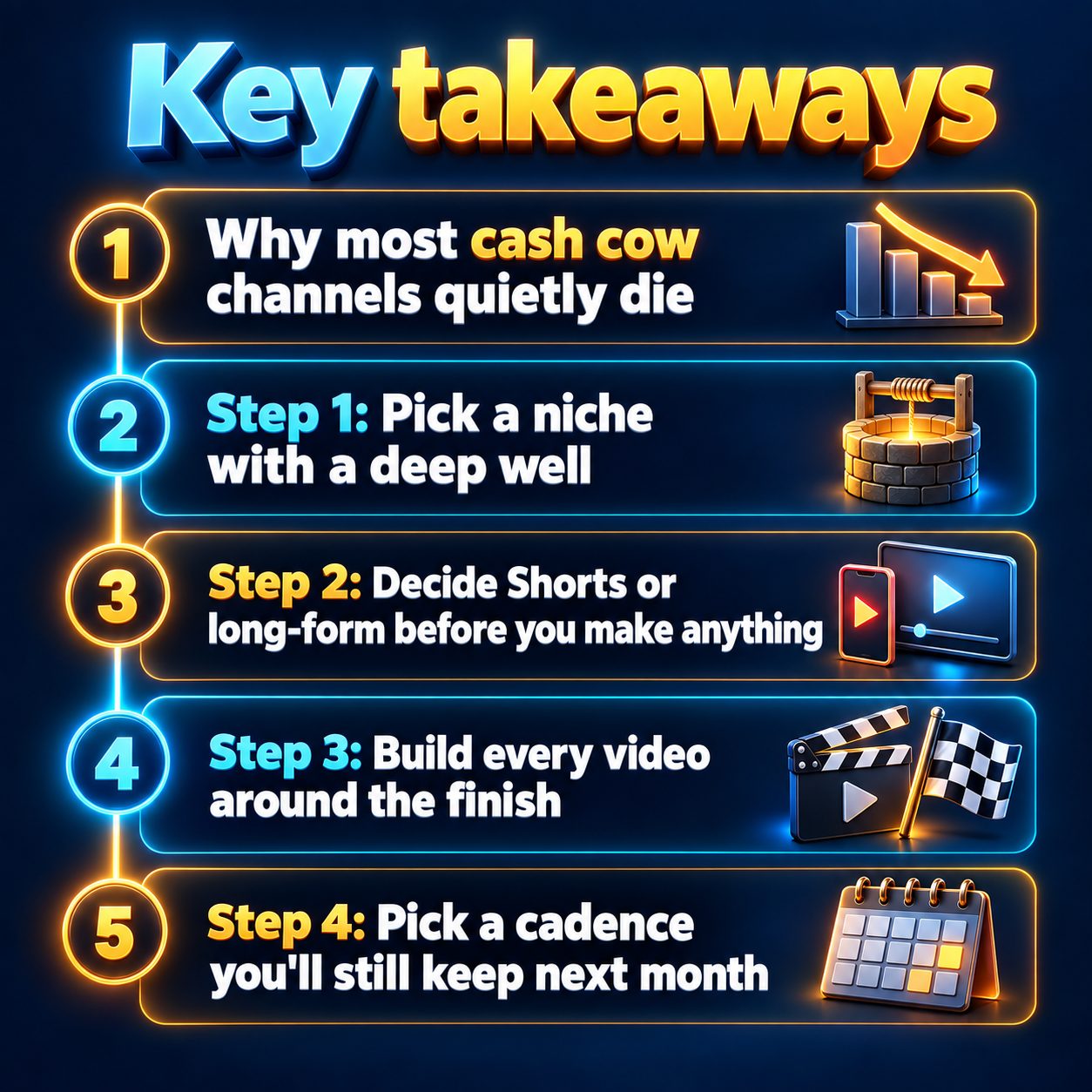
Step 2: Decide Shorts or long-form before you make anything
This is the uncertainty most people never untangle, and it changes everything downstream.
To join the YouTube Partner Program, you need 1,000 subscribers plus either 4,000 valid public watch hours in the last 12 months or 10 million valid public Shorts views in the last 90 days. For most new channels, the watch-hours path is far more reachable than the Shorts-views path. Regular videos also typically earn much more ad revenue per view than Shorts do.
Shorts are vertical or square and up to 3 minutes long. They're brilliant for discovery, because people find you through the feed. Longer horizontal videos are where watch hours pile up.
A sensible setup for a cash cow channel is to use Shorts to get found and longer videos to get paid. You don't need to do both on day one. Just know which path you're walking, so you aren't surprised later.
Step 3: Build every video around the finish
Faceless videos live or die in the first sentence. Nobody's there to see your face, so the words have to do all the work.
A structure that holds up:
- Hook first. Open on the most surprising claim or question. Skip "welcome back" and skip the intro.
- Set up a problem, then pay it off. Give the viewer a reason to wait, and actually deliver.
- End with one next step. A single follow-up thought, not a speech.
Keep captions on and readable, since plenty of people watch on mute. Cut every line that doesn't move the story forward. A tight 30-second Short that people finish beats a padded one they swipe away from.
Step 4: Pick a cadence you'll still keep next month
Here's the unspoken question: "What if I get excited, post for two weeks, and quit?" That's how most channels end. It's rarely a lack of talent. It's that the channel depends on your motivation every single day.
So pick a cadence you can keep even on a bad week. Daily is great if you can sustain it. Three times a week, kept for months, beats daily kept for a fortnight. Batch your work: write a week of topics in one sitting and produce them in one or two sessions.
This is also where tools earn their place. MaqtAi's Autopilot renders videos from a topic queue you manage, on a cadence you pick (daily, three times a week, or weekly). By default every finished video waits for your one-tap approval before anything goes out. The point isn't to hand your channel to a robot. It's to make your cadence stop depending on how you feel on a Tuesday.
What no tool can do for you
If your scam radar is pinging, good. Keep it on. Here's what no tool, course, or AI can honestly promise:
- It can't pick a niche people want. That's your call, and it's the biggest one you'll make.
- It can't guarantee views or monetization. Views come from the niche, the hook, and consistency. Approval for monetization is YouTube's decision.
- It can't replace your judgment. Read your scripts. Fact-check anything historical or true crime. Reject anything that feels generic.
Will people judge you for running an AI channel? Viewers judge boring, not tools. And if you use realistic synthetic footage, follow the platform's AI disclosure rules. The label doesn't hurt reach, but skipping it can get videos removed.
Am I too late? Every niche feels crowded from the outside. But audiences keep turning over, topics keep coming, and most channels quit early. The competition you're really up against is the version of you that keeps planning.
What waiting actually costs you
Every week you spend researching instead of posting is a week of data you don't collect. You don't learn which hooks land or which topics people finish, and YouTube gets no signal about who your videos are for. Meanwhile the channel you're worried about competing with posted again today.
The smallest useful step is to make one video in the niche you're leaning toward and watch it back honestly. With MaqtAi, verifying your email gives you 450 free credits with no card. That's roughly 3 to 4 videos on the still-frame default, or one with AI motion. Free renders are watermarked, so treat them as a test run, not your launch. A render typically takes about 6 minutes, and the pricing page shows exactly what each quality tier costs before you spend anything. By tonight you'd know whether this niche feels like yours.
Doing this by hand is the part most people quit at. MaqtAi writes the script, narrates it, generates the visuals and captions, and assembles the faceless short for you. Verify your email and you get 450 free credits: about 3 videos on the still-frame tier, or one with AI motion. Free renders carry a watermark.
Try it on your niche freeFrequently asked questions
Can a cash cow YouTube channel get monetized if it uses AI? Yes, if the content is original and varied. YouTube demonetizes mass-produced, repetitive content, not AI tools themselves, so make every video genuinely different and worth finishing.
Should a cash cow channel post Shorts or long videos? Most channels do best using Shorts for discovery and longer videos for watch hours. The watch-hours path to the Partner Program is usually more reachable than the Shorts-views path, and long-form typically earns more per view.
Do I need to show my face or record my voice? No. Faceless channels use AI narration, visuals, and captions, so you never appear on camera or record yourself.
How often should I post on a new channel? Post as often as you can keep up for months, not weeks. Three videos a week, kept up steadily, beats a daily burst that stops after two weeks.
Results vary, and nothing here is a guarantee of income.