
"But doesn't TikTok want faces?"
This is probably the worry that brought you here. Every creator you follow seems to talk into the camera, so it feels like faces must be the whole game.
They aren't. TikTok doesn't know or care whether a person is on screen. It watches what viewers do. Did they stop scrolling? Did they watch to the end? Did they rewatch, comment, share or follow? A calm voice over good footage does all of that just as well as a face. Sometimes it does better, because the viewer is paying attention to the story and not to whoever is telling it.
What a face really gives you is a shortcut to trust. Without one, you build that trust in other ways. You need a voice that sounds like it knows the subject. You need a consistent look, so people recognize your videos in the feed. And you need a topic narrow enough that someone thinks "oh, it's that account again" and follows.
So your niche isn't too different, and being camera-shy isn't a disadvantage. You just trade one kind of trust for another.
What faceless TikToks actually look like
You've seen far more faceless videos than you realize. Here are the common shapes:
- Narrated stories. Scary stories, history, true crime, strange facts. A voice tells the story while the visuals move underneath it.
- Explainers. Money basics, psychology, "why does this happen" content. The words carry the video and the images just support them.
- Screen recordings. Apps, software, games, spreadsheets. Your screen does the showing.
- Hands-only. Cooking, crafts, unboxing, drawing. The camera points at the work, never at you.
- Text and captions. Quotes, motivation, quizzes. You barely need a voice at all.
They all have the same backbone. A hook in the first line, a problem or question in the middle, a payoff before the viewer gets bored, and roughly 15 to 30 seconds for most of them. If you want to see which niches suit which format, the use cases page goes through a lot of them.
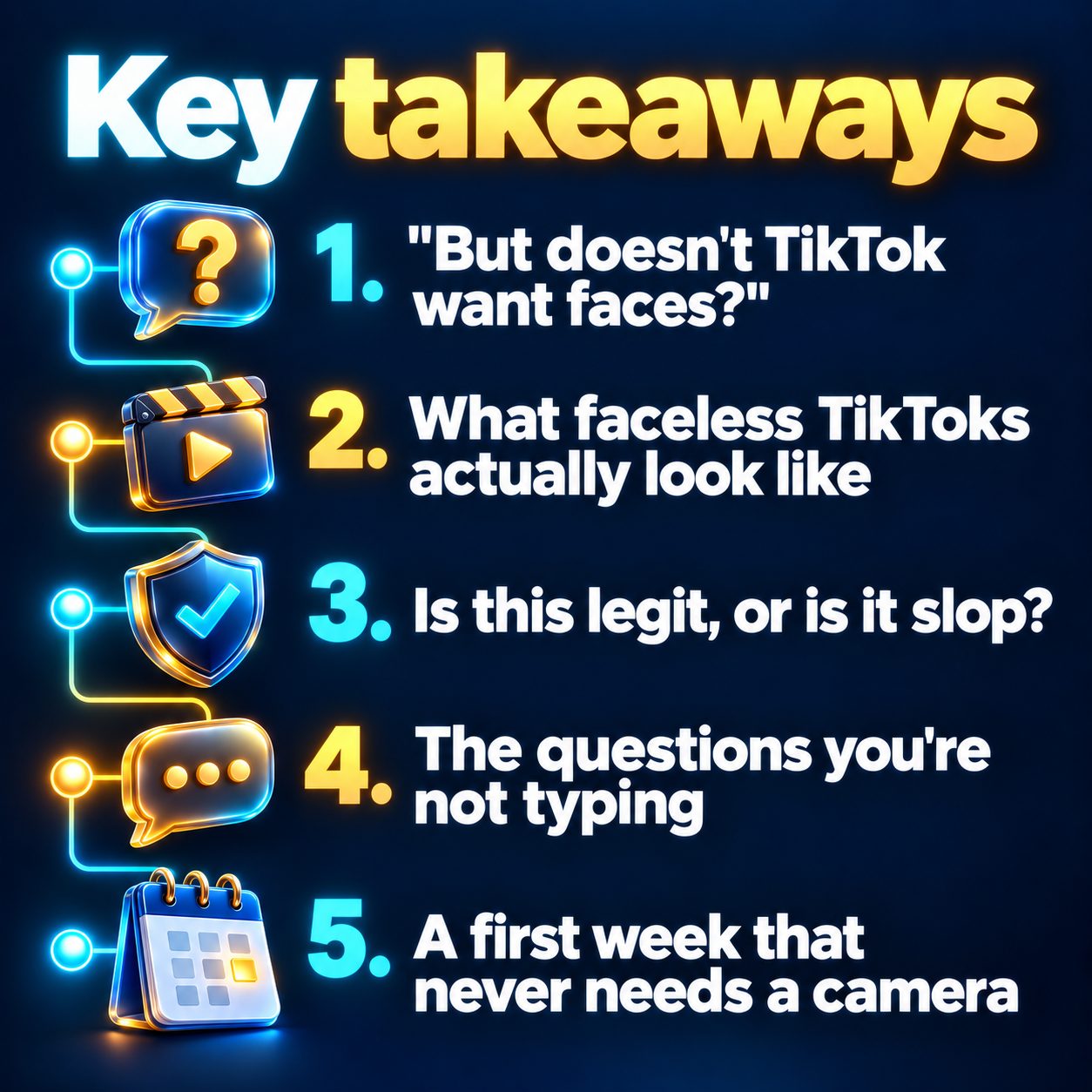
Is this legit, or is it slop?
Fair question. Your feed probably has a lot of low-effort faceless content in it, and you don't want to add to the pile.
Here's what TikTok actually requires. Content that's unoriginal or just reposted can be kept out of the For You feed under its For You feed eligibility standards. And realistic AI-generated content should carry the AI label, as TikTok explains in its AI-generated content guidance. The label doesn't bury your video. Skipping it is what can get you in trouble.
The slop problem isn't really about faces or AI either. It's about videos with nothing to say: the same template, the same facts everyone else posts, no reason to watch to the end. A faceless account with a real point of view is fine. A faceless account that copies other people's clips isn't, and TikTok treats those two very differently.
No tool fixes a boring idea, and that includes the one I'll mention later. The honest test is simple: would you watch this if someone else posted it?
The questions you're not typing
"Will people I know find out?" Only if you tell them. Use a channel name that isn't yours, a separate email, and don't sync your contacts. Plenty of people run faceless accounts that their coworkers never find.
"Do I have to use my voice?" No. You can write on-screen text, use TikTok's built-in text-to-speech, or use an AI narrator. Your own voice is an option, not a requirement.
"Will people judge me for it?" The viewers who stick around are judging the video, not how it was made. The comments you'll actually get are about the story.
"Am I too late?" New viewers show up every day, and the feed isn't first come, first served. What's late is waiting another month to post your first video.
"What if I quit after two weeks?" Most people do, and usually it's because editing ate their evenings, not because the idea was bad. So pick a setup that's light enough to keep going with on a tired Tuesday.
A first week that never needs a camera
Here's how I'd start if I were camera-shy and starting from zero:
- Pick one niche you could talk about for months. You want something narrow enough to be recognizable. "Weird history" is better than "interesting stuff."
- Write ten hooks before you make anything. One sentence each. The hook is the part that decides whether anyone watches.
- Choose one format and one look. Same voice, same caption style, same pacing. Being consistent is how a faceless account becomes recognizable.
- Post once a day for the first week. Don't read the numbers yet. You're collecting data about which hooks keep people watching.
- At the end of the week, keep the best hook pattern and drop the weakest one.
The step that kills most people is the production in the middle: finding footage, recording voiceover, timing captions. This is where MaqtAi comes in. You give it a niche and a topic, and it writes the script (hook first, payoff, one next step), narrates it with an AI voice, generates moving visuals, adds animated captions and puts together a vertical video. You never appear on camera and never record your voice. On a paid plan it can publish straight to TikTok once you've connected your account. On the free tier you download the video and post it yourself.
Be honest about what it doesn't do. It doesn't pick trending topics for you. It doesn't make a weak hook strong. It doesn't guarantee views. The niche, the hook and showing up every day are still your job.
What waiting actually costs
Every week you don't post is a week where TikTok learns nothing about your account. You find out nothing about which hooks work. You don't get a single follower who might remember you. Meanwhile someone in your niche posted seven times this week, and nobody saw their face either.
You don't need to decide your whole channel today. You only need one video, to see whether this feels doable. MaqtAi gives you free credits when you verify your email, with no card needed. That's enough for a few test videos on the default still-image style, or one with AI motion. They come with a watermark, so treat them as a trial run and not your launch. The details are on the pricing page. One afternoon is enough to find out whether faceless posting fits you.
Doing this by hand is the part most people quit at. MaqtAi writes the script, narrates it, generates the visuals and captions, and assembles the faceless short for you. Verify your email and you get 450 free credits: about 3 videos on the still-frame tier, or one with AI motion. Free renders carry a watermark.
Try it on your niche freeFrequently asked questions
Is it against TikTok's rules to never show your face? No. Nothing in TikTok's rules requires you to appear on camera. What it does limit is unoriginal or reposted content, and realistic AI content needs to be labeled.
Do faceless TikTok videos get fewer views? TikTok ranks videos by how viewers behave, like watch time, rewatches and shares, not by whether a face is on screen. Weak hooks and copied content hurt reach. Being faceless doesn't.
Can I post faceless TikToks without using my own voice? Yes. On-screen text, TikTok's text-to-speech, or an AI narrator all work, and plenty of accounts never use a real voice.
Should I label AI-made faceless videos on TikTok? If the content is realistic AI-generated media, yes. TikTok asks you to label it, and the label is safer than skipping it.