
"But don't you need to show your face to grow?"
This is probably the most common objection, and it made sense ten years ago when YouTube was mostly vlogs and talking heads. It does not hold up anymore.
Think about channels you have watched recently. Chances are, several of them never showed a creator's face. Channels covering topics like space facts, historical mysteries, scary stories, psychology breakdowns, and motivational content routinely pull millions of views with nothing but narration over visuals. The format is not a workaround. It is a legitimate content style that audiences actively prefer in certain niches because the visuals and storytelling carry the experience.
YouTube's algorithm does not care whether your face appears. It cares about click-through rate, average view duration, and engagement signals like likes, comments, and shares. A faceless video with a strong hook and good retention will outperform a face-on-camera video that loses viewers after three seconds. Every time.
So no, you do not need to show your face. You need to show up with content worth watching.
Which niches actually work without a face?
Not every topic suits the faceless format equally, so this is worth being honest about. Niches that rely on visual storytelling, curiosity, or emotional resonance tend to perform best. Here are categories where faceless channels consistently thrive:
- Scary stories and true crime (narration over atmospheric visuals)
- History and mythology (illustrated timelines, maps, archival imagery)
- Stoic motivation and dark psychology (text-driven with powerful voiceover)
- Science and space (explainer format with graphics)
- Startup stories and business lessons (case-study storytelling)
- Bedtime and sleep content (ambient, calming narration)
- Comic stories (illustrated panels with voiceover)
The list goes on. There are over 40 proven faceless niches that creators run profitably right now. The common thread is that the content itself is the star, not the creator's personality.
If your niche is something highly personal, like daily vlogs or "day in my life" content, then yes, face-on-camera is probably better. But if your content is built around information, stories, or ideas, faceless is not a compromise. It is often the stronger format.
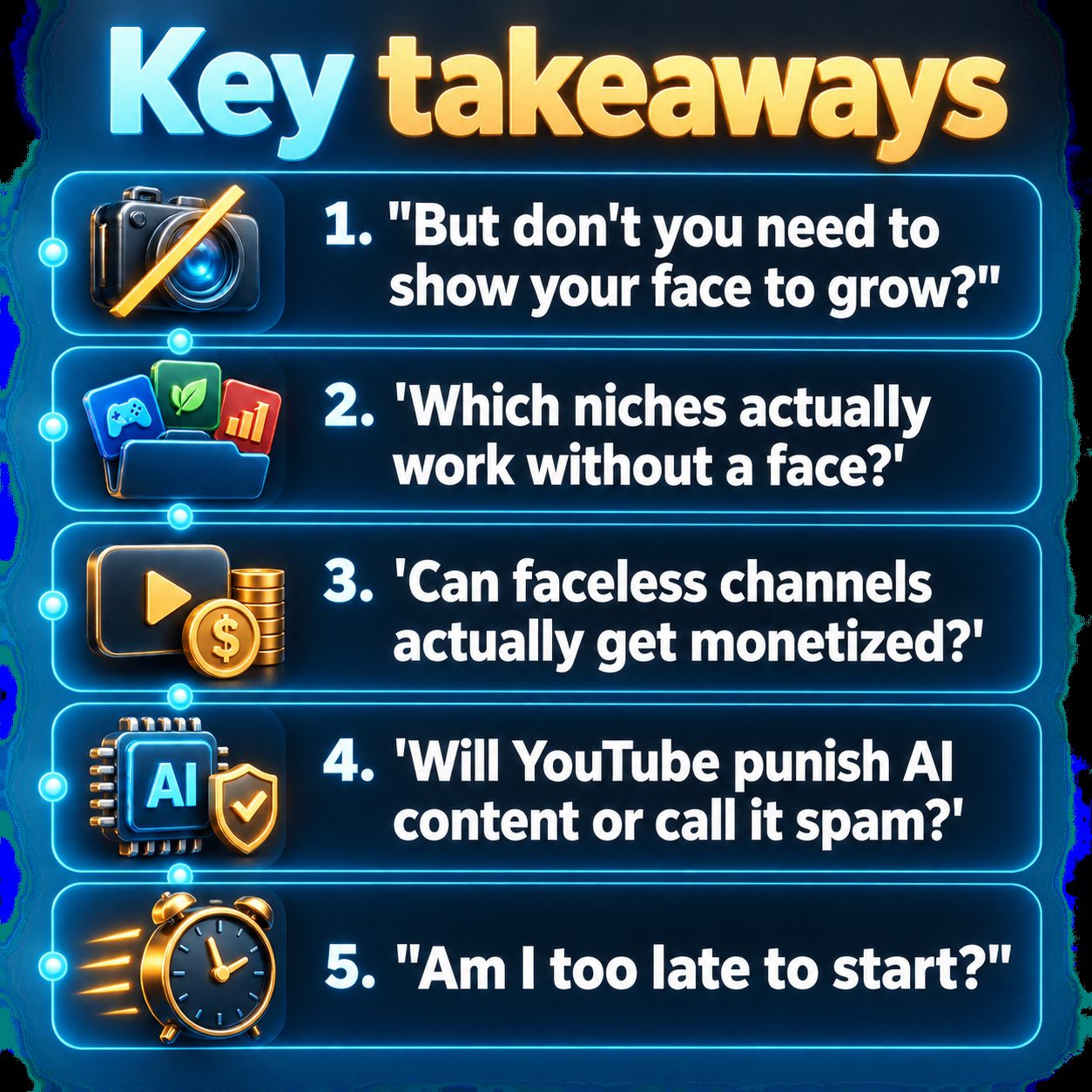
Can faceless channels actually get monetized?
This is the real question behind the question. "Successful" usually means "making money."
YouTube's Partner Program requirements are the same for every channel: 1,000 subscribers and either 4,000 watch hours (long form) or 10 million Shorts views in 90 days. Faceless channels are eligible on exactly the same terms as any other channel. YouTube does not have a separate policy that penalizes or excludes faceless content.
Beyond AdSense, faceless channels often monetize through affiliate links in descriptions, digital product sales, sponsorships (yes, brands sponsor faceless channels), and by running multiple channels simultaneously. Because you are not tied to being on camera, scaling to two or three channels across different niches becomes realistic.
The key metric is consistency. A channel posting daily or near-daily accumulates watch time and subscriber momentum far faster than one posting weekly. This is where most aspiring creators stall, not because the format fails, but because keeping up with production is exhausting when you are scripting, recording, editing, and uploading everything manually.
Will YouTube punish AI content or call it spam?
Let's address this directly because the worry is valid.
No platform down-ranks a video just for being AI-made. YouTube, TikTok, Instagram, and Facebook rank Shorts by viewer behavior: watch time, completion rate, likes, and shares. Not by production method. YouTube's own AI content guidelines focus on disclosure of realistic synthetic media (like deepfakes), not on whether you used AI tools to create visuals or voiceover.
What does get punished is spam behavior: uploading identical files across many accounts, mass-posting near-duplicate content, or misleading thumbnails. That is true for any channel, AI or not.
Honest limits matter here. AI-generated content is not a magic shortcut to millions of views. A poorly scripted, generic video will flop whether a human or an AI made it. The tool does not replace good taste and topic selection. It replaces the tedious production work so you can focus on those higher-level decisions.
"Am I too late to start?"
You are asking this question while someone else is posting their first video today. Short-form content on YouTube Shorts, TikTok, and Instagram Reels is still growing. The platforms are actively pushing short-form because it keeps users on the app, which means the algorithm is hungry for new content to serve.
There is no finish line where all the niches are "taken." Audiences grow, new angles emerge, and creators who posted two years ago quit all the time. The real disadvantage of waiting is not that the opportunity disappears. It is that every day you do not post is a day the algorithm has zero data about your channel. Growth compounds. The channel you start today and post to daily for three months will have a meaningful head start over the one you start in January.
How to actually start (without burning out in week two)
The reason most faceless channels fail has nothing to do with the format. It is production fatigue. Writing a script, finding or creating visuals, recording voiceover, syncing captions, editing the timeline, and exporting takes hours per video. Multiply that by daily posting across multiple platforms, and burnout is almost guaranteed.
This is where modern AI video tools change the math. Instead of spending your afternoon editing, you spend it choosing topics and reviewing output.
MaqtAi was built specifically for this workflow. You pick a niche and a topic, and the AI writes a hook-first script, generates matching visuals with real motion, narrates with a realistic AI voice, adds animated captions, and assembles a publish-ready vertical video. You review it, tweak anything you want, and auto-publish to TikTok, Instagram Reels, and YouTube Shorts on a schedule you set. No filming. No editing software. No voice recording.
The part that matters most for consistency: Autopilot lets you load a queue of topics, pick a cadence (daily, three times a week, or weekly), and the system renders and publishes on schedule, with an approval step so nothing goes live without your review. It turns "I need to make a video today" into "I need to approve the video that is already waiting."
The expensive choice is not starting. It is staying stuck.
Every week you spend researching whether faceless channels work is a week your channel does not exist. No watch hours accumulating. No algorithm data building. No subscriber count growing. Meanwhile, someone in your exact niche is posting their seventh video this week.
The smallest possible step is making one video. MaqtAi gives you free credits when you verify your email, enough for a few videos, no card required. Pick a niche, pick a topic, and see what comes out. If it is not for you, you spent an afternoon. If it clicks, you have your first piece of content live before dinner.
Doing this by hand is the part most people quit at. MaqtAi writes the script, narrates it, generates the visuals and captions, and assembles the faceless short for you. Verify your email and you get 450 free credits: about 3 videos on the still-frame tier, or one with AI motion. Free renders carry a watermark.
Try it on your niche freeFrequently asked questions
Do faceless YouTube Shorts get monetized the same as regular videos? Yes. YouTube does not distinguish between faceless and face-on-camera content for monetization eligibility. You need the same subscriber and view thresholds, and ad revenue is calculated the same way based on your audience and niche.
Can I run multiple faceless channels at once? Absolutely. This is one of the biggest advantages of faceless content. Because you are not the on-screen talent, you can run channels in completely different niches simultaneously. MaqtAi lets you connect multiple accounts and manage several series in parallel.
Do I need to disclose that my videos are AI-generated? YouTube asks creators to disclose realistic synthetic media, meaning content that could be mistaken for real footage of real people or events. Stylized, illustrated, or clearly narrated explainer content typically does not trigger this requirement, but when in doubt, label it. The disclosure label itself does not reduce your reach.
What if I run out of video ideas after a few weeks? Topic selection is the one skill faceless creators genuinely need to develop. Start with proven angles in your niche, pay attention to what your audience engages with, and iterate. MaqtAi's My Brand page helps you develop topics into angles and hooks, so you always have a queue of ideas ready to go.
Results vary by niche, content quality, posting consistency, and audience. Nothing in this article is a guarantee of income.