
YouTube has never required your face
This is the single biggest misconception about YouTube monetization. YouTube's Partner Program does not evaluate whether you appear on camera. It never has. The eligibility criteria are about your channel's audience metrics, not your production style.
Think about the channels you actually watch. Compilation channels, animated explainers, nature documentaries, narrated top-ten lists. Many of the most successful creators on the platform never show their face. Some of the largest channels in categories like scary stories, history deep dives, and motivational content are entirely faceless.
YouTube cares whether people watch. It does not care how you made the video.
What YouTube actually requires for monetization
YouTube runs two tiers of its Partner Program. The full program requires 1,000 subscribers plus either 4,000 valid public watch hours in the past 12 months or 10 million valid public Shorts views in the past 90 days. A lower tier for fan-funding features opens at 500 subscribers with either 3,000 watch hours or 3 million Shorts views over the same periods.
Notice what is not on that list: face visibility, voice origin, or production method. A faceless channel with narrated visuals hits those thresholds the same way any other channel does, by building an audience that watches consistently.
The practical takeaway? Your path to monetization is identical whether you film yourself talking or publish narrated content you never appeared in. Post consistently, keep people watching, and grow subscribers.
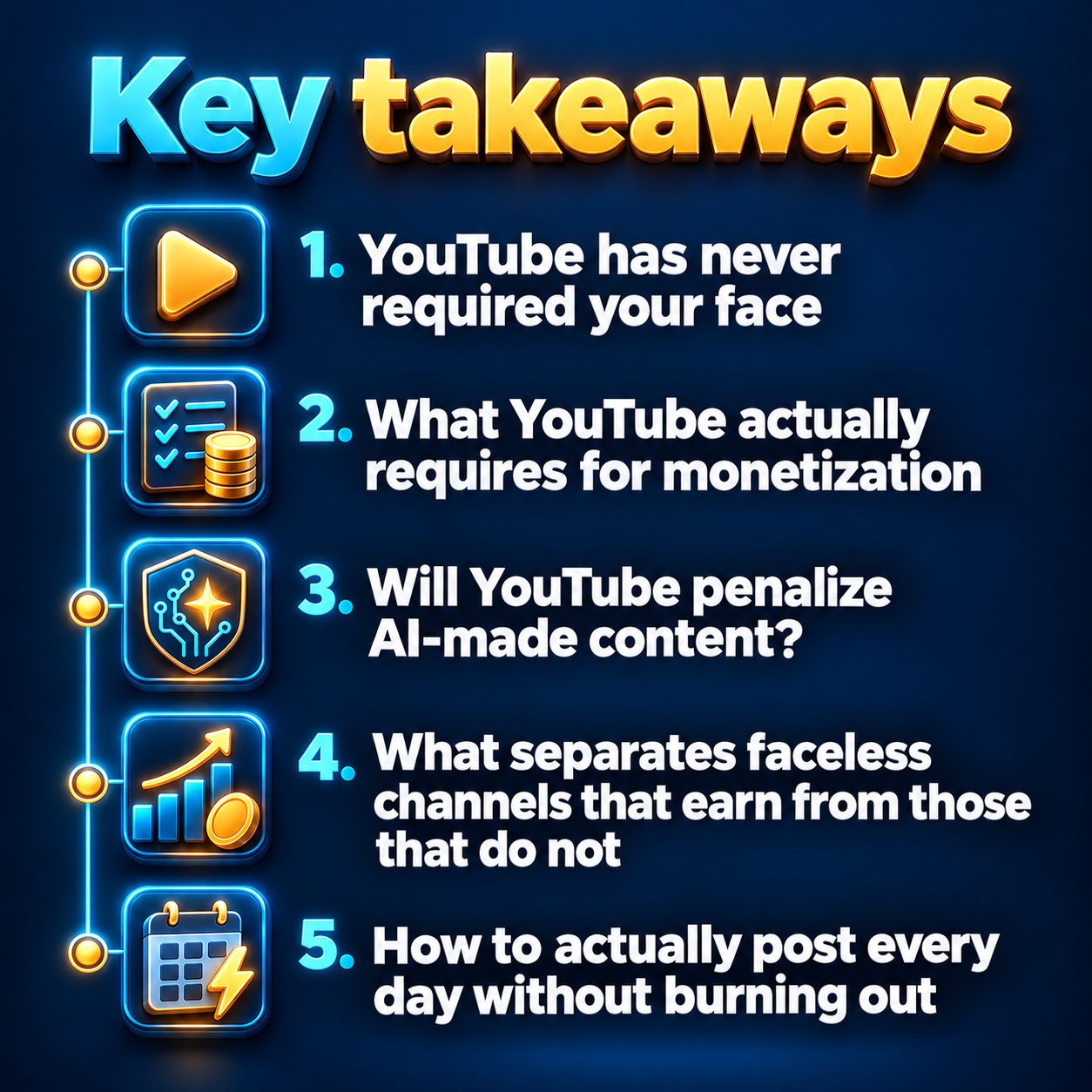
Will YouTube penalize AI-made content?
This is the real worry behind the question, and it deserves a straight answer.
YouTube does not down-rank videos for being AI-generated. Their ranking system is built around viewer behavior: watch time, click-through rate, likes, shares, and session time. The algorithm measures whether viewers enjoy the content, not how it was produced.
YouTube does require creators to disclose when realistic synthetic media depicts real people or events. That disclosure label itself does not reduce your reach. Skipping it when it applies risks removal, so use it when appropriate.
What will actually hurt a faceless channel is the same thing that hurts any channel: weak hooks, repetitive scripts, or spam patterns like uploading near-identical videos across multiple accounts. The production method is not the problem. Boring content is.
What separates faceless channels that earn from those that do not
Monetization eligibility is a threshold. Getting there is about volume, consistency, and the quality of the content itself. Here is what actually matters:
Niche selection. Some niches have naturally higher watch times. Scary stories, true crime, dark psychology, and history tend to keep viewers engaged because the content is narrative-driven. Motivation and stoic philosophy perform well in Shorts because they deliver a complete thought in under a minute.
Posting frequency. The channels that reach monetization fastest are the ones posting daily or near-daily. Each video is a data point for the algorithm and another chance to surface in recommendations. Posting once a week is fine, but it means a longer runway to those subscriber and watch-hour thresholds.
The first three seconds. YouTube measures how quickly viewers scroll past. A strong opening hook matters more than any other production element. Your first line should create a question or tension the viewer needs resolved.
Watch time per video. For long-form, YouTube rewards videos people finish. For Shorts, completion rate is everything. Tight scripting that eliminates dead air keeps viewers watching through.
None of these require showing your face. They require good content, posted often.
How to actually post every day without burning out
This is where most aspiring faceless creators stall. They understand the strategy. They know consistency wins. But scripting, finding visuals, editing, adding captions, and publishing across platforms takes hours per video. Doing that daily while holding a job is not realistic for most people.
That is exactly the bottleneck tools like MaqtAi are built to remove. You pick a niche and topic. The AI handles the script, voiceover, visuals with real motion, animated captions, and even auto-publishing to YouTube Shorts, TikTok, and Instagram Reels on a paid plan. The whole process takes a few minutes instead of hours, across 19 faceless niches including scary stories, history, true crime, stoic motivation, and more.
The point is not that AI does the creative thinking for you. You still choose your niche, shape your topics, and review what gets posted. The point is that the production bottleneck disappears, so you can actually post at the frequency the algorithm rewards.
The real cost of waiting
Every day you are not posting is a day your channel has zero data in YouTube's system. No impressions, no watch time, no algorithmic learning about your audience. The creators who will cross monetization thresholds six months from now are the ones who start this week.
You do not need to figure everything out first. You need to publish your first few videos, see what resonates, and adjust from there.
If you have been researching faceless content but have not posted anything yet, make today the day that changes. MaqtAi gives you 450 free credits when you verify your email, enough for three or four watermarked still-frame videos on the Express tier, no card required. That is enough to test a niche, see the quality for yourself, and decide if daily posting fits your life before you spend a dollar.
Doing this by hand is the part most people quit at. MaqtAi writes the script, narrates it, generates the visuals and captions, and assembles the faceless short for you. Verify your email and you get 450 free credits: about 3 videos on the still-frame tier, or one with AI motion. Free renders carry a watermark.
Try it on your niche freeFrequently asked questions
Does YouTube pay less for faceless or AI-made content? No. Ad revenue is determined by your niche's CPM, your audience demographics, and advertiser demand. The production method does not affect how much you earn per view.
Do I need to disclose that my videos are AI-generated? YouTube requires disclosure when content contains realistic altered or synthetic media that could be mistaken for real footage of real people or events. Stylized, narrated, or clearly illustrated content typically does not trigger this requirement, but when in doubt, disclose. The label does not hurt your reach.
Is it too late to start a faceless YouTube channel? No. New faceless channels gain traction regularly because YouTube recommends individual videos, not entire channel histories. A strong video published next week has the same chance of being surfaced as one from a channel that started years ago. The algorithm does not penalize newcomers.
Can I run a faceless channel in a language other than English? Yes. Many faceless niches perform well globally, and non-English markets often have less creator competition. AI video tools now support dozens of languages for voiceover and captions, making it practical to publish in markets that English-heavy creator pools underserve.
Earnings vary by niche, audience, and consistency. Nothing in this article is a guarantee of income.