
"But people buy from people." Mostly true, with a catch
This is the first thing most business owners say, and they're not wrong. People want to know who they're buying from. But on TikTok, trust rarely comes from a face. It comes from three things. The video is useful. It's specific to you. It shows something real.
A faceless video handles the first two well. A clip that explains why a customer's sourdough keeps going flat builds more trust for a bakery than a smiling owner saying "come visit us." The third part is your job. Use real photos of your product, your storefront, your finished work. That's what makes a faceless account feel like your business and not a generic content farm.
Here's the honest exception. If you are the product, faceless is the weaker choice. That covers coaches, consultants, personal trainers and anyone whose clients are hiring their personality. You can still use faceless videos for education, but somewhere down the line people will want to see or hear you. For a shop, a service business, a local trade or an online store, faceless works fine. The product is the star anyway.
The faceless formats that actually fit a business
Forget "brand awareness" videos. Nobody watches those. These formats earn attention because they give the viewer something:
- The customer question. Every business hears the same questions over and over. Each one is a video. A plumber: "The thing you should never pour down your kitchen sink." A florist: "Why your roses droop the day after you buy them."
- The myth-bust. Correct something your customers wrongly believe. It hooks people because it challenges what they think they know.
- The behind-the-product story. How something is made, sourced or fixed. Narration over footage or visuals, no presenter needed.
- The mistake video. "The mistake people make when choosing a wedding cake." It's useful, a little urgent, and it positions you as the one who knows better.
- The presenter-style ad. When you do want a person talking about your offer, you can use a stock AI presenter or a narrated product walkthrough. Save this for your actual promotions, not every post.
Match the video to the question in your customer's head, not to what you want to announce. If you want more angles for your type of business, browse some use cases and see which format fits your trade.
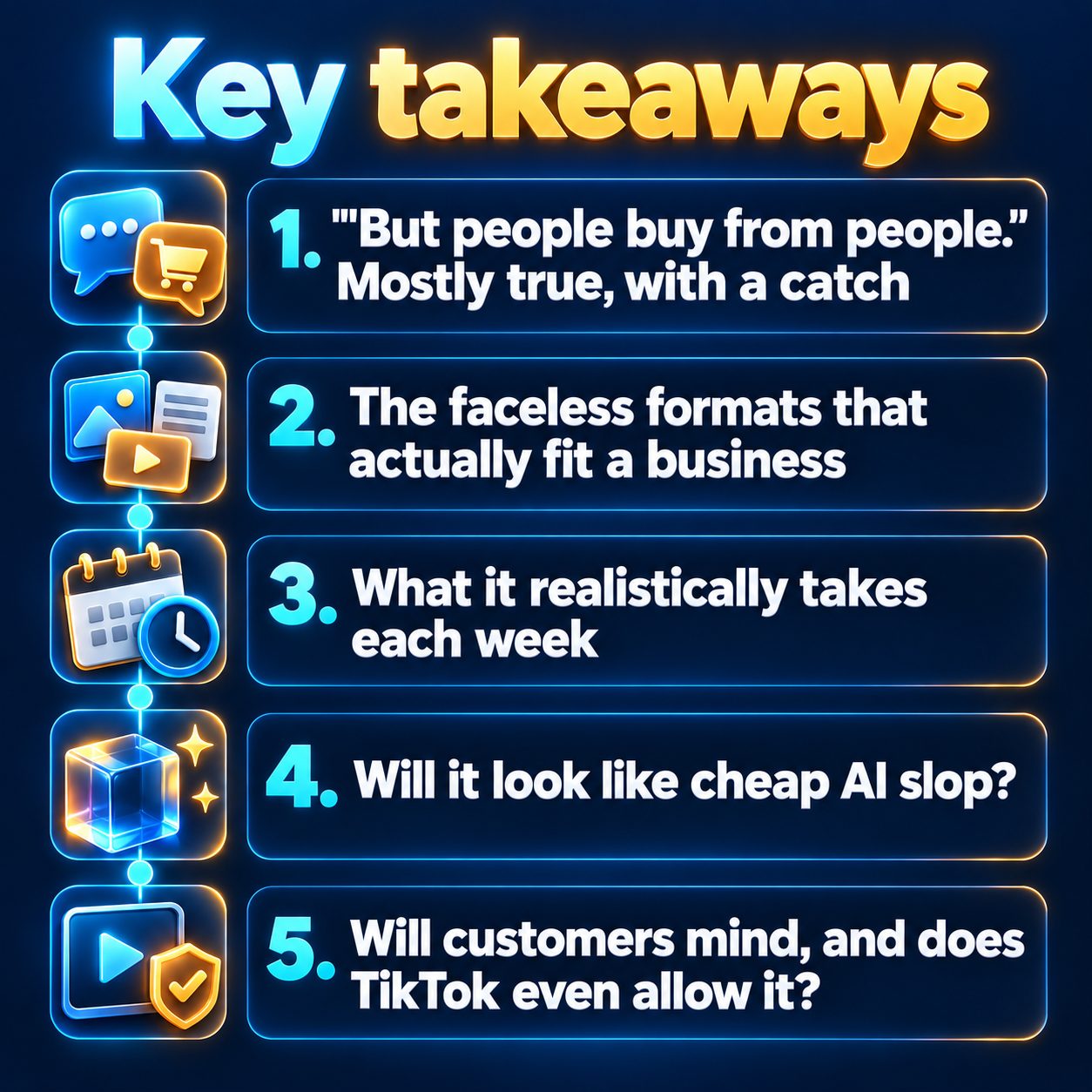
What it realistically takes each week
This is the part nobody can judge alone. So here's the plain version.
The work isn't the editing. It's the topics. Sit down once and list every question customers ask you, every complaint you hear about competitors, every "I wish people knew" thought. That list is months of videos.
For cadence, pick something you can hold. Posting three times a week for months beats posting daily for two weeks and then vanishing. TikTok needs a steady stream of videos to figure out who your viewers are. A burst followed by silence teaches it nothing.
Keep each video short, around 15 to 30 seconds for most business topics. Open with the problem in the first sentence. Answer it. End with one next step, like "save this" or "our shop is on the link." That's the whole structure.
Will it look like cheap AI slop?
Your scam radar is right to go off here. A lot of faceless content is bad. You can spot it in seconds: a generic topic, a static slideshow, a flat robotic voice, and the same video recycled with a new title.
What separates a decent faceless business account from slop is specificity. "Tips for healthy hair" is slop. "Why hard water in our town is wrecking your blonde" is a real salon talking to real locals.
Now the limits, because they matter. No AI tool knows your prices, your area, your process or what makes you different unless you tell it. It won't fix an unclear offer. And it won't make a boring topic interesting. Views come from the hook, the topic and the consistency. The tool only removes the filming and editing. If your videos flop, the fix is almost always a sharper first line or a better question, not a different app.
Will customers mind, and does TikTok even allow it?
TikTok doesn't push a video down just because AI made it. It ranks videos by viewer behavior: how long people watch, whether they finish, like and share. What hurts reach is spam, like near-identical videos posted in bulk, or weak opening seconds.
There's one real rule to follow. TikTok expects realistic AI-generated content to be labeled. The label itself doesn't cut your distribution. Skipping it on realistic synthetic media is what risks removal. Turn the label on when it applies and move on.
As for customers judging you, people don't mind the tool. They mind being misled. So don't have an AI presenter pose as a happy customer, and don't invent reviews. Use AI to explain, demonstrate and answer questions, and nobody feels tricked. Plenty of viewers won't notice or care, because the video helped them.
The real risk is quitting in week two
The unspoken question is usually "what if I start this and give up?" Or its cousin, "am I too late?" You're not too late. Your competitors are local or niche, not the whole internet, and most of them still aren't posting consistently. The real risk is stopping.
Business owners quit because making each video eats an evening. So remove that step. A simple four-week plan looks like this. In week 1, write your question list and make your first few videos. In weeks 2-3, post on your chosen cadence and watch which topics people finish. In week 4, make more of whatever held attention and drop what didn't.
This is where a tool like MaqtAi fits. You give it a topic, and it writes the script with a hook first, narrates it with an AI voice, generates visuals with real motion, adds animated captions and builds the vertical video. On a paid plan it can post directly to TikTok, and it can also front your promotions with a stock presenter. It has scheduling tools too, which you can read about on the features page. One honest caveat: its Autopilot can't auto-post to TikTok yet, so TikTok videos wait in an approval queue for your tap.
Here's what waiting costs you. Every week you don't post, TikTok learns nothing about who your customers are. A competitor who answers those same questions gets there first. Your list of good topics just sits in your head.
So take one small step. Pick your single most-asked customer question and turn it into a video today. MaqtAi gives new users free credits when they verify their email, with no card needed. That's roughly 3 to 4 videos on the default still-frame style, or one with AI motion. Free videos carry a watermark, so treat them as a test of whether the format suits your business before you spend anything. The details are on the pricing page.
Doing this by hand is the part most people quit at. MaqtAi writes the script, narrates it, generates the visuals and captions, and assembles the faceless short for you. Verify your email and you get 450 free credits: about 3 videos on the still-frame tier, or one with AI motion. Free renders carry a watermark.
Try it on your niche freeFrequently asked questions
Will a faceless TikTok hurt my brand's credibility? Not if the videos are specific and useful. Credibility drops when content is generic or misleading, not when your face is missing. Show your real product or work and people will connect it to your business.
How often should a small business post faceless TikToks? Pick a cadence you can keep for months. A few times a week is a sensible start. Consistency matters more than volume, because TikTok needs steady posting to learn who your audience is.
Can I use an AI presenter instead of appearing myself? Yes, and it's a good fit for promotions and product ads. Just don't present an AI person as a real customer, and label realistic AI content the way TikTok expects.
Do I have to label AI videos on TikTok? TikTok expects realistic AI-generated content to be labeled. The label doesn't reduce reach, but skipping it on realistic synthetic media can get a video removed.
Results vary by business, and nothing here is a guarantee of sales or income.