
YouTube cares about the video, not the tool that made it
There is no policy anywhere that says "made with AI, therefore no ad revenue." What monetization actually hangs on is whether your uploads are original and add something. YouTube's monetization rules go after inauthentic content: mass-produced, repetitious uploads with no commentary, no transformation, nothing a person decided.
AI just happens to be the fastest way to produce exactly that, which is why AI channels get caught more often than average. The tool is not the problem. The pattern is.
So the same template, the same stock clips, the same flat narration reading Wikipedia paragraphs, uploaded over and over? That gets held back, and honestly it should. A channel with one clear niche, scripts that make an argument or tell a story, and a voice a viewer starts to recognize? That is monetizable, whether a camera was involved or not.
The two doors into the Partner Program, and one is much harder
Here is the requirement, exactly: 1,000 subscribers, plus either 4,000 valid public watch hours in the last 12 months or 10 million valid public Shorts views in the last 90 days.
Read those two options side by side for a second. One of them asks for a moderate amount of watch time. The other asks for a view count that most channels will never see. Almost everyone chasing monetization through Shorts alone is standing in front of the hard door.
The shape of your file decides which door you are in. YouTube classifies automatically: vertical or square, up to 3 minutes, is a Short (Shorts specs here). Anything 16:9, or longer than 3 minutes, is a regular video. Shorts earn from their own revenue pool under a separate policy, and regular videos typically earn far more ad revenue per view.
So the sane plan for an AI-produced channel is both. Shorts do the discovery and bring subscribers in. Longer 16:9 videos on the same topics build the watch hours that actually open the door. Same niche, same research, two shapes.
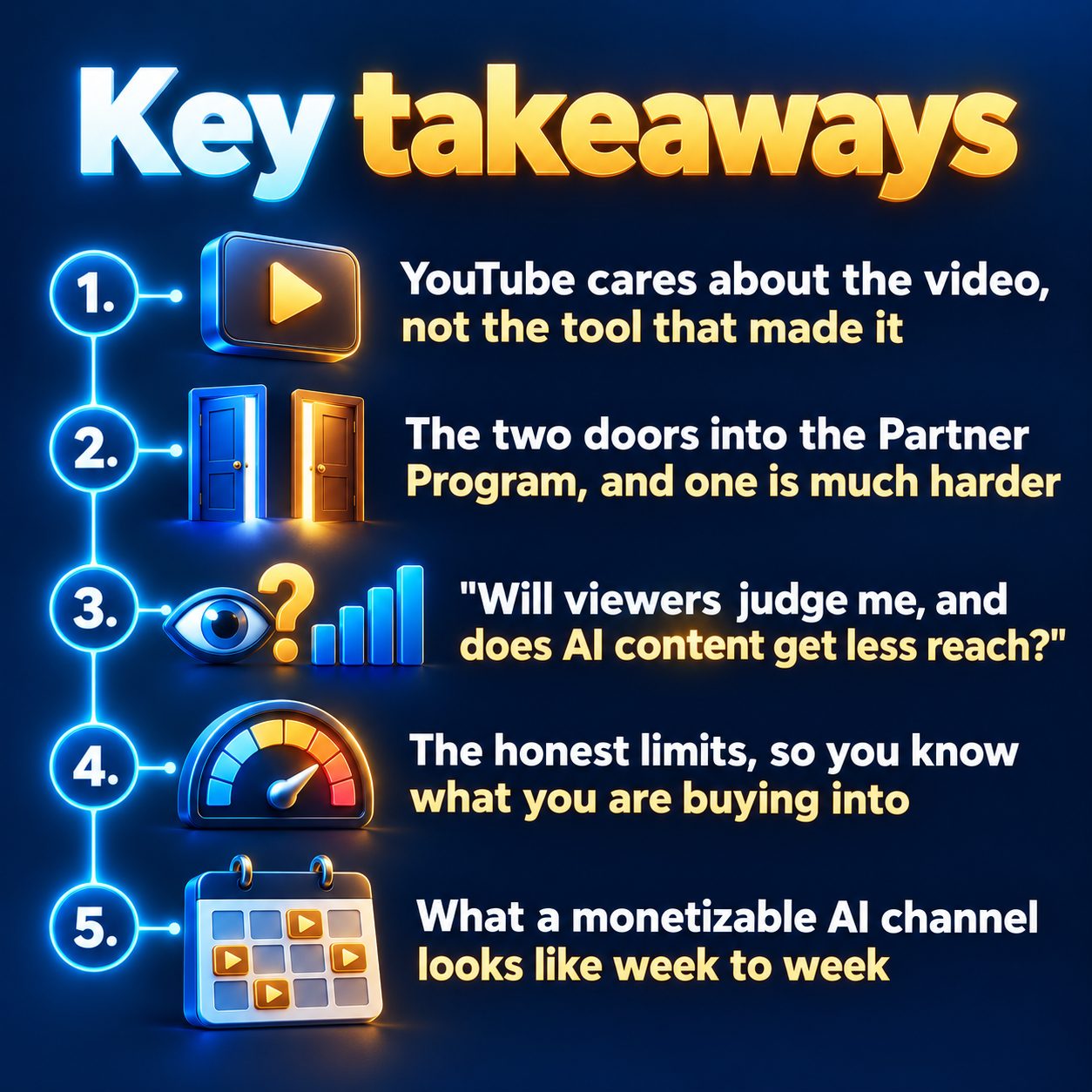
"Will viewers judge me, and does AI content get less reach?"
No platform down-ranks a video for being AI-made. YouTube, TikTok, Instagram and Facebook rank short videos on viewer behavior: how long people watch, whether they finish, whether they like and share. Production method is not an input.
What does hurt reach is more boring than that. Identical files posted across several accounts. Near-duplicate uploads at volume. Opening seconds that give a viewer no reason to stay. And ignoring the AI disclosure rule when your video contains realistic synthetic media. The disclosure label itself does not reduce your distribution, but skipping it when it applies risks removal, which obviously does.
On being judged: faceless channels have been a normal part of YouTube for years. Nobody scrolling asks who edited it. They ask whether the next fifteen seconds are worth their time.
The honest limits, so you know what you are buying into
AI production removes filming and editing. It does not remove the part that decides whether you get monetized.
It cannot pick a niche you find interesting enough to stay with. It cannot give you a point of view. It cannot make a generic listicle feel like it came from someone who thinks about the topic. If you feed a tool nothing but thin topics, you get thin videos fast, which is worse than slow bad videos because you build the exact upload pattern YouTube flags.
And no tool can promise monetization. Review involves both automated systems and human reviewers, and it can go against you. Also worth saying plainly: do not clone someone else's voice or face, and do not stitch together other people's footage and call it yours. That is a different policy problem and a faster one.
A rough self-test that works: if you would be slightly embarrassed to send a video to a friend who knows the subject, it probably fails the value-added bar too.
What a monetizable AI channel looks like week to week
Pick one niche you could keep talking about for a year. Not the one with the biggest imagined audience, the one you would still open on a Tuesday night. Then write for one specific person in it rather than "everyone interested in history."
Set a cadence you can genuinely hold. Daily Shorts if your life allows it, three a week if it does not. Consistency matters more than volume, because the algorithm needs repeated data about the same channel and the same audience to learn who to show you to.
Then add one longer 16:9 video per week on your best-performing Short's topic. That is your watch-hour engine.
And vary the videos. Different hooks, different angles, different structures inside the niche. This is the single habit that separates channels that get monetized from channels that get held back.
This is where a tool earns its place. MaqtAi takes a niche and topic and produces the finished vertical video, script, voiceover, motion visuals and animated captions, and on a paid plan it can auto-publish to your connected channels on a schedule (see how the pieces fit). Pick 16:9 at 2 or 5 minutes in the wizard and it writes a long-form structure instead, so the watch-hour side does not become a second job. Editing any line is free before you render, which is how you keep your own judgment in the loop.
What waiting actually costs you
Nothing about the rules gets friendlier next quarter. What changes is your position. The watch-hour window is rolling over the last 12 months, which means the hours you do not bank this month are simply not there later. Your channel spends every week without uploads teaching the algorithm nothing. And whoever is posting in your niche today is accumulating the subscriber base you will be competing against.
The useful next step is small: make one video, in one niche, and see whether you like watching it back. Verifying your email on MaqtAi gives you 450 free credits, no card, which covers three or four watermarked still-frame videos on the Express tier, enough to produce your first one today and find out (credits and tiers here). If you hate it, you have lost an afternoon. If you do not, you have started.
Doing this by hand is the part most people quit at. MaqtAi writes the script, narrates it, generates the visuals and captions, and assembles the faceless short for you. Verify your email and you get 450 free credits: about 3 videos on the still-frame tier, or one with AI motion. Free renders carry a watermark.
Try it on your niche freeFrequently asked questions
Does YouTube require me to disclose that a video is AI-generated? You need to disclose realistic synthetic media, for example content that could be mistaken for real people, places or events. Illustrated or clearly stylized faceless content is a different case. The label does not reduce your reach, so when in doubt, disclose.
Can an AI voiceover get a channel monetized? Yes. There is no rule requiring a human voice. What matters is that the script is original and the video adds something, rather than being one of many near-identical uploads.
Should I start with Shorts or long-form for monetization? Both, with different jobs. Shorts bring subscribers, and 16:9 videos longer than 3 minutes build the watch hours that make the Partner Program threshold realistic.
Do I own the videos an AI tool makes for me? With MaqtAi, yes. Videos you generate are yours to post, monetize and use commercially on your own channels.
Results vary. Nothing here is a guarantee of monetization or income.