
The frustration is real, and so is the misunderstanding
You spent weeks cutting clips. The uploads get views. Then the Partner Program email arrives with two words: reused content. Or it's worse, and a channel that was already earning loses monetization. That stings, especially when bigger compilation channels seem to get away with it.
Most "bypass" guides skip one detail. Reused content isn't a Content ID match, and it isn't a copyright strike. It's one of YouTube's channel monetization policies, and reviewers apply it by looking at your channel as a whole. So they aren't asking "is this file a duplicate?" They're asking "what did this creator add?"
Once you see that, the whole problem looks different.
Why the usual tricks don't work
Mirroring the frame. A slight speed-up. A border, a pitch shift, a zoom crop. These tricks are aimed at automated matching. They might dodge a copyright claim for a while. They do nothing for a person who watches a few of your videos and sees someone else's footage with no voice, no story and no point of view.
They can also backfire. A channel full of lightly disguised clips looks like it was built to upload in bulk with as little effort as possible. That's exactly what YouTube's monetization rules are written against, including the separate inauthentic content policy on the same page, which covers mass-produced, repetitive uploads.
So the honest answer to "how do I bypass it" is that you can't, not reliably. Every attempt costs you another rejection and another wait before you can reapply.
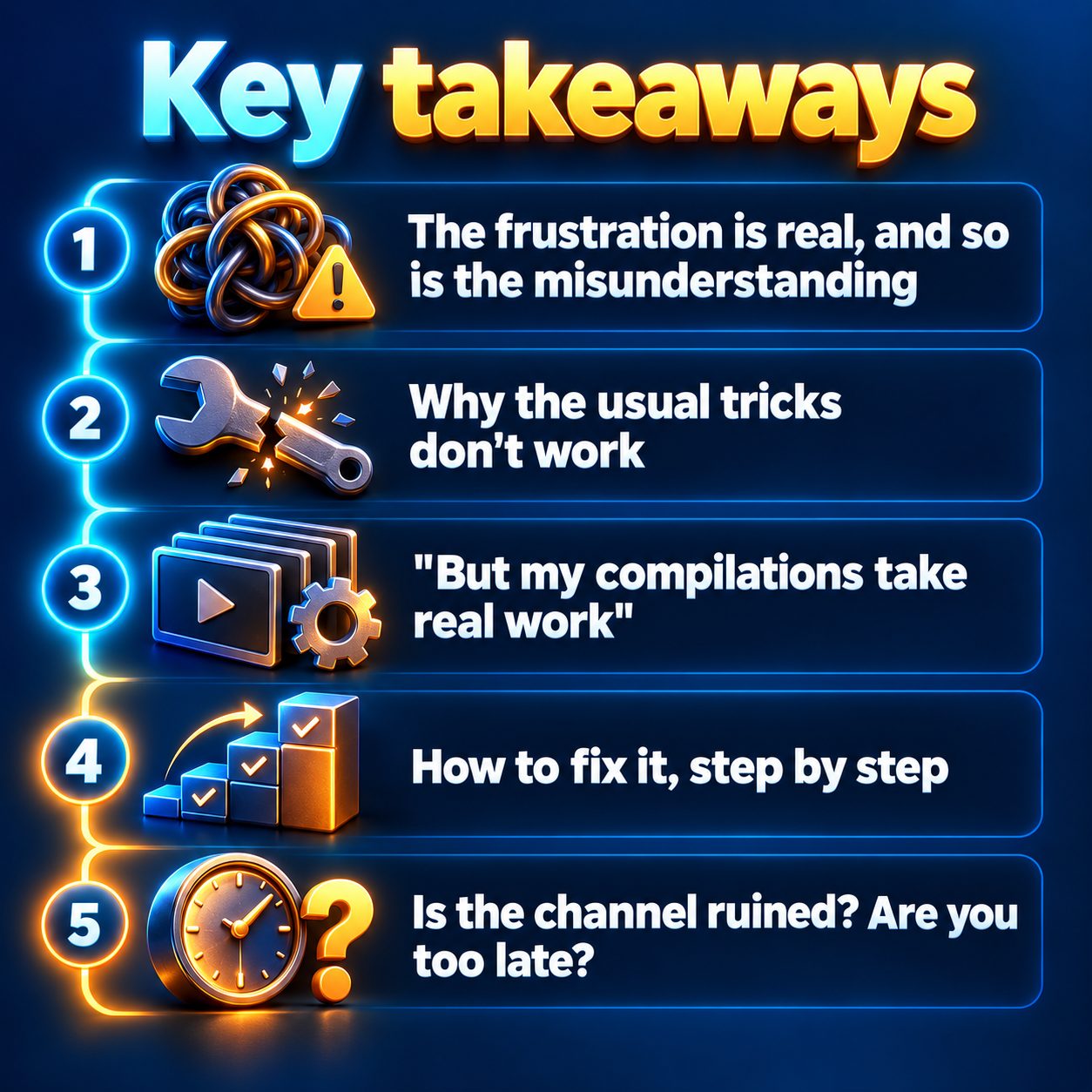
"But my compilations take real work"
They probably do. Hunting down clips, putting them in order, timing the cuts: that's real labor. The catch is that the policy rewards contribution a reviewer can see, not effort. A reviewer can't see the hours you spent searching. They can see whether you explain, rank, argue or tell a story.
Picture two videos built from the same clips. The first is a string of funny fails over a music bed. In the second, a narrator explains why each fail happened, whether it was the physics or the bad decision, and gives a verdict at the end. Same footage. Only one of them has a creator in it.
The policy page gives examples of what counts as acceptable, like critical commentary on footage and edits that substantially change it. "I picked good clips" isn't on that list. "I told you something about them" is.
How to fix it, step by step
- Audit the whole channel, not just the flagged video. Reviewers look across your uploads. Split them into two piles: videos where your voice, script or analysis is obvious, and videos that are only clips. The second pile is your problem.
- Deal with the clip-only pile. Many creators set their weakest uploads to private before reapplying so the channel being judged is the one they're actually building. Nobody can promise that's enough on its own, but it stops old uploads from speaking for you.
- Give every new video a reason to exist beyond the footage. That means a hook in the first line, a point in the middle and a payoff at the end, all in your framing.
- Use visuals you have the right to use. Clips you don't own carry their own copyright risk, and that's a separate headache from reused content. Original or properly licensed visuals take both off the table.
- Post on a steady cadence until the new format fills the channel. Once it does, reapply. The Partner Program overview explains eligibility and when you can apply again.
Is the channel ruined? Are you too late?
These are the questions people think but don't type. The short answer: no, and no.
A reused content rejection isn't a strike and doesn't take your channel down. Your subscribers stay. Some will drift off when the format changes. The ones who followed you for your taste in material often stick around for your take on it.
You're not too late either. Short-form feeds rank each video by how viewers behave with it, not by your channel's history. A strong original video gets its chance the same as anyone's.
One honest note: some clip channels were never going to be monetized, because there's nothing the operator can add. If that's you, it's often cleaner to start a fresh original channel in a niche you actually have opinions about. Put what you learned about pacing and hooks into that.
If you don't want to film or record your voice
Most compilation operators got into clips for one reason: they don't want to be on camera. Fair enough. Original content doesn't need your face. It needs a script, narration and visuals that belong to that video and not to someone else's.
That's the specific friction MaqtAi removes. You give it a niche and a topic. It writes the script (hook first, then the problem and payoff, then one next step), narrates it with an AI voice, generates fresh visuals with real motion, adds animated captions and puts together a vertical video. There's no borrowed footage in it, and the videos are yours to post and monetize. You can edit any line before it renders, and you should. The feature tour shows scheduling and auto-publish too.
Now the limits, because they matter. No tool makes you immune. YouTube's inauthentic content policy can demonetize mass-produced, repetitive AI videos, so pushing out near-identical videos from one template just swaps one problem for another. Vary your topics, rewrite the scripts in your own angle and pick a niche where you have something to say. The use cases page is a good place to test niche ideas.
What waiting actually costs
Every week you spend testing another disguise trick is a week your channel isn't collecting viewer data on a format that could pass. Meanwhile, someone in your niche is posting original videos daily and building the watch history you're after.
So take one small step. Pick one topic from your niche, make a single original version of it and put it next to your latest compilation. When you verify your email, new accounts get free credits with no card required. That's roughly 3 to 4 videos on the still-frame default, or one with AI motion, as the pricing page explains. Free renders carry a watermark, so treat them as a test, not your next upload. It's an afternoon, and it answers the real question: can your channel sound like you?
Doing this by hand is the part most people quit at. MaqtAi writes the script, narrates it, generates the visuals and captions, and assembles the faceless short for you. Verify your email and you get 450 free credits: about 3 videos on the still-frame tier, or one with AI motion. Free renders carry a watermark.
Try it on your niche freeFrequently asked questions
Is a reused content rejection the same as a copyright strike? No. It's a monetization decision about your channel as a whole, not a Community Guidelines or copyright strike. Your channel and subscribers stay.
Does mirroring or speeding up clips get past the reused content review? It might slip past automated matching for a while, but a person reviews your channel by watching it. Disguised clips with nothing added still look like reused content.
Can I still use clips at all? Yes, if you add real commentary, analysis or a story that changes what the footage means, and you have the right to use it. Clips with only music or text overlays rarely count.
Will AI-generated videos get flagged for reused content? Not for being AI-made. A fresh script, narration and generated visuals aren't reused footage. But mass-produced, repetitive AI videos can fall under YouTube's inauthentic content policy, so variety and your own angle still matter.
Results vary, and nothing here is a guarantee of monetization approval or income.