Views come from one thing: people not swiping
YouTube shows your Short to a small pocket of viewers first. What happens in those few seconds decides everything. If most people swipe away instantly, the Short stops there. If they watch to the end, or watch twice, it goes out to a bigger pocket. That loop repeats.
So the highest-leverage thing you can change is not your editing software. It is the opening second.
Practical version:
- No intro, no logo, no "hey guys welcome back". Start mid-thought.
- Lead with the claim, the weird fact, or the question. Save context for later.
- Put something moving on screen from frame one. A still frame reads as a slideshow and gets swiped.
- Keep it tight. A Short that runs 30 seconds and loops beats a 60 second one that sags in the middle.
A test that costs you nothing: mute your own Short and watch the first second. If a stranger would not stop for it silently, rewrite the hook.
"My niche is too small for this to work"
This is the objection almost everyone has, and it is usually backwards. Shorts distribution is topic-driven. The system is trying to figure out who likes what you make. A narrow lane makes that easy. A channel that posts history one day, motivation the next, and a recipe on Friday makes it hard, so the videos get tested on mismatched audiences and die there.
So pick one thing and be boringly consistent about it. Roman history. Stoic discipline. Unsolved cases. Personal finance for people in their twenties. Weird animal facts. If you want to see how narrow other people go, the niche examples here are a decent starting map.
Small niche is not the problem. Scattered niche is.
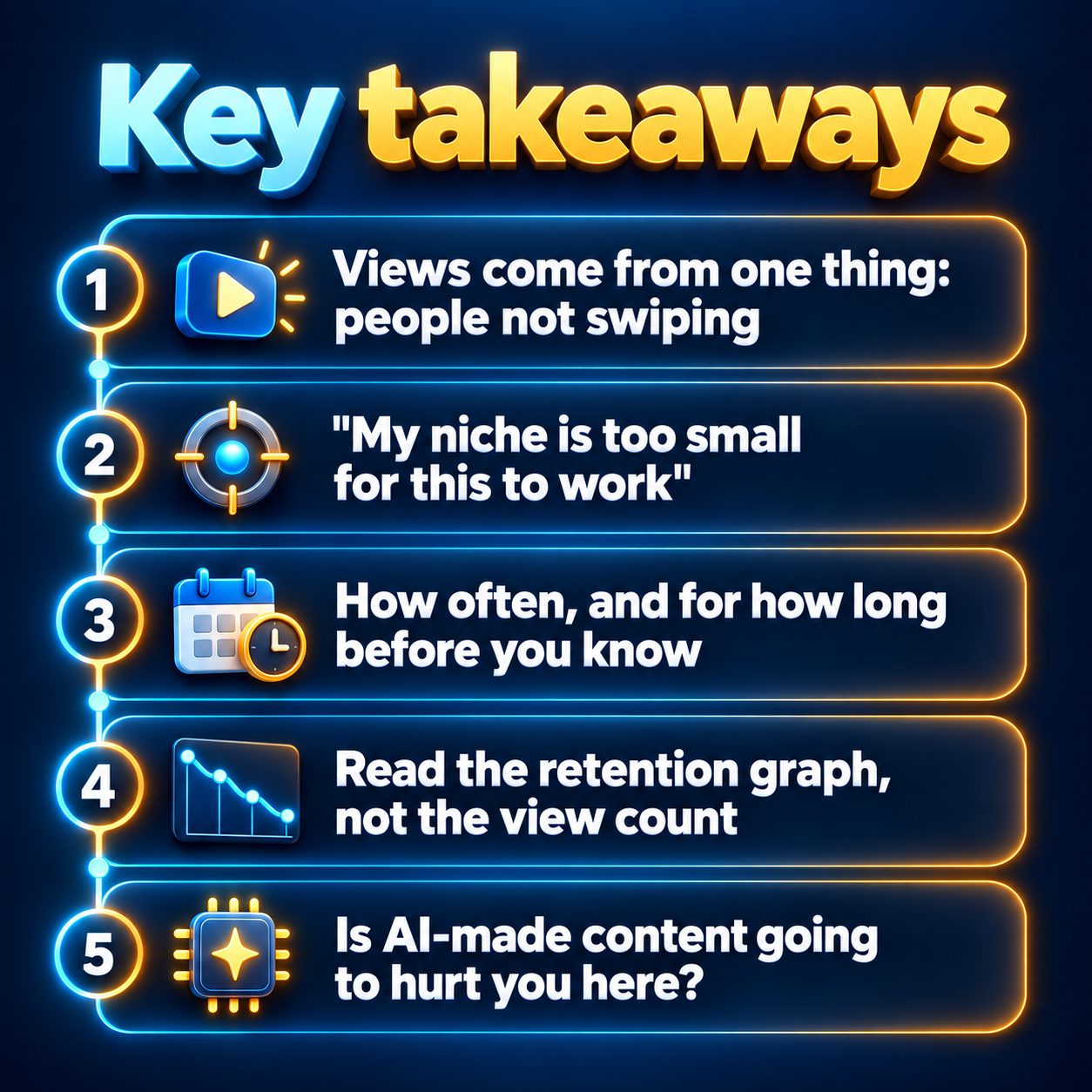
How often, and for how long before you know
This is the part you cannot evaluate on your own, so here it is plainly.
Daily is the standard on Shorts. Not because of a secret rule, but because each upload is another test of another hook with another audience pocket. Three a week is a workable floor. Anything less and you are guessing for months.
And the timeline is longer than most people expect. A handful of videos tells you nothing. After a few dozen, patterns show up: certain hook shapes hold viewers, certain topics do not. That is the actual feedback you are paying for with volume.
Which is why most channels die of cadence, not quality. People burn a weekend making one polished Short, get modest views, and quit. The realistic fix is batching: write hooks for a whole week in one sitting, produce them together, and schedule them out so daily posting does not depend on how you feel on a Tuesday.
Read the retention graph, not the view count
Open YouTube Studio, go to a Short, and look at audience retention. You are looking for two things:
- The cliff in the first seconds. That is a hook problem. Same topic, new opening line, post again.
- The sag in the middle. That is a pacing problem. Cut the setup, change the visual every few seconds, get to the payoff sooner.
If the graph is flat and high but views are still small, your hook is fine and your topic reach is small. Change the topic, keep the format.
Do this with your last handful of Shorts and you will have a better content strategy than most channels running a year.
Is AI-made content going to hurt you here?
Straight answer: no platform down-ranks a video for being AI-made. Shorts are ranked on viewer behavior, watch time, completion, likes, shares. Plenty of faceless AI channels pull serious reach because the hooks are good.
What does hurt you, honestly:
- Spam patterns. The same file across several accounts, near-duplicate uploads at volume.
- Weak openings, which is the same problem everyone has, AI or not.
- Skipping disclosure. YouTube requires you to disclose realistic synthetic media when it could be mistaken for real. The label itself does not cut your reach; ignoring the rule risks removal.
And the limit worth knowing before you plan around money: monetizing Shorts through the Shorts path needs 10 million Shorts views in 90 days, while the long-form path needs 1,000 subscribers and 4,000 valid public watch hours. If revenue is the goal, mixing in 16:9 videos is the far more reachable route. YouTube also demonetizes mass-produced repetitious content, so churning identical scripts is a dead end on purpose.
None of this makes a tool magic. Nothing writes a good hook for a niche you have not thought about. The tool removes production friction. The niche, the hook, and the cadence are still yours.
A week you can actually run
- Monday: pick your lane and write 7 topics for the week. One line each.
- Same sitting: write two hook options per topic. Pick the one that makes less sense out of context.
- Produce all seven together. Batching is what makes daily survivable.
- Post at roughly the same time daily, or spread across a window so you can compare hours later.
- Friday: check retention on all seven. Keep the hook shapes that held. Bin the rest.
- Repeat for a month before you judge anything.
If the production step is where you always stall, this is the friction worth removing. MaqtAi writes the script, narrates it, generates moving visuals, adds animated captions and builds the vertical file, then Autopilot can schedule and publish it on the cadence you set, with an approval step if you want to eyeball each one first.
What waiting actually costs
Nothing dramatic happens if you start next month. That is exactly the problem. Your channel gathers no data, the system never learns who to show you to, and the person in your niche who posts daily builds a month of hook experience you do not have. Shorts rewards accumulated attempts, and attempts only happen on a calendar.
So make one. Pick a topic you could talk about for months, write one hook that would stop you mid-scroll, and get a single Short out today. New accounts that verify their email get 450 free credits, no card, which covers three or four watermarked videos on the still-frame Express tier, or one with AI motion on.
One video today beats a perfect plan in October.
Doing this by hand is the part most people quit at. MaqtAi writes the script, narrates it, generates the visuals and captions, and assembles the faceless short for you. Verify your email and you get 450 free credits: about 3 videos on the still-frame tier, or one with AI motion. Free renders carry a watermark.
Try it on your niche freeFrequently asked questions
How long should a YouTube Short be for the most views? Short enough to loop. Most hooks resolve comfortably in 30 to 45 seconds, and a tight Short that replays beats a longer one that loses people halfway. Let the topic decide, not a target length.
Do hashtags and posting time matter for Shorts views? Far less than the hook. Use two or three relevant tags and pick a posting time you can keep, then spend your remaining effort on the opening second and your retention graphs.
How many Shorts should I post before deciding it is not working? Give it a month of consistent posting, then judge patterns rather than individual videos. If retention is improving but views are not, keep the format and change the topics.
Can I use AI voices and visuals on a monetized channel? Yes, as long as the content is not mass-produced repetitious filler and you disclose realistic synthetic media where YouTube requires it. Original scripts and a real point of view are what keep a channel eligible.
Results vary. Nothing here is a guarantee of views, subscribers, or income.