Why a crowded niche is the safest place to start
You've probably looked at a niche, seen big channels already in it, and decided you're too late. Flip that around. A crowded niche is proof that people watch it. Topics with no channels are usually empty because nobody searches for them.
What viewers never get enough of is a specific angle. Not "history" but the strange little moments history class skipped. Not "motivation" but what one philosopher actually wrote on a bad day. Your edge is a narrower slice and a steadier rhythm, not an untouched topic.
The second filter is boring but decisive. Sit down for ten minutes and list topics for the idea you like. If the page fills up easily, you can sustain it. If you stall early, pick something else now, not after you've posted for a month.
Ideas that teach something in under a minute
Weird history moments. Short form loves a "wait, really?" fact with a story attached. One incident per video gives you a beginning, a twist and an ending inside a minute. First video: "The Great Fire of London started in a bakery." Nobody expects real footage of the seventeenth century, so illustrated or generated period scenes feel natural.
Money basics in plain language. One concept per video, explained like you'd explain it to a friend. First video: "Why your savings shrink even when the balance doesn't move." It's a voice plus simple visuals. One rule: explain, don't advise. No stock picks, no promises.
The science of everyday things. Every title is a question the viewer has wondered about, so the hook writes itself. First video: "Why chopping onions makes you cry." Animated diagrams and close-up visuals do all the showing.
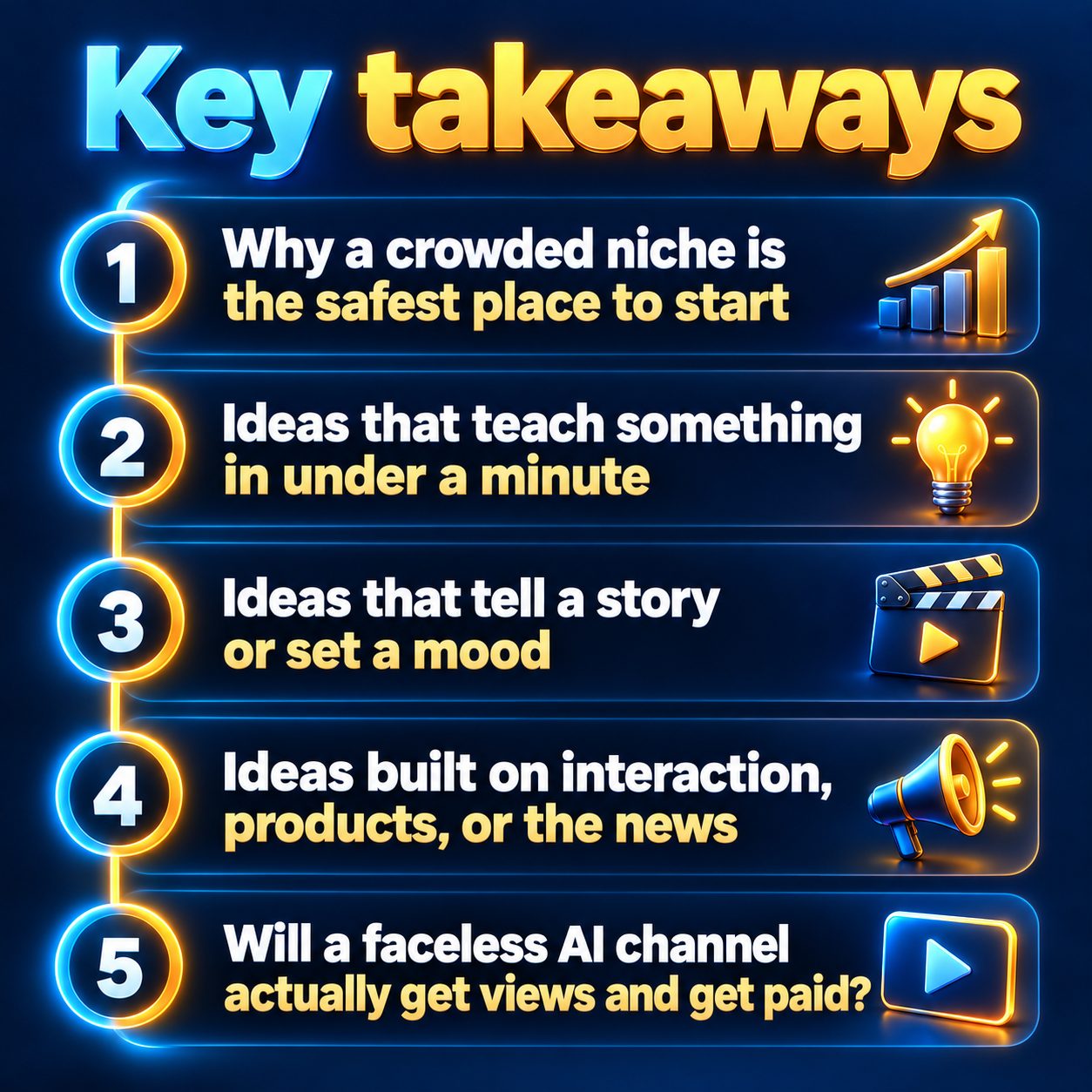
Ideas that tell a story or set a mood
Scary stories. Short horror rewards a slow build and one chilling final line, which is exactly what keeps people watching to the end. First video: "The neighbor who always waved back." Narration and dark visuals carry it. Write your own stories rather than reading someone else's post word for word.
Startup origin stories. People love hearing that famous companies started as something else. First video: "Slack began as a video game that didn't work out." These stories are told, not shown, so you never need a camera. Accuracy matters here, so check every claim.
Stoic motivation. It's popular, which means generic quote videos drown. Win by giving context. First video: "What Marcus Aurelius told himself on mornings he didn't want to get up." A calm voice and moody visuals are the whole format.
Sleep stories. This one breaks the usual rules. No loud hooks, slow pacing, soft narration. It fits longer horizontal YouTube videos better than Shorts, because nobody's swiping at bedtime. First video: "A slow walk through a lighthouse at night."
Ideas built on interaction, products, or the news
Quiz and guessing games. The comments do the work for you, since everyone wants to post their answer. First video: "Guess the country from the clues before the answer appears." Text on screen, a pause, a reveal. That's it.
Explainers for your own small business. If you sell something, answer the questions customers keep asking. A small bakery's first video: "Why our sourdough takes so long." Your product photos and facts are the content, and you never have to stand in front of a lens.
A weekly recap of one narrow niche. "This week in board games, in under a minute." Pick a hobby you already follow. The catch: you have to check facts, and recaps age fast, so this one needs the most discipline.
Want to browse more niches and who they suit? Here's a wider list.
Will a faceless AI channel actually get views and get paid?
This is the question behind the question, so here's the honest version. Platforms rank short videos by viewer behavior: watch time, completion, likes, shares. They don't push a video down just because AI helped make it. What does hurt reach is a weak opening, near-identical videos posted in bulk, and skipping a platform's disclosure label when the content looks like real footage.
Money is a separate gate. To join the YouTube Partner Program you need 1,000 subscribers plus either 4,000 valid public watch hours in the last 12 months or 10 million valid public Shorts views in the last 90 days (YouTube Help). YouTube also demonetizes content it sees as mass-produced and repetitive. That's why the angle matters so much. A channel where every video says something specific holds up. A template with the nouns swapped doesn't. No tool fixes that for you, and anyone claiming otherwise is selling something.
What if you pick the wrong idea?
You'll probably adjust, and that's normal. Commit to one idea for weeks 1-4 and post on a fixed rhythm, daily or three times a week. Then look at retention: where do people drop off? Usually the fix is the hook or the angle, not the whole niche. Switch niches only if almost nobody stays past the opening.
The idea is rarely what kills a channel. Stopping after two weeks is. And the worry about being judged for AI? Viewers judge boring. They scroll past a dull video no matter who made it, and they stay for a good one.
What another month of deciding costs you
Every week spent comparing ideas is a week with zero data. The algorithm can't learn who your viewers are from videos that don't exist, and somewhere a channel in your niche posted again today. The smallest real step is this: pick one idea above, write the first title, and make that one video.
The making part is where most people stall, and it's what MaqtAi removes. You give it a niche and a topic, and it writes the script, narrates it with an AI voice, generates visuals with real motion, adds captions and assembles a vertical video (see how it works). Most new accounts that verify their email get free credits with no card, enough for a few still-frame videos or one with AI motion, watermarked on the free tier (details here). That's enough to find out whether your idea has legs before you spend anything.
Doing this by hand is the part most people quit at. MaqtAi writes the script, narrates it, generates the visuals and captions, and assembles the faceless short for you. Verify your email and you get 450 free credits: about 3 videos on the still-frame tier, or one with AI motion. Free renders carry a watermark.
Try it on your niche freeFrequently asked questions
What is the easiest YouTube channel idea for a beginner? Quiz channels and everyday-science explainers are the easiest to keep going, because topics are endless and each video answers one simple question. Pick whichever you'd happily research on a tired evening.
Do I need to show my face to grow a YouTube channel? No. Platforms rank videos by how viewers behave, not by whether a face appears. Storytelling, explainers and quizzes all work with narration and visuals alone.
Can a faceless AI channel be monetized on YouTube? It can if it meets the Partner Program requirements and the content is original rather than mass-produced and repetitive. Specific, well-researched videos are what keep a channel on the right side of that line.
How long should I try one idea before switching? Give it a month of steady posting, then judge by retention, not by your feelings. Most of the time you'll fix the hook or angle rather than abandon the niche.
Results vary, and nothing here is a guarantee of views or income.