
What "faceless" actually means (and why it matters)
A faceless video is any short-form video where nobody appears on camera and nobody records their own voice. The creator stays invisible. Think of those scary-story reels, stoic-motivation shorts, or history explainers flooding your feed. The narrator is an AI voice. The visuals are AI-generated or stock footage. Captions do the heavy lifting.
This matters because it removes the two biggest excuses people have for not starting a channel: "I hate being on camera" and "I have no editing skills." A good AI faceless video generator handles both for you.
What to actually look for before you pick a tool
Not every tool calling itself a "faceless video generator" does the same thing. Some write scripts but leave you to find visuals. Others edit clips you upload but do not generate anything from scratch. Before you compare pricing pages, figure out which parts of the workflow you want automated:
- Scriptwriting. Does it write a hook-first script tuned to your niche, or does it hand you a generic paragraph?
- Voiceover. Does it sound like a real narrator, or like a GPS giving directions?
- Visuals with motion. Static images with a slow zoom are not the same as genuine AI-generated motion. This is the single biggest quality gap between tools right now.
- Captions. Animated captions are standard for short-form. If the tool skips this step, you will need a separate app.
- Publishing. Can it post directly to TikTok, Instagram Reels, and YouTube Shorts, or does it just export an MP4 and leave you to upload manually three times?
The more steps the tool covers, the fewer hours you spend stitching apps together.
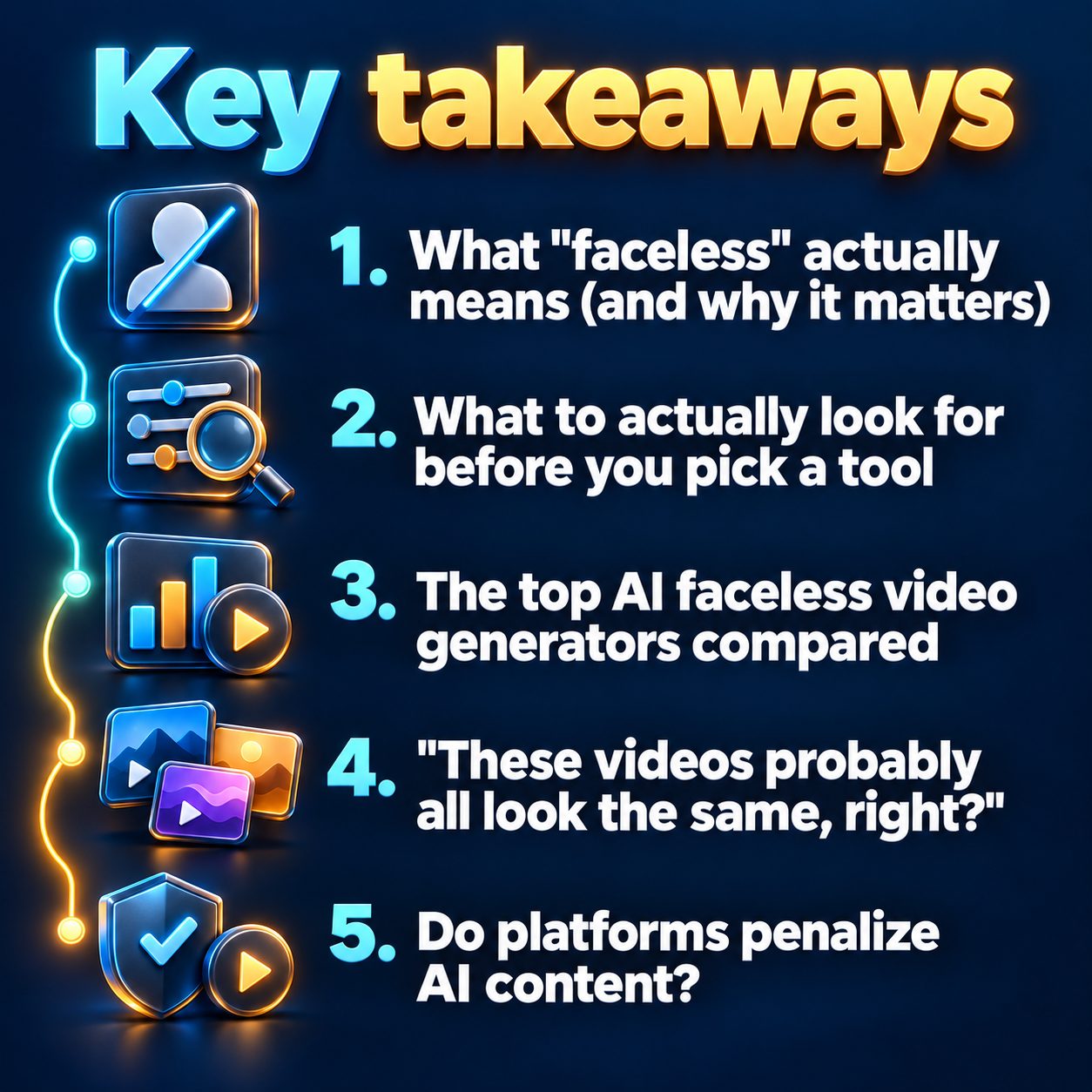
The top AI faceless video generators compared
Here is an honest look at the most popular options. Every tool has strengths; the right choice depends on your workflow and budget.
InVideo AI
InVideo AI lets you describe a video in a text prompt and generates a draft with stock footage, voiceover, and music. It is strong at long-form content and gives you a timeline editor to rearrange clips. The learning curve is gentle, and the template library is large. Where it is less suited: if you want fully AI-generated visuals rather than stock clips, or if you need one-click publishing to multiple short-form platforms, you will need extra steps.
Pictory
Pictory is built for turning existing long-form content (blog posts, scripts, Zoom recordings) into short clips. It is excellent at repurposing, and its text-based editing is beginner-friendly. The trade-off: it works best when you already have source material. If you are starting from nothing but a topic, you will do more prep work upfront.
Fliki
Fliki combines realistic text-to-speech with a video builder that pairs your script to stock media. It supports dozens of languages and voices. It is a solid middle-ground tool, especially for explainer-style content. The visual side leans on stock footage rather than AI-generated imagery, so the look will feel familiar rather than distinctive.
Synthesia
Synthesia is the go-to for AI avatar videos, where a digital human presents to the camera. That makes it great for training videos and corporate explainers, but it is not really a "faceless" tool. The presenter is the point. If you want no face at all, this is not your match.
MaqtAi
MaqtAi is purpose-built for faceless short-form channels. You pick a niche and a topic, and it handles the entire pipeline: hook-first script, AI voiceover (ten voices, adjustable speed), AI-generated visuals with real motion, a matched ambient soundscape, animated captions in 50+ languages, and auto-publishing to TikTok, Instagram Reels, and YouTube Shorts. It also offers scheduling and an Autopilot mode that renders and publishes on a cadence you set (TikTok destinations wait in the approval queue), with a Suggest topics button and an AI-niche mode that keep the queue filled. It covers 19 faceless niches out of the box, from true crime to bedtime stories to startup explainers. New users who verify their email get 450 free credits, three or four watermarked videos on the still-frame Express tier, with no card required.
"These videos probably all look the same, right?"
Fair concern. A year ago, most AI-generated videos did look identical: stock clip, robot voice, basic subtitles. That sameness came from every creator using the same stock-footage libraries.
The gap now is motion. Tools that generate AI visuals with genuine movement (characters walking, rain falling, camera pans through a scene) produce something that feels like original footage. Tools that layer a slow Ken Burns zoom over a still image do not. When you trial any generator, look at the motion in the output. That single detail separates forgettable from watchable.
MaqtAi offers multiple quality tiers for exactly this reason. Stylized art styles like anime or comic look great on the Standard tier, while realistic, people-heavy footage benefits from Premium or Full Cinematic motion. Honest advice: do not overspend on the highest tier for every style. Match the tier to the visual.
Do platforms penalize AI content?
Short answer: no. YouTube, TikTok, and Instagram have all published guidelines that allow AI-generated content as long as it is not deceptive (for example, deepfakes pretending to be real people). What the algorithms actually reward is watch time and engagement. A faceless video that hooks viewers in the first two seconds and holds attention for 30 will outperform a hand-filmed vlog that loses people at second five.
That said, pure slop gets buried fast. Low-effort content with no real value will not rank regardless of how it was made. The tool matters less than the topic selection and script quality.
You are not too late, but standing still has a cost
Every week you spend comparing tools is a week your channel has zero videos, zero algorithm data, and zero momentum. The platforms reward consistency. A channel that posts daily for 30 days teaches the algorithm who its audience is. A channel with two videos and a three-week gap teaches the algorithm nothing.
The most expensive choice here is not picking the wrong tool. It is picking no tool and spending another month in research mode while someone in your niche posts every day.
So here is a small, concrete step: make one video today. Pick whichever tool on this list offers a free trial, give it a topic you care about, and watch what comes out. If you want the fastest path from "I have a topic" to "it is live on three platforms," MaqtAi's free credits let you produce three or four watermarked still-frame videos with just an email and no card, though publishing to platforms needs a paid plan. That is enough to know if this workflow fits you.
Doing this by hand is the part most people quit at. MaqtAi writes the script, narrates it, generates the visuals and captions, and assembles the faceless short for you. Verify your email and you get 450 free credits: about 3 videos on the still-frame tier, or one with AI motion. Free renders carry a watermark.
Try it on your niche freeFrequently asked questions
Can I monetize faceless AI videos on YouTube? Yes. YouTube allows monetization of AI-generated content as long as it provides value and follows community guidelines. Faceless channels across niches like motivation, history, and true crime are active in the YouTube Partner Program today.
Do I need editing skills to use an AI faceless video generator? Not with tools that cover the full pipeline. MaqtAi, for example, lets paid plans review and tweak scenes, swap voices, or adjust captions before publishing, but you never need a timeline editor or any prior editing experience.
What if my niche is not covered by these tools? Most generators focus on popular categories. MaqtAi supports 19 faceless niches ranging from scary stories and dark psychology to startup stories and bedtime sleep content. If your niche is very specialized, look for a tool that lets you customize scripts and visuals rather than locking you into templates.
How many videos should I post per week to grow a faceless channel? Consistency matters more than volume, but most successful faceless creators post at least three to five times a week. Tools with scheduling or autopilot features make that pace sustainable without daily manual work.
Results vary by niche, content quality, and platform algorithm changes. Nothing in this article is a guarantee of income.