Why sleep content plays by different rules
Most short-form advice tells you to grab attention in the first second. Flash a bold visual. Hit them with a loud hook. That advice will destroy a bedtime channel.
Your viewer is lying in bed, lights off, phone propped on a pillow. They want to fall asleep. Anything that jolts them awake is a failure, not a success. This means the entire playbook flips: quiet openings, slow pacing, warm visuals, and a voice that feels like a weighted blanket.
That constraint is actually your advantage. Sleep content earns long watch times naturally because people leave the video running as they drift off. The algorithm sees a viewer who stayed through your entire video and treats it like strong engagement, even if they were asleep for most of it.
The audience is massive and returning. Stress, screen fatigue, and restless nights send people searching for something to help them wind down every single evening. And they come back. A bedtime channel builds repeat viewers faster than almost any other niche because the need is daily.
The hook that works when your viewer wants to sleep
Forget "wait until you hear this" energy. A bedtime hook is an invitation, not a cliffhanger. It sets a mood.
Think: "Tonight, we visit a quiet village at the edge of a forest, where lanterns glow along a cobblestone path." That sentence does three things. It signals this is a bedtime story. It places the listener somewhere peaceful. And it gives just enough curiosity to keep them from scrolling past.
Strong opening patterns for this niche:
- Scene-setting: "Imagine you are walking through..." or "Picture a small cottage beside a still lake."
- Gentle promise: "This is a story to carry you into sleep."
- Continuation: "Last night we visited the mountain village. Tonight, the river beyond it."
The key is warmth without excitement. Your first sentence should lower the viewer's heart rate, not raise it.
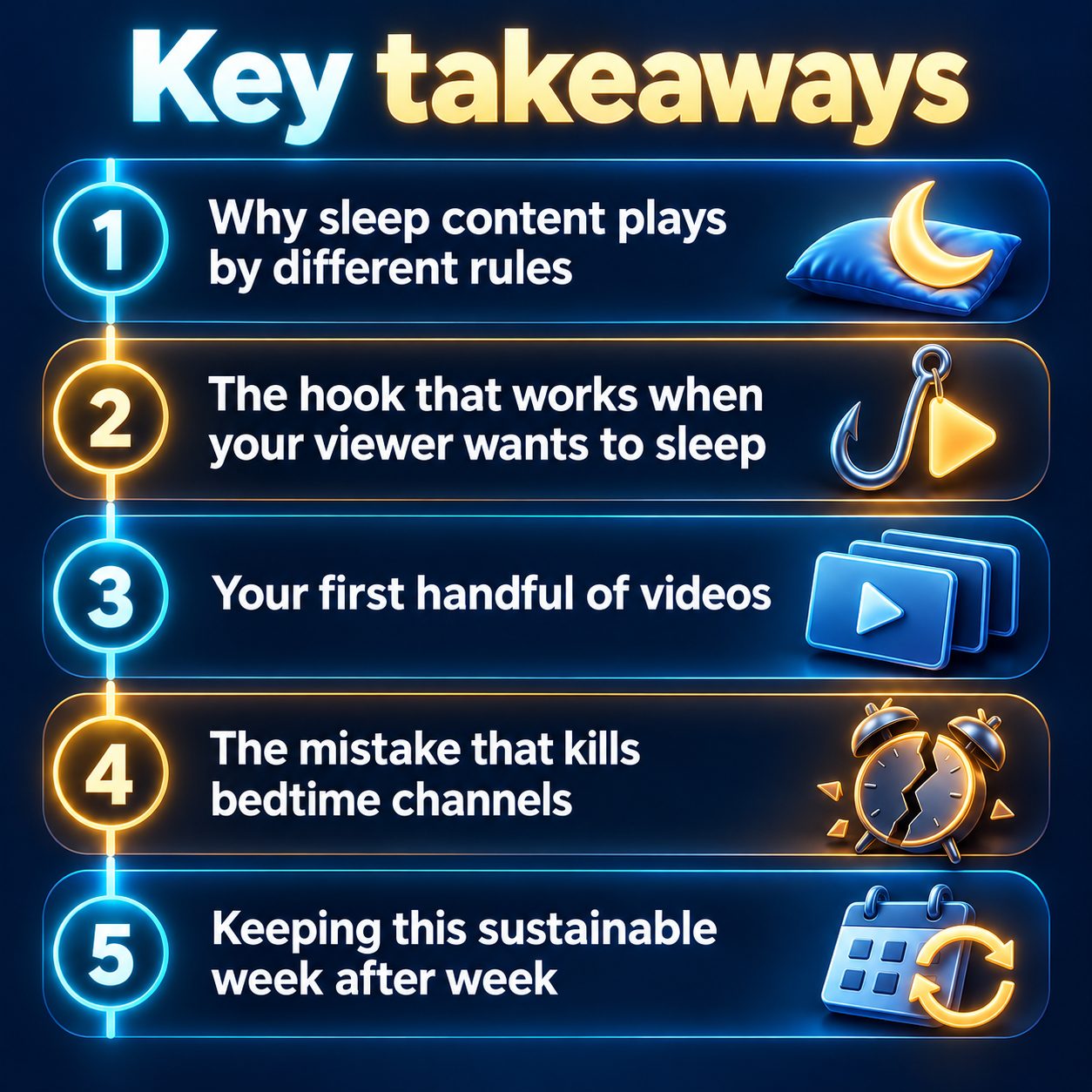
Your first handful of videos
Start with variety so you learn what resonates. Here are concrete first videos to try:
- "The Lighthouse Keeper's Evening." A slow story about a keeper lighting lanterns along a coastal path, waves in the background.
- "Rain on the Roof of a Wooden Cabin." Minimal plot, maximum atmosphere. A character settles in for the night while rain falls.
- "The Sleepy Forest Train." A gentle journey through a quiet forest at dusk. Describe the scenery passing the window.
- "A Letter from the Countryside." Someone reads a calm letter describing their peaceful rural life. The epistolary format works beautifully for sleep.
- "The Baker Who Closed at Sunset." A baker finishing their day, kneading the last dough, locking the shop. Routine as comfort.
Notice these are not dramatic. No twists, no villains, no tension. The "plot" is someone being somewhere peaceful. That is the entire point.
For format, aim for videos between one and three minutes. Longer is better for sleep content because the viewer wants to be carried, not interrupted.
The mistake that kills bedtime channels
Inconsistency in tone.
One calm video followed by something intense. One soft narration followed by a fast, loud one. Your audience chose you because your channel feels safe. The moment you break that feeling, they leave and find someone who never will.
This extends to visuals. Sleep content should use muted palettes: deep blues, soft golds, gentle greens. Bright flashes or neon pull the viewer out of their drowsy state. Stylized art like watercolor or soft illustration tends to work better than hyper-realistic footage for this exact reason.
It also extends to your posting pattern. Bedtime viewers build habits. They check your channel at the same time every night. If you post for a few days and then vanish for two weeks, you lose them to someone who shows up reliably.
The discipline here is restraint. Every creative instinct tells you to vary things, surprise people, keep it fresh. In this niche, predictability is the product.
Keeping this sustainable week after week
The biggest challenge is not making one good bedtime video. It is making the next one, and the one after that, night after night.
You need a system. Batch your story concepts in groups. A "forest" series. A "seaside" series. A "rainy evening" series. Each series shares a setting and mood, so you are not inventing from scratch every time. You just need a new gentle scenario within that world.
Narration speed matters enormously for this niche. Slow your narrator down well below normal conversational pace. MaqtAi offers speech speed adjustment from 0.5x to 2x in the video wizard, so pull it toward the slower end until the words feel unhurried. Pair that with a natural ambient soundscape (rain, crickets, a crackling fireplace) and the video handles most of the relaxation work on its own.
For cadence, daily is ideal if you can manage it. Three times a week is the minimum to build the habit loop sleep audiences rely on. Autopilot can handle the publishing rhythm so you are not manually posting at bedtime every night.
Start with one story tonight
The real cost of waiting is not dramatic. It is quiet. Every night you do not post is a night someone else's channel becomes your potential viewer's sleep routine. Once a bedtime listener finds a channel that works for them, they rarely switch. That loyalty is yours to earn, but only if you start.
You do not need a camera, a microphone, or a studio. Pick one peaceful scenario: a cabin, a garden, a quiet train ride. MaqtAi can turn that single topic into a narrated, captioned, gently animated video. New accounts get enough free credits to make their first few videos with just an email verification, no card required.
Make one tonight. See if it feels like something you would fall asleep to. If it does, your viewers will too.
Doing this by hand is the part most people quit at. MaqtAi writes the script, narrates it, generates the visuals and captions, and assembles the faceless short for you. Verify your email and you get 450 free credits: about 3 videos on the still-frame tier, or one with AI motion. Free renders carry a watermark.
Try it on your niche freeFrequently asked questions
Do bedtime videos work better as YouTube Shorts or longer uploads? Both work, but longer videos tend to perform better for sleep because viewers want to drift off without interruption. Videos up to three minutes still qualify as Shorts. If you want to go beyond that, a widescreen upload gives you more room and stronger watch-hour accumulation toward monetization.
Will an AI voice feel too robotic for a sleep channel? Modern AI narration voices are calm and natural enough for storytelling. The key is choosing a warm, steady voice and slowing the speed down. Preview available voices and pick one that sounds like someone reading to you, not presenting to you.
Should I add background music to bedtime stories? Ambient sound (rain, wind, fire crackling) often works better than music for this niche. A gentle soundscape matched to your story's setting helps the listener relax without competing with the narration.
Can I monetize a faceless bedtime story channel? You own the videos you create and can post and monetize them on your own channels. Be aware that YouTube requires content to offer genuine value rather than being mass-produced repetitive material. A channel with unique stories and real care in each video is in a strong position.
Results vary, and nothing in this article is a guarantee of income.