
Two doors into YPP, and one is much narrower
YouTube gives you two ways in for ad revenue. Door one: 1,000 subscribers plus 4,000 valid public watch hours in the last 12 months. Door two: 1,000 subscribers plus 10 million valid public Shorts views in the last 90 days (YouTube's own requirements page). There is also a lower tier that unlocks fan funding features earlier, at 500 subscribers, listed on that same page.
Read those two numbers next to each other and the strategy writes itself. The Shorts door is built for channels that already went viral repeatedly. The watch-hours door is built for patience. If you are starting now with no audience, you are aiming at the watch-hours door, and Shorts are the thing that feeds subscribers into it rather than the thing that gets you monetized.
So the honest shape of the plan is: Shorts for discovery, longer videos for watch time. Not one or the other.
"But faceless AI channels get demonetized"
Half true, and the half that is true matters a lot.
YouTube does not ban AI-assisted or faceless content. What it acts on is inauthentic content: mass-produced, repetitious material with no meaningful commentary, narrative, or effort behind it (YouTube's inauthentic content policy). A channel that pumps out the same script template with a swapped noun, or that reuses other people's footage without adding anything, is exactly what that policy is written for.
The difference in practice is not the tool. It is whether each video has a real point of view. A history channel with a specific angle, a stoic-philosophy channel with an actual argument per episode, a startup-stories channel that tells one story properly: those read as original, whether you filmed them or not. Ten videos that are visibly the same video read as spam.
One more piece of hygiene: if your visuals or voice are realistic synthetic media, disclose it in YouTube's altered-content field when you upload. The label itself does not suppress your video. Skipping it when it was required can cost you the video.
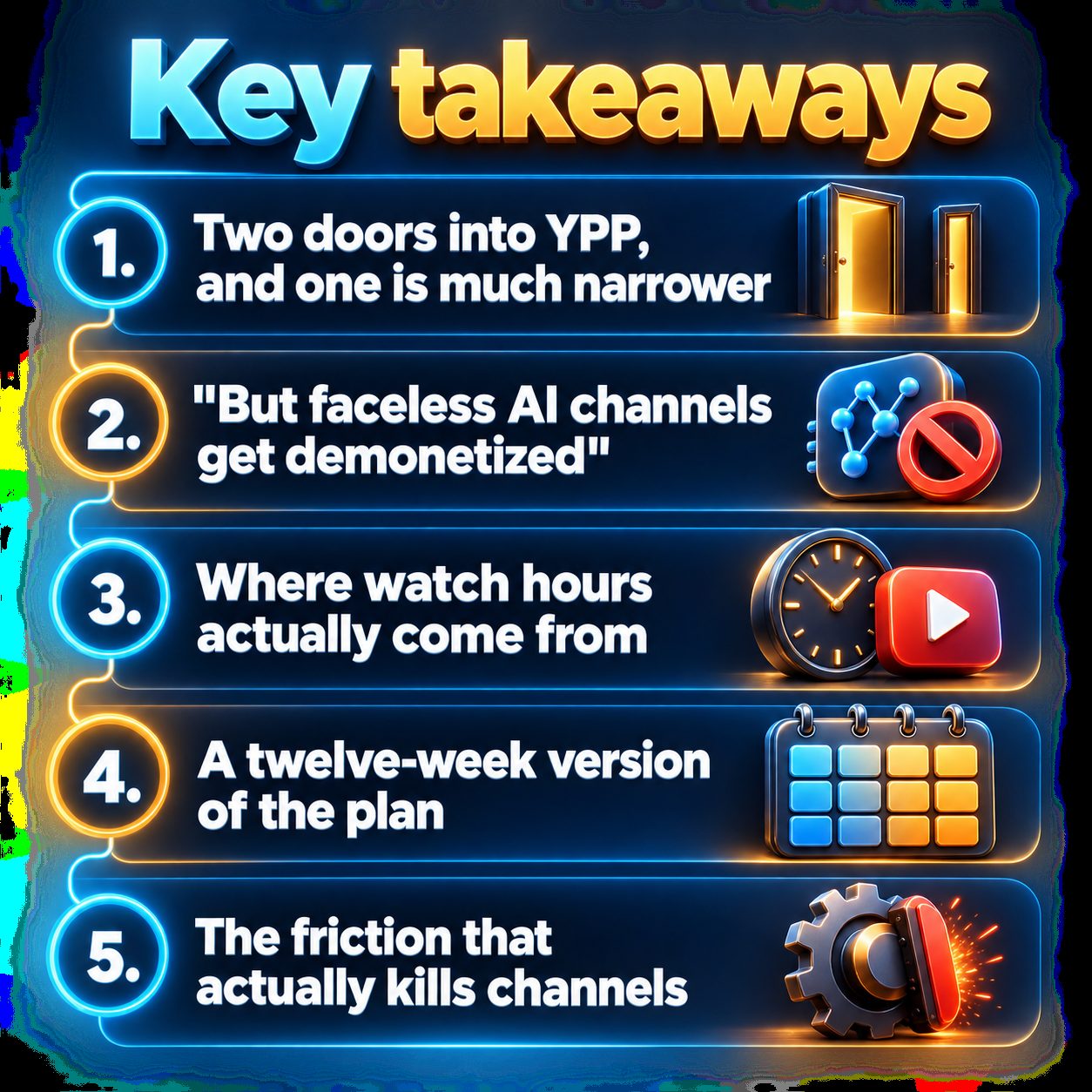
Where watch hours actually come from
Here is the part people skip. Shorts views do not count toward the 4,000 watch hours. Neither door borrows from the other.
Which means a channel posting only vertical clips can build subscribers for months and still be nowhere near ad monetization. If your goal is YPP through the watch-hours door, you need videos that YouTube classifies as regular long-form. YouTube decides that automatically: vertical or square and up to 3 minutes is a Short, 16:9 or longer than 3 minutes is a regular video.
So the practical setup for a faceless channel:
- Shorts, near-daily. They are your top of funnel. Cheap to make, high reach, and they are what makes strangers subscribe.
- Long-form, weekly. This is what accrues watch hours. Five to ten minutes is plenty if the structure holds: a hook in the first fifteen seconds, three or four themed sections, a recap.
- Same niche across both. A subscriber who came from a Shorts about Roman engineering will actually click a long video about Roman engineering. They will not click your unrelated finance video.
Aim your long-form at holding people, not at running long. Watch hours are minutes watched, not minutes uploaded. A tight seven-minute video that people finish beats a padded twenty-minute one they abandon.
A twelve-week version of the plan
Weeks 1 to 2. Pick one niche and stay in it. Publish one Short per day and one long-form video. Do not touch the design of your channel banner yet. Nobody subscribes because of a banner.
Weeks 3 to 6. Keep the cadence. Now start reading retention. On each Short, look at where people drop. On each long video, look at the first thirty seconds. Rewrite hooks, not topics. Most channels quit their niche at exactly the moment their hooks were the problem.
Weeks 7 to 9. Double down on whatever two or three topics outperformed the rest. Make more long-form on those specifically. This is usually when subscribers start compounding, because you finally have a recognizable promise.
Weeks 10 to 12. Apply the moment you cross the threshold. There is no advantage to waiting, and review takes time. If you are rejected, YouTube tells you the reason and you can reapply after 30 days.
The hard part of this plan is not any single step. It is week 6, when you are still small and the posting feels pointless. That is the week the algorithm is still gathering data on you.
The friction that actually kills channels
Almost nobody misses YPP because they picked the wrong niche. They miss it because they stopped posting.
That is a production problem, not a talent problem. Writing, recording, sourcing visuals, and editing a daily Short plus a weekly long-form is a real part-time job on top of your actual job. Around week four, one skipped day becomes three, and the channel goes quiet.
This is the specific friction worth removing, and the only reason a tool belongs in this conversation. MaqtAi builds faceless vertical videos end to end from a niche and a topic, script and AI voiceover and moving visuals and animated captions, and can post them to your connected accounts on a cadence you set. You pick 16:9 at five minutes in the wizard's length step and you get a long-form structure with a hook, themed sections, and a recap, which is the format that feeds the watch-hours door. Autopilot and scheduling, both of which need an active subscription, are what keep week six from being the week you disappear.
What it does not do: it does not pick a good niche for you, it does not know your audience better than you do, and it will not save a channel where every video says the same thing. Review the scripts. Change the ones that feel interchangeable. That editorial judgment is the whole difference between an original channel and one the policy is written about.
Start the clock, because it is a rolling window
The 4,000 hours are measured over the trailing twelve months. Watch hours you earned last winter are aging out right now, whether you are uploading or not. Every week you do not publish is not neutral. It is a week of data the algorithm does not have about who to show you to, and a week your competitor in the same niche used to build the topic authority you wanted.
So make one video today. Not a channel plan, not a logo, one video. If you want to see what a finished faceless video looks like before committing a single evening to it, verifying your email on MaqtAi gives you 450 free credits and no card is asked for. That is enough for a first video, watermarked and without a presenter, so you can decide with something real in front of you.
Doing this by hand is the part most people quit at. MaqtAi writes the script, narrates it, generates the visuals and captions, and assembles the faceless short for you. Verify your email and you get 450 free credits: about 3 videos on the still-frame tier, or one with AI motion. Free renders carry a watermark.
Try it on your niche freeFrequently asked questions
Do Shorts views count toward the 4,000 watch hours? No. Shorts views count only toward the separate Shorts threshold, and long-form watch time counts only toward the watch-hours threshold. You need to meet one door fully.
Can I get into YPP without showing my face or using my voice? Yes. YouTube has no rule requiring a face or a human-recorded voice. The requirement is originality and meaningful effort, not the production method.
How long does YPP review take after I apply? YouTube says most applications are reviewed within about a month, though it can be longer during busy periods. If you are declined you get a reason and can reapply after 30 days.
Should I run a second channel to double my chances? Usually not at the start. Two half-fed channels reach the threshold slower than one fed properly. Add a second one only once the first is running on a cadence you can sustain.
Results vary. Nothing here is a guarantee of income, monetization approval, or channel growth.