What YouTube actually means by "reused"
There are two policies here, and faceless channels mix them up all the time.
Reused content is about source material. Say a video is mostly someone else's work: clips, compilations, a reuploaded podcast, a reaction where you barely react. If you haven't added significant commentary, real changes, or educational or entertainment value, it doesn't qualify for monetization. Here's what catches people off guard. Having permission or paying for a license doesn't fix it. Reviewers ask what you added, not whether you were allowed to use it.
Inauthentic content is about sameness. This one targets channels that look mass-produced. Think the same template with tiny swaps, slideshows with no real narrative, or uploads anyone could crank out at scale. Both policies live on YouTube's channel monetization policies page, and both are judged across your whole channel. Reviewers look at your most-watched and newest videos, plus your titles, thumbnails and descriptions. One strong video won't carry a feed of weak ones.
"But my whole channel is AI. Isn't that the problem?"
This is the worry I hear most. It's understandable, but it's aimed at the wrong thing. YouTube doesn't ban AI tools, and no major platform pushes a video down just because AI made it. Ranking follows what viewers do. Channels get demonetized when their content has nothing of its own. A robotic voice reading a scraped article over random stock clips is one example. The same video remade daily with a new name swapped in is another.
Think of AI as the camera, not the author. Owning a camera doesn't make a vlog original. The person using it does. Give your script a real angle, make visuals for that script, and leave viewers with something the next channel over didn't give them. Do that and AI production isn't what gets judged.
One AI rule does matter. If a video shows realistic synthetic people or events a viewer could mistake for real, use YouTube's altered or synthetic content disclosure. The label itself isn't the risk. Skipping it is.
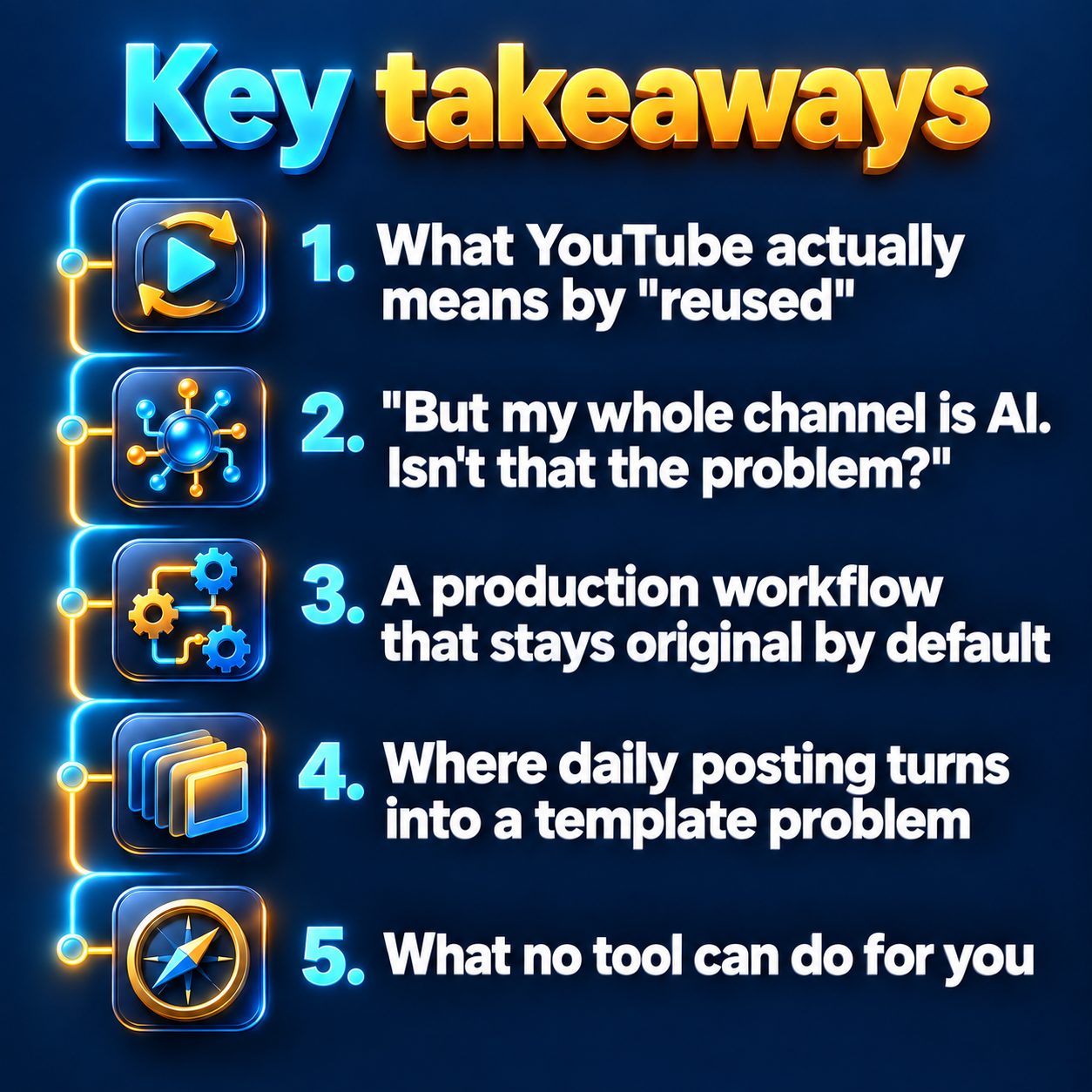
A production workflow that stays original by default
Build originality into every step so you're never trying to rescue a video at upload time.
Start from a question, not a source. Don't open a wiki page and paraphrase it. Pick a question your audience actually has, like "why do people freeze instead of running when they're scared?", and decide your answer before you write. That answer is your point of view, and nobody can reuse it.
Write the script like you'd say it. Hook in the first sentence, set up the problem, pay it off, end with one next step. Read it out loud. Cut anything that sounds like a summary of someone else's article, and check your facts yourself.
Make visuals for this script. Movie clips, footage from trending videos and other creators' shorts are the fastest way to get rejected for reused content. Visuals made for your specific lines are a different thing entirely.
Narrate with intent. An AI voice is fine. A flat voice reading scrolling text with no story is exactly what the policy describes. Match the voice to the niche, adjust the pacing, and make sure the narration is actually saying something.
Do a viewer pass. Watch it once like a stranger would. Does this video say something the last one didn't? If not, fix the script, not the thumbnail.
Keep metadata honest and fresh. Titles and descriptions are part of the review. Describe what's actually in the video, and don't paste the same description on every upload.
Where daily posting turns into a template problem
Here's the fear nobody types: "If I post every day, am I mass-producing by definition?" No. How often you post isn't the problem. Sameness is.
A consistent structure is fine. Plenty of good channels open every video the same way. The trouble starts when the structure is the only thing there, and the topic, wording and visuals could be swapped between videos. A few habits keep a daily channel safe:
- Plan topics in batches, and make sure no two in a batch answer the same question.
- Rotate formats within your niche: a story, an explainer, a myth versus fact, a "what would you do".
- Let the topic pick the visual style, instead of cycling through the same looks on repeat.
- End a series once you run out of new angles. Don't stretch it.
If you catch yourself dropping a new name into last week's script, stop. That's the exact pattern reviewers are trained to spot.
What no tool can do for you
Honest limits, because they matter here. No tool can guarantee Partner Program approval. A human reviewer makes that call. Software can't give your channel a point of view or know your audience better than you do. It also won't catch a wrong date in a history script you never checked. And if you let automation run without ever looking, it makes the template trap easier to fall into, not harder.
What a tool can do is remove the grind that tempts people to cut corners. That's where MaqtAi fits. It writes a fresh script from your niche and topic, generates visuals with real motion for that script, and adds narration and captions. On a paid plan you can review and edit every video before it posts. Autopilot, which also needs a paid plan, holds each finished video for your approval by default, so nothing goes live without you seeing it. You bring the angle and the judgment. It handles the filming and editing you'd otherwise skip.
Already uploaded some risky videos?
You're not doomed. Reviewers look at the channel as a whole, so clean up before you apply or reapply. Make clip-based or compilation videos private, or delete them. Then build a clear run of recent uploads that are obviously your own work. YouTube's Partner Program page covers eligibility and what to do after a rejection. Just don't reapply with the same catalog and hope for a different result.
The real cost of staying unsure
Waiting feels safe, but it isn't free. Every week you spend worrying about the policy is a week with no uploads. That's no catalog for a reviewer to judge and no viewer data telling you which hooks work. Meanwhile someone in your niche is posting daily and learning faster than you.
So take one small step. Pick a question only you would answer your way, and turn it into one original video today. When you verify your email, MaqtAi gives you 450 free credits with no card needed, enough for one watermarked AI-motion video, or three to four on the still-frame tier.
Doing this by hand is the part most people quit at. MaqtAi writes the script, narrates it, generates the visuals and captions, and assembles the faceless short for you. Verify your email and you get 450 free credits: about 3 videos on the still-frame tier, or one with AI motion. Free renders carry a watermark.
Try it on your niche freeFrequently asked questions
Does using an AI voiceover count as reused content? No. Reused content is about repurposing someone else's material. An AI voice only becomes a problem when it reads text with no story, commentary or value, which falls under the inauthentic content policy.
Is licensed stock footage safe on a monetized channel? Licensed footage is allowed, but a license doesn't make a video original. If the footage is basically the whole video, your script and editing need to add the value.
Can I post daily without being flagged as mass-produced? Yes, as long as each video has its own topic and angle. YouTube is looking for sameness across your channel, not counting your uploads.
Do reaction videos get around the reused content policy? Only when the commentary is substantial. A short reaction over someone else's full clip is a classic example of reused content.
Results vary, and nothing here guarantees monetization approval or income.