Faceless is not the problem. Borrowed is.
Nothing in YouTube's monetization rules says you have to show your face. Channels that never film anything get approved all the time. What gets refused is a channel where a reviewer cannot find the part you made.
That distinction is the whole article. Reused content is not about production method. It is about whether the upload is substantially somebody else's work with a thin layer on top. A compilation of other creators' clips. A re-upload with a new intro card. A slideshow of stock photos under a robot read of an article you did not write. Those fail. A researched script, structured your way, over visuals you generated or licensed, does not fail for being faceless.
So stop asking how to hide that you are faceless. Ask what you added.
The four patterns that actually trip it
Other people's footage doing the heavy lifting. If you pulled clips from TikTok, movies, gameplay, or another YouTuber and your contribution is captions and a music bed, that is the textbook case. Commentary that genuinely reacts is different from clips stitched end to end.
One template with the words swapped. Same opening frame, same three stock images, same music, same voice, same sentence rhythm, only the topic changes. Even if every script is technically yours, a reviewer scrolling your grid sees a machine, not a channel. This is the one that catches honest creators by surprise.
Narration that is a read-aloud. Feeding a Wikipedia section or a news article straight into a voice and posting it. The words are not yours. Research widely, then write it in your own structure and your own voice.
The same file posted across several accounts. Running five channels off one render is the fastest way to look like spam to every platform at once, not just YouTube.
Notice that three of these are about laziness in the middle of the process, not about being faceless.
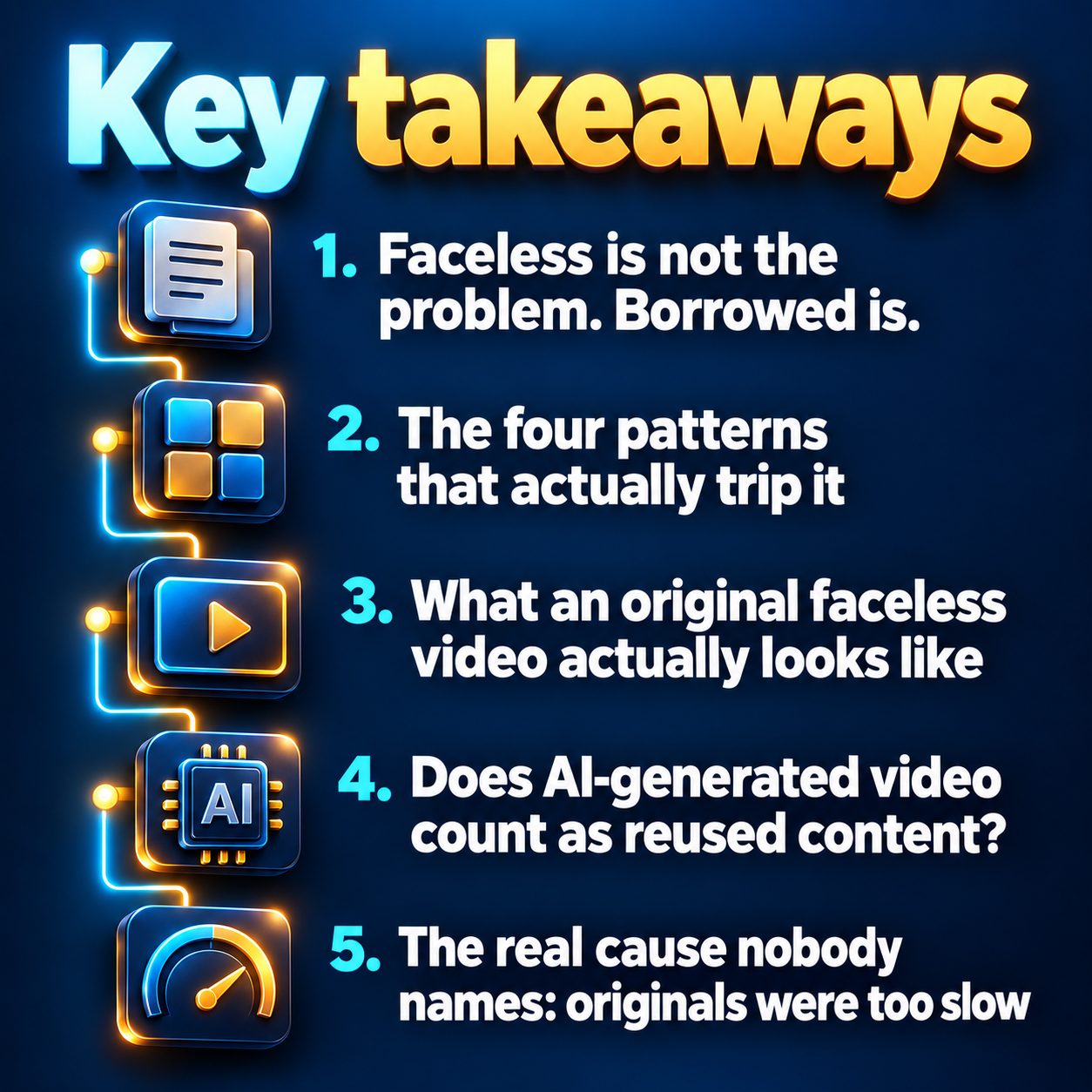
What an original faceless video actually looks like
Here is the working checklist I would hold every upload to before applying:
- The script exists nowhere else. You read three or four sources, then wrote your own version with your own ordering and your own point of view. Not a paraphrase of one page.
- The visuals are yours to use. Generated, licensed, or shot. If you do use a third-party clip, it is short, it is doing a job, and your material surrounds it.
- The angle is specific. Not "the story of the Titanic" but the one detail you find strange about it. Specific angles are also what makes people watch to the end, so this pays twice.
- The channel has variety inside its niche. Different hooks, different pacing, different visual treatments. A niche is a topic, not a template.
- You would be comfortable explaining, in one sentence, what you made. If that sentence is "I put captions on it", fix the video.
Get those five right and the reused content question mostly answers itself.
Does AI-generated video count as reused content?
No. AI is how the video was made, not whose work it is. A script you directed, visuals generated for that script, and a synthetic narrator is original material. That is not the same as a reupload.
Two honest caveats, because pretending otherwise helps nobody. First, YouTube's inauthentic content policy is aimed at mass-produced, repetitious uploads. If you queue a hundred near-identical videos and walk away, you are building exactly the pattern that gets demonetized, and the fact that AI made them is beside the point. Second, if your video contains realistic synthetic media that could be mistaken for real footage or a real person, disclose it. The label does not shrink your reach. Skipping it can cost you the video.
Also worth knowing before you pick a format: the long-form path into the YouTube Partner Program needs 1,000 subscribers plus 4,000 valid public watch hours in 12 months, while the Shorts path needs 10 million valid public Shorts views in 90 days. If monetization is the goal, 16:9 videos longer than 3 minutes are usually the more reachable route.
The real cause nobody names: originals were too slow
Almost every creator who ends up with a reused content problem did not set out to cut corners. They set out to post daily. Then week two arrived, an original video took most of an evening, and grabbing a compilation felt like the only way to keep the schedule.
That is the actual failure. Not ethics, not ignorance of the policy. Cadence outrunning capacity.
So fix capacity. Batch your research on one day so scripts are never written cold. Keep a running topic list so you never open a blank page. And shorten the production step until an original video costs you a topic and an angle instead of an evening. That is where a tool like MaqtAi fits: you give it your niche and topic, it writes the script from that brief, narrates it, generates the visuals and the animated captions, and hands you a publish-ready video you can edit line by line before it goes anywhere. Nothing is scraped from another creator. If you already have a script, paste it and it is used word for word.
What it does not do: pick your angle, check your facts, or give a copy-paste channel a personality. If you run the same template on repeat, you have automated the exact thing that gets flagged. The judgment stays yours.
If the rejection email already arrived
Do not just promise to do better going forward. Reviewers look at the catalogue you have. Go back through it, unlist or delete the uploads that were mostly other people's material, and replace them with a run of clearly original videos before you reapply. The email tells you when you can apply again. Use that window to build the evidence, not to wait.
What waiting costs
Every week you spend deciding is a week your channel gathers no data. The algorithm learns nothing about who to show you to. Your watch hours sit still. Somebody in your niche posts again tomorrow.
So make one original video today. Pick a topic you actually find interesting, write the angle in a sentence, and get it published. If the production step is what has been stopping you, verify your email on MaqtAi and you get free credits to make the first one with no card (details on the pricing page), and if you like the rhythm, scheduling and auto-publish can hold the cadence for you.
Doing this by hand is the part most people quit at. MaqtAi writes the script, narrates it, generates the visuals and captions, and assembles the faceless short for you. Verify your email and you get 450 free credits: about 3 videos on the still-frame tier, or one with AI motion. Free renders carry a watermark.
Try it on your niche freeFrequently asked questions
Does using stock footage count as reused content? Licensed stock is fine as supporting visuals. It becomes a problem when the stock clips are the video and your contribution is a voice track over them with no original writing or structure.
Will an AI voice get my channel flagged for reused content? No. The narrator is a production choice, not an ownership question. What matters is whether the script and the visuals are yours rather than lifted from someone else.
Can I run the same video on two of my own channels? Don't. Near-duplicate files across accounts is one of the clearest spam signals to every platform. Re-cut it with a different angle and a different opening if you want to cover the topic twice.
How many original videos should I have before applying to YPP? There is no magic count. Aim for a body of work where every recent upload passes the checklist above, with enough variety that a reviewer can see a channel rather than a template.
Results vary. Nothing here is a guarantee of monetization, approval, or income.