
Where faceless YouTube money actually comes from
Everyone pictures ad revenue first, and that's also the income with a gate in front of it. YouTube only shares ad money once you're in the YouTube Partner Program. To get in you need 1,000 subscribers plus either 4,000 valid public watch hours in the last 12 months or 10 million valid public Shorts views in the last 90 days. Until then, the channel earns nothing from ads. Most people selling the dream leave that part out.
Once you're in, format matters a lot. Regular horizontal videos usually earn far more per view than Shorts, which are paid under their own revenue policy. So a Shorts-only channel can pile up big view counts and still get a small check.
Ads aren't the only income, though. Faceless channels also earn from:
- Affiliate links for products that fit the niche, like a finance channel linking a budgeting app or a sleep channel linking a white noise machine.
- Sponsorships, once the audience is focused enough that a brand wants to reach it.
- Your own thing, like a guide, a template, a newsletter or a service. For many faceless creators this turns out to be the real money, and the channel works as the shop window.
Here's the part worth remembering. Affiliate and product income don't need the Partner Program. You can earn something before YouTube ever pays you.
Why those earnings screenshots deserve your suspicion
You've seen them: a dashboard, a big number and a link to a course. Some are real. But look at who's posting them. These are people whose business is selling you the dream. A screenshot shows one channel in one month, and it was picked because it looked good.
What actually decides a channel's earnings is the stuff the screenshot hides. The niche matters, since finance and business audiences attract pricier ads than comedy clips do. So do where your viewers live, whether the views come from Shorts or long videos, and how many quiet months came first. Two channels with similar view counts can earn wildly different amounts.
So here's the honest version. Yes, people are making money. Some make a side income and a few make a living. Many make nothing, because they stopped before the channel had a chance. If someone gives you a confident monthly figure for a channel you haven't started yet, they're guessing or selling.
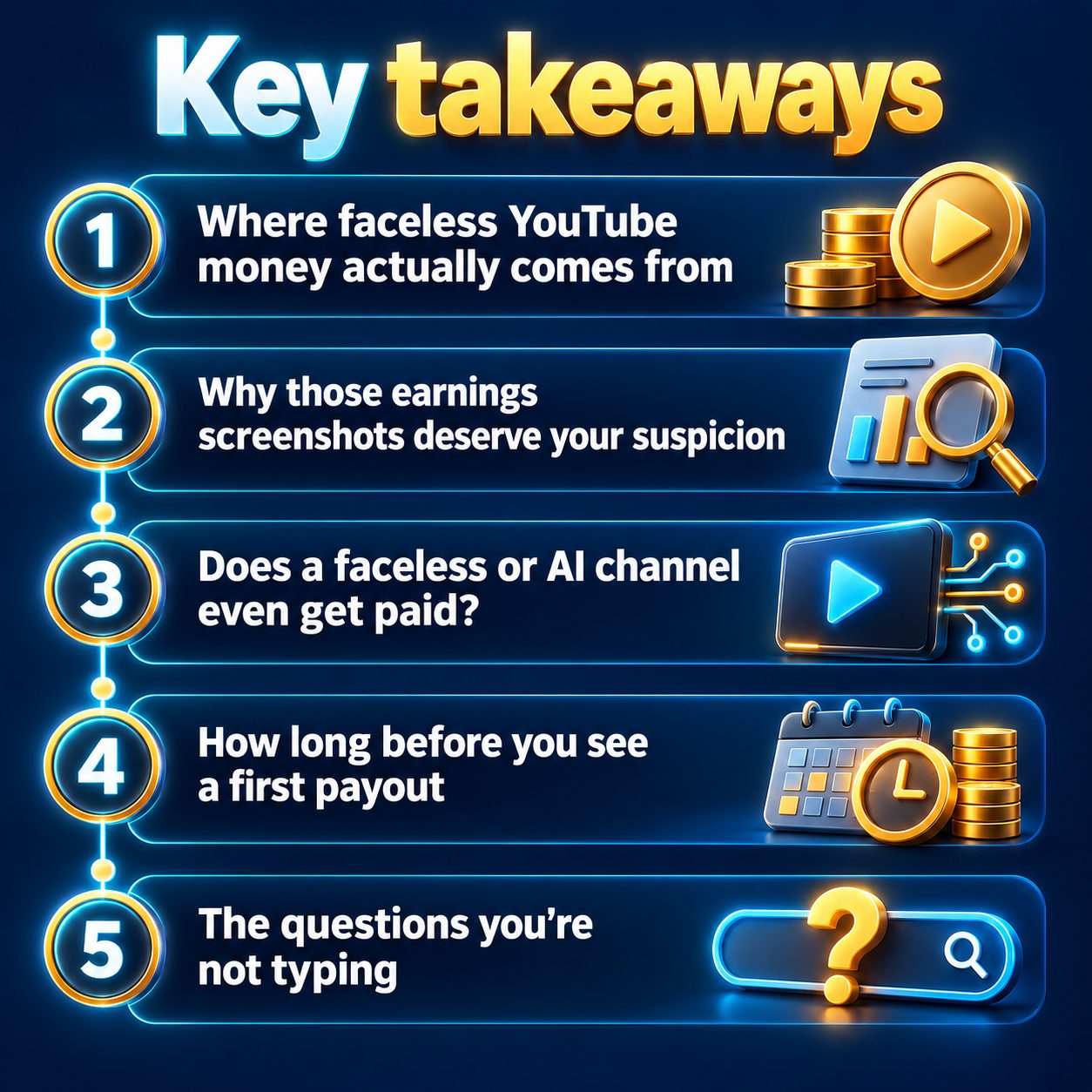
Does a faceless or AI channel even get paid?
This is the worry behind most of these searches: "Won't YouTube just demonetize it?" Not for being faceless. Plenty of channels have been monetized for years with nothing but narration and footage. And no platform ranks a video lower just because AI helped make it. YouTube ranks on what viewers do, like how long they watch and whether they finish.
What YouTube refuses to pay for is content that's mass-produced and repetitious. Its inauthentic content rule targets channels that churn out near-identical videos from a template with nothing new in them. That line is about sameness, not tools. One more rule: if you use realistic synthetic people or scenes, add YouTube's disclosure label. The label doesn't hurt reach, but skipping it risks removal.
A faceless channel that gets paid usually has:
- A clear angle a viewer could describe in one sentence.
- Scripts that say something specific instead of generic filler.
- Real variety between episodes, even inside a tight niche.
If you'd be bored watching your own videos back to back, YouTube's reviewers probably would be too.
How long before you see a first payout
Longer than the ads promise. Reaching the Partner Program thresholds usually takes months of steady posting, not weeks. For many channels it takes much longer.
The path you pick changes the math. The long-form route through watch hours is generally far easier to reach than the Shorts route, which asks for a huge view count in a short window. A lot of faceless creators use long videos to make money and Shorts to bring new people to the channel. Shorts are vertical or square and up to 3 minutes long according to YouTube's Shorts spec. That makes them quick to produce and a cheap way to test hooks.
Treat the first stretch as research. You're finding out which topics hold people and which opening lines make them stay. That data only builds up if you keep posting.
The questions you're not typing
Am I too late? No. New viewers keep arriving in every niche, and the channels that fade leave room behind them. What's crowded is low-effort copies. A channel with a real point of view still stands out.
Will people judge me for AI content? Mostly, viewers judge whether the video was worth their time. A good story told well gets watched. Generic sludge gets skipped, no matter who or what made it.
What if I stop after two weeks? Then it won't work, and that's the most common way faceless channels fail. Pick a cadence you can keep up for months, even if that means three a week instead of daily. Boring consistency beats a burst of enthusiasm.
Making the slow part survivable
The hard part isn't making one great video. It's the long middle, the weeks when you post and not much happens. Production time is what kills most attempts, because scripting, voice, visuals and editing all have to happen again for every single video.
MaqtAi was built to remove that friction. You give it a niche and a topic. It writes the script, narrates it with an AI voice, generates visuals with real motion, adds captions and assembles the video. You never appear on camera. For the YouTube money path, you can choose a 16:9 horizontal shape that gets a long-form structure (hook, themed sections, recap). Then you can make a standalone companion Short on the same topic. Once you've found a rhythm, Autopilot can render from your topic queue daily, three times a week or weekly. Nothing publishes without your approval unless you turn auto-publishing on.
Now the honest limits. It won't pick a winning niche for you, it doesn't read trends, and it can't make a channel monetizable. That still depends on your angle, your hooks and enough variety that YouTube sees a real channel and not a template. If you're still choosing a niche, browse the faceless niches it covers.
What waiting actually costs
Every week you spend researching earnings is a week your channel isn't collecting the one thing that predicts its future: data on what your viewers actually watch. Meanwhile someone in your niche posted today, and their algorithm history just got a little longer than yours.
You don't need to commit to anything big. Pick a niche, write down a handful of topics and make one video to see how it feels. MaqtAi gives you 450 free credits when you verify your email, with no card needed. That covers roughly 3 to 4 videos on the still-frame default, or one with AI motion. Free renders carry a watermark, so treat them as a test drive, not your launch. The pricing page shows what each quality tier costs. After that, you'll be answering this question with your own channel instead of someone else's screenshot.
Doing this by hand is the part most people quit at. MaqtAi writes the script, narrates it, generates the visuals and captions, and assembles the faceless short for you. Verify your email and you get 450 free credits: about 3 videos on the still-frame tier, or one with AI motion. Free renders carry a watermark.
Try it on your niche freeFrequently asked questions
Do faceless YouTube channels get monetized? Yes, faceless channels can join the Partner Program like any other channel. YouTube refuses mass-produced, repetitious content, not channels without a face.
Do Shorts or long videos make more money? Regular long videos usually earn far more ad revenue per view than Shorts. Many faceless creators use Shorts to get discovered and long videos to earn.
Can I earn before joining the YouTube Partner Program? Yes, through affiliate links, sponsorships or selling your own product. Ad revenue only starts once you're accepted into the program.
How long does it take to make money from a faceless channel? Usually months of consistent posting, and sometimes much longer. Nobody can promise a timeline, which is why a cadence you can sustain matters most.
Results vary, and nothing here is a guarantee of income.