YouTube doesn't ask if it's AI. It asks if it's yours
Here's the worry I hear most. You've read that YouTube is cracking down on AI, so why bother? Fair question. But read the actual channel monetization policies and you won't find a rule against AI tools. What you'll find is a rule against inauthentic content: videos that are mass-produced, repetitive, or so templated they look like they came off a conveyor belt.
That difference matters a lot. When your channel is reviewed, the question is whether a real person is making choices. Is there a point of view? Do the videos differ in substance, not just in title? Would a viewer come back on purpose?
An AI voice, AI visuals and AI script drafts don't disqualify you on their own. Faceless channels built on narrated stories, explainers and history deep cuts can get approved. Channels that pump out the same stock-footage list with swapped keywords don't, no matter who edited them.
What mass-produced actually looks like
It's easier to spot from the outside, so here's the pattern that gets flagged:
- Every video uses the same script skeleton with only the nouns changed.
- The narration rewords someone else's article or video and adds nothing.
- The same visuals show up again and again across videos.
- Uploads are so frequent and so alike that nobody could have watched them before posting.
And here's what reads as a real channel:
- A clear niche with a recognizable angle. Not just "facts" but "the strange legal history behind everyday objects."
- Scripts that take a position, tell a story with a payoff, or teach something specific.
- Variety inside the niche: different hooks, structures and pacing.
- Signs that someone is steering. Titles match the content, the voice stays consistent, and topics build on each other.
One more thing. Realistic synthetic media, like a lifelike person saying something they never said or a made-up event that looks real, needs YouTube's AI disclosure label at upload. The label doesn't bury your video. Skipping it when it applies is what gets you in trouble.
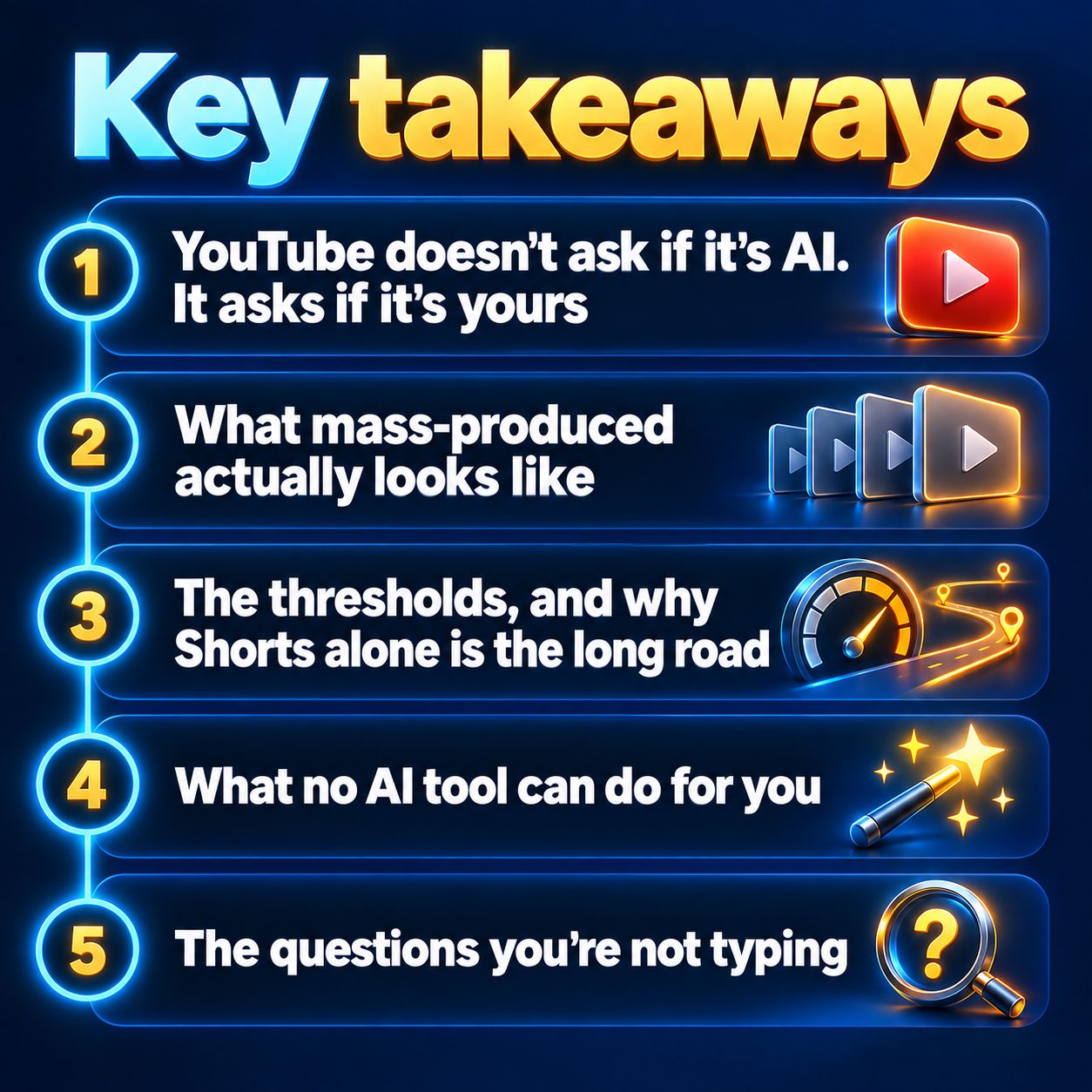
The thresholds, and why Shorts alone is the long road
To join the Partner Program, the entry requirements are 1,000 subscribers plus either 4,000 valid public watch hours in the last 12 months or 10 million valid public Shorts views in the last 90 days.
Read that twice. The Shorts route asks for a huge pile of views in a short window. Some channels get there. For a lot of beginners, though, the watch-hours route is easier to reach, because one longer video can bank far more watch time than a single Short.
The pay works differently too. Shorts ad revenue is pooled and split by share of views under its own Shorts monetization policy, and it typically pays less per view than regular videos. That's no reason to skip Shorts. They're how new people find you, and some of them go on to subscribe and watch your longer videos.
So here's the practical play. Use Shorts for reach and regular horizontal videos for watch hours, in the same niche with the same voice. YouTube counts vertical or square videos up to 3 minutes as Shorts and everything else as regular videos. The shape you export decides which shelf your video lands on.
What no AI tool can do for you
I'll be straight with you, because this is where people get burned.
A tool can't pick a niche people actually want. It can't promise a hook will land. It can't make a channel original if you feed it the same topic in different costumes. It won't get you approved, and it can't tell you whether a video is good enough to post. That's your call, and your judgment is exactly what reviewers are looking for.
What a tool takes off your plate is the grind of filming, recording and editing. That matters, because the grind is usually what kills faceless channels. But put the time you save into better topics and hooks. Don't spend it posting more of the same.
The questions you're not typing
Will people judge my channel for being AI? Viewers decide in the first seconds. If the story's good and the voice fits, they stay. Platforms rank Shorts by how people watch, finish and share them, not by how they were made. What turns people off is slop. Slop is a choice, not a tool.
Am I too late? Every niche looks crowded from the outside. What's actually rare is a channel that posts well and keeps going. You don't need to be first. You need to still be posting after the novelty wears off.
What if I quit after two weeks? Then nothing happens, and that's the real risk. Monetization rewards watch time and subscribers that build up over time, and a paused channel stops building. Pick a cadence you can hold on a bad week. Three videos a week that you actually keep up beats a daily sprint that dies in a fortnight.
From zero to a channel worth reviewing
- Pick one niche and an angle only you would take. If you're stuck, browse faceless niche examples.
- Build every script around a hook, a real payoff and one next step. Rewrite any line that sounds generic.
- Post Shorts on a cadence you can keep up, and add regular 16:9 videos on the same topics so watch hours start adding up.
- Watch completion and comments, not just views. Make more of whatever people finish.
- Before you apply, binge your own channel the way a reviewer would.
If production is what's been stopping you, this is where MaqtAi fits. It writes a hooked script you can edit line by line, narrates it, animates the visuals and adds captions. In the wizard you choose vertical for a Short or 16:9 for a regular video. A finished 16:9 video can also spin off a companion Short that stands on its own. Scheduling and auto-publish keep your cadence going when life gets busy. It won't pick your niche or save a weak topic. That part stays yours.
What waiting actually costs
Every week you spend deciding is a week with no watch hours, no subscribers and no data on which hooks work for you. Meanwhile, someone in your niche posted again today. The thresholds stay where they are. The only thing that changes is how far behind you start.
So take the smallest possible step: make one video this afternoon and see if you like it. Verify your email and you get free credits to do it, with no card needed (details on pricing). If it's not for you, you've lost an afternoon. If it is, your channel starts counting today.
Doing this by hand is the part most people quit at. MaqtAi writes the script, narrates it, generates the visuals and captions, and assembles the faceless short for you. Verify your email and you get 450 free credits: about 3 videos on the still-frame tier, or one with AI motion. Free renders carry a watermark.
Try it on your niche freeFrequently asked questions
Can AI-generated Shorts get monetized on YouTube? Yes, as long as the channel is original and adds value. YouTube's policies go after mass-produced, repetitive content, not the use of AI tools.
Do I need to disclose AI in my YouTube Shorts? Only for realistic synthetic content, like a lifelike person or an event that never happened. The label doesn't reduce distribution, but skipping it when it applies risks removal.
Is it faster to monetize with Shorts or with longer videos? For many new channels, the watch-hours route through regular videos is easier to reach than the Shorts views route. Running both in the same niche gives you reach and watch time together.
Do I own the AI videos I make with MaqtAi? Yes. The videos you generate are yours to post, monetize and use commercially on your own channels.
Results vary, and nothing here is a guarantee of income.