
The seven jobs, not the seven tools
Every faceless short runs through the same chain. Pick by job instead of by product name and the shopping list stops being intimidating.
1. A script with a hook. The first sentence decides whether the rest gets watched. Your script tool only has to do three things: open with a hook, set up a problem and pay it off, and end on one clear next step.
2. A narration voice. Realistic, consistent across videos, and adjustable in speed. Voice consistency matters more than voice beauty. Viewers recognize a channel by its sound.
3. Visuals with motion. Still images fading into each other read as a slideshow, and slideshows lose people in the first seconds. You need footage or generated scenes that actually move.
4. Animated captions. Most short-form viewing happens on mute or half-attention. Burned-in animated captions are not decoration, they are the retention mechanic.
5. Assembly. Somebody has to line up voice, visuals, captions and audio into one vertical file at the right size. If you are doing this by hand in an editor, this is the job that eats your evenings.
6. A title and a cover. Feeds autoplay, so in-feed views come from your opening frame, not a thumbnail. Covers still matter on your profile grid and in YouTube search.
7. Publishing on a cadence. The unglamorous one, and the only one that correlates with a channel going anywhere. A tool that posts for you beats a tool that makes a slightly prettier video.
What you can skip on day one
- Trending topic finders. For a new channel, your niche has maybe twenty evergreen questions people search constantly. Write those first.
- Stock footage subscriptions. You will pay monthly for a library you barely search while your generated visuals sit unused.
- Keyword research suites. Useful at scale, useless before you have a channel with data.
- A separate thumbnail designer. Cover generation is bundled into most video tools now.
- A music licensing plan. Ambient beds and non-instrumental vocal beds cover almost every faceless niche, and loud music actively hurts sleep, story and documentary content.
- Talking avatars. Genuinely useful for product ads and UGC-style promos. For a storytelling or history channel, you do not need a face.
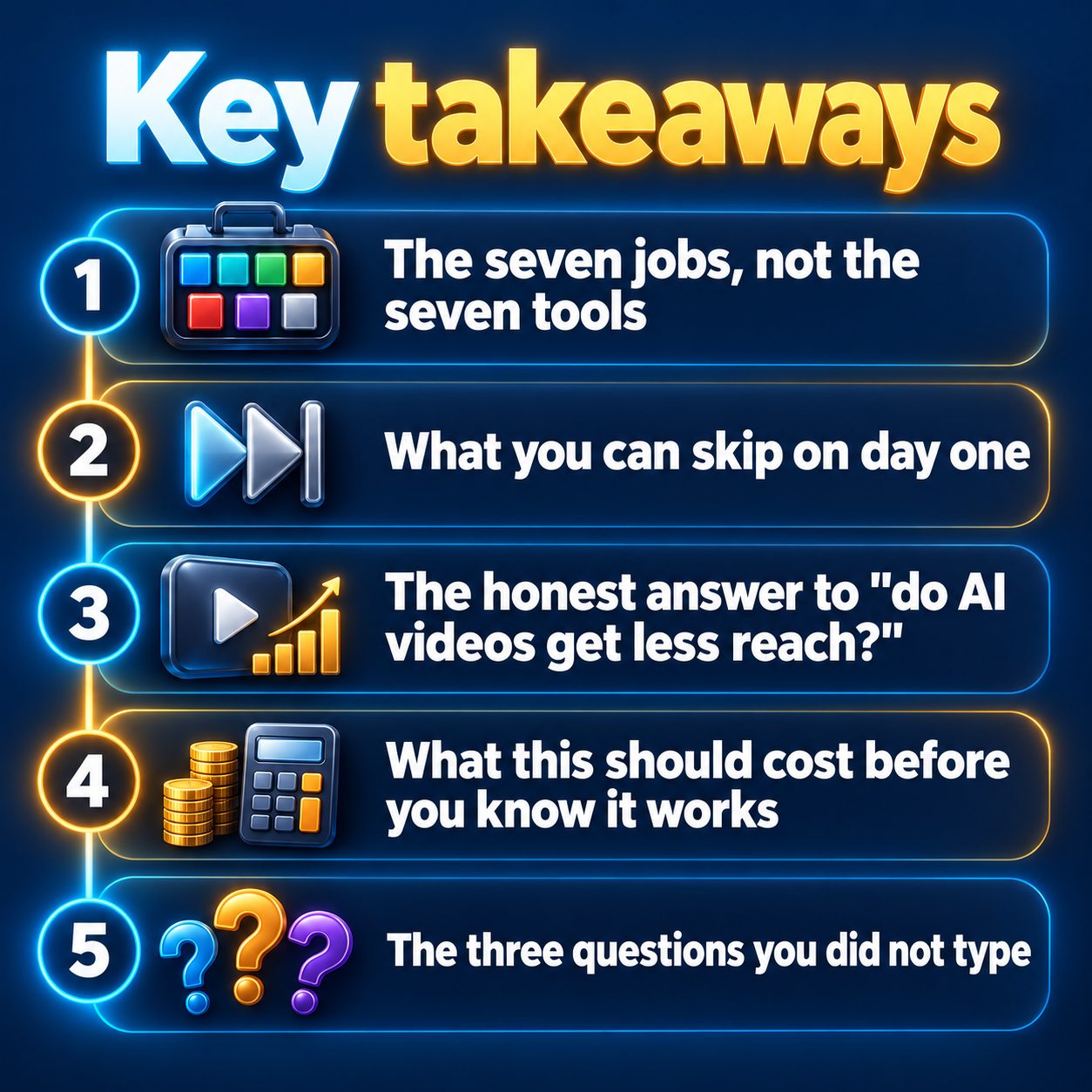
The honest answer to "do AI videos get less reach?"
No platform down-ranks a video for being AI-made. TikTok, Instagram, YouTube and Facebook rank short-form by viewer behavior: watch time, completion, likes, shares. Nothing in that list knows how the file was produced.
What does hurt you is real, though, and worth saying plainly. Spam patterns get caught: identical files posted across several accounts, near-duplicate videos pushed out in bulk. Weak opening seconds kill you before the algorithm even has a signal. And if your video uses realistic synthetic media, follow the platform's disclosure rule. The label itself does not reduce distribution, but skipping it risks removal.
On monetization, be clear-eyed. YouTube's inauthentic content policy demonetizes mass-produced, repetitious content, so churning out the same video with different words is the one strategy that reliably fails. And the Partner Program bar is 1,000 subscribers plus either 4,000 valid public watch hours in 12 months or 10 million valid public Shorts views in 90 days, which is why a lot of faceless creators eventually add 16:9 long-form instead of living on Shorts alone.
What this should cost before you know it works
Here is the rule I would give a friend: pay nothing up front that you cannot cancel after a month, and buy nothing annual until you have posted daily for four weeks straight.
Most creators get this backwards. They spend a weekend comparing tools, buy three subscriptions, then discover the actual bottleneck was that they hate writing scripts. The cheap experiment is making ten videos badly and finding out which step you avoid.
The three questions you did not type
Am I too late? Short-form watch demand grows faster than good faceless channels get made. The niches that are crowded are crowded because they work, and most of the competition posts inconsistently.
Will people judge me for AI content? A small number of commenters will. Most viewers never think about it, because they are not evaluating your production pipeline, they are deciding in two seconds whether to keep watching. Your taste in topics and hooks is still the thing people follow.
What if I stop after two weeks? This is the real risk, and it is why I would weight the stack toward scheduling rather than polish. A tool that renders and posts while you are at work survives a bad week. A workflow that needs three hours of your Sunday does not.
Where the whole stack collapses into one workflow
All seven jobs in one chain is exactly what MaqtAi was built to do: you give it a niche and a topic, and it writes the script, narrates it, generates moving visuals, adds animated captions, and assembles a publish-ready vertical video, typically in about six minutes. Autopilot and scheduling then run a topic queue on a cadence and publish to YouTube, Instagram and Facebook Reels, with an approval step on by default so nothing posts without your tap. TikTok arrives as a draft in your inbox for now, which is TikTok's review process, not a bug.
The honest limits, because you should hear them before you try: Autopilot needs a paid plan, free-tier videos carry a watermark, and no tool picks your niche or tells you whether a hook is good. That judgment stays yours. Videos you generate are yours to post and monetize.
What another week of deciding actually costs
Nothing dramatic happens if you wait. That is the problem. The channel does not grow, the algorithm collects no data about who your videos suit, and whoever started in your niche last month is building a back catalogue while you compare feature tables.
So make one video. Not a content calendar, not a brand, one video about the topic you would explain to a friend anyway. Verifying your email gets you 450 free credits, no card, which is enough to see your own idea come out as a finished short this afternoon. If you hate the result, you have lost an hour and learned something specific.
Doing this by hand is the part most people quit at. MaqtAi writes the script, narrates it, generates the visuals and captions, and assembles the faceless short for you. Verify your email and you get 450 free credits: about 3 videos on the still-frame tier, or one with AI motion. Free renders carry a watermark.
Try it on your niche freeFrequently asked questions
Do I need a separate tool for captions and thumbnails? Not usually. Animated animated captions and a generated cover are bundled into most short-form video tools, including MaqtAi. Buying standalone tools for these before you have posted anything is the classic beginner overspend.
Can I run more than one faceless channel from one stack? Yes. You can connect multiple accounts, including more than one channel on the same platform, and pick which ones each video goes to. If you want channels kept fully separate, use a separate workspace for each.
Should I post Shorts or long-form videos? Both eventually. YouTube classifies vertical video up to 3 minutes as a Short, while 16:9 becomes a regular video, and the long-form monetization path is far more reachable than the Shorts path.
What if I do not speak English well enough to script? Write in your own language. Script, narration and captions can be generated together in 59 languages, and a finished video can be regenerated with a new voiceover in another language later without redoing the visuals.
Results vary. Nothing here is a guarantee of views, monetization or income.