
First, agree on what "long form" means here
Two different things hide under that phrase, and they have different quality bars.
YouTube sorts your upload automatically. Vertical or square video up to 3 minutes is treated as a Short, while 16:9 (or anything longer than 3 minutes) runs as a regular video, per YouTube's own Shorts documentation. So a 2m40s vertical narration is still a Short in the algorithm's eyes, no matter how long it felt to make.
Why this matters for quality: a Short lives or dies in the first two seconds. A regular video lives or dies on structure. Someone who clicked a 6 minute video already decided to give you time. They leave when the middle sags, when the narration flattens out, when the visuals start repeating. Those are the three things AI tools are accused of, so let's be specific about which accusations are true.
What AI genuinely does well at length
Narration is the surprise. Modern synthetic voices hold a consistent tone for minutes without the fatigue, breath noise, and re-takes that make human recording miserable. For explainer, history, story, and list formats, most viewers are not sitting there thinking about the voice. They are following the topic.
Captions and pacing are also solved. Animated captions that stay in sync for six straight minutes used to be an editing chore. Now it is a checkbox.
And AI is good at organizing information it already knows into ordered sections. That is exactly what a long-form faceless script is: a hook, four or five themed chunks, a recap. If your niche is "explain a known thing clearly," the machine is genuinely competent.
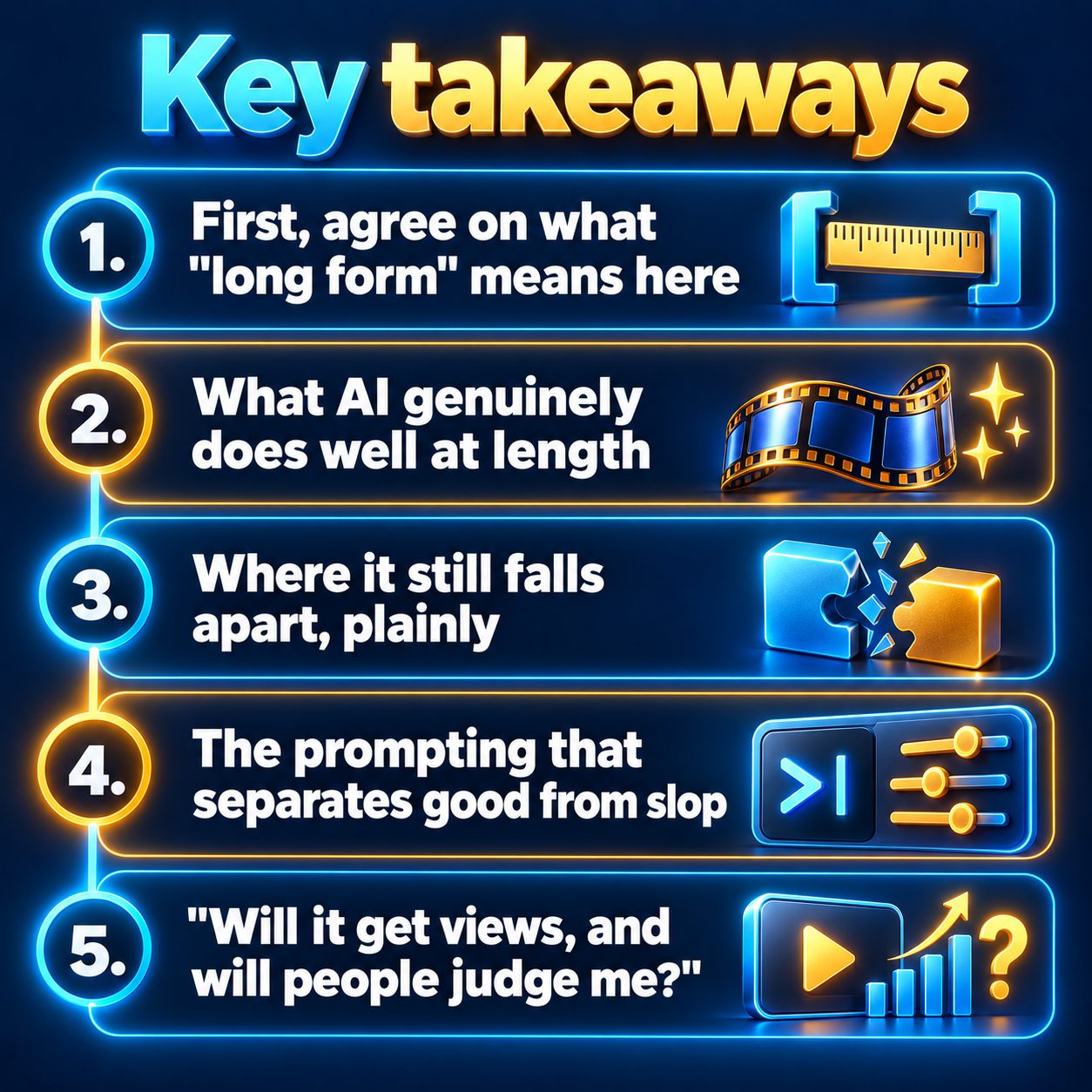
Where it still falls apart, plainly
This is the part most tool pages skip.
It drifts if you give it one line. Ask for "a 6 minute video about the Roman economy" and you get an encyclopedia entry with no throughline. The middle repeats itself because nothing told it not to.
Visuals get samey. Ten minutes of AI-generated shots in one style start to blur. This is the single most common reason a long-form AI video feels cheap.
It has no opinion. AI will not tell your audience what you think, what surprised you, or what everyone else gets wrong. In niches built on a point of view, that gap is the whole product.
It should not be trusted alone on facts. Recent events, numbers, names, dates: check them. A confident wrong sentence at minute four costs you the comment section.
Honest verdict: AI carries delivery. You still carry the argument. If you are not willing to write or at least shape an outline, long form is not for you yet. Stay on shorts.
The prompting that separates good from slop
"When prompted well" is doing heavy lifting in your search. Here is what "well" actually means.
- Pick the duration before the script. Length shapes how much script gets written. Deciding afterward gives you either a rushed skim or padding.
- Hand over an outline, not a topic. Five section headings in the order you want them. This one change fixes most of the drift problem.
- Write the first two lines yourself. The opening is the part where a generic sentence is most expensive. Say the surprising thing immediately.
- Direct the visuals per section. "Empty grain warehouse, dust in the light" beats letting the tool pick for the fourth time.
- Break the rhythm on purpose. Change scene length between sections. Add a one-line recap before the last chunk. Monotony reads as low quality even when every asset is sharp.
- Read the finished script out loud once. You will catch the flat paragraph faster than any review step.
Do those six things and the output stops looking machine-made. Skip them and no tool saves you.
"Will it get views, and will people judge me?"
No platform down-ranks a video for being AI-made. TikTok, Instagram, YouTube, and Facebook rank on viewer behavior: watch time, completion, likes, shares. Production method is not an input.
What does hurt you is spam behavior. Identical files across several accounts, near-duplicate topics posted in bulk, thin videos with a weak opening. That is what gets throttled, and it would get throttled if a human filmed it too. Also follow the AI-disclosure rule when your media is realistic synthetic footage. The label itself does not cut your reach, but skipping it can get the video pulled.
As for judgment: in faceless niches, viewers came for the topic. Nobody watches a story channel and files a complaint about the narrator's origin. The people who care are usually other creators, not your audience.
The money question, honestly
Long-form matters here more than anywhere else. YouTube's main Partner Program path asks for 1,000 subscribers plus 4,000 valid public watch hours in 12 months, while the Shorts path asks for 10 million valid public Shorts views in 90 days (YouTube's eligibility page). For most faceless channels, watch hours are the more reachable door, and regular videos generally earn more ad revenue per view than Shorts.
The catch: YouTube's inauthentic content policy demonetizes mass-produced, repetitious content. So the strategy that gets you paid is the opposite of the one people assume. Fewer, better, genuinely different videos. Not a queue of near-identical uploads.
A workflow that survives past week three
Most faceless channels die from cadence, not quality. So build something you can repeat on a bad week.
One long-form video per week, one vertical video most days. The long-form builds watch hours; the shorts feed discovery. Reuse research across both, never the same file.
This is where a tool earns its place. In MaqtAi you pick the shape at the Length and aspect step, and choosing 16:9 at 2 or 5 minutes applies a long-form script structure automatically: hook, themed sections, recap. A finished 16:9 video also has a "Make a companion Short" button that creates a separate standalone vertical video on the same topic, with its own payoff rather than a teaser clip. You can paste your own script instead of generating one, and it gets used word for word. More of that on the features page and the three-step overview.
The real cost of waiting is not a missed offer. It is that your channel has no watch hours accumulating, no data for the algorithm to learn from, and someone in your niche is publishing this week while you decide. The fix is one video, not a content calendar.
Verify your email and you get 450 free credits, no card, which covers one AI-motion video or three to four on the still-frame Express tier, each watermarked and without a presenter, so you can judge the output with your own eyes instead of a review. Credit costs per quality tier are on the pricing page.
Doing this by hand is the part most people quit at. MaqtAi writes the script, narrates it, generates the visuals and captions, and assembles the faceless short for you. Verify your email and you get 450 free credits: about 3 videos on the still-frame tier, or one with AI motion. Free renders carry a watermark.
Try it on your niche freeFrequently asked questions
Can AI actually write a 10 minute script that stays coherent? It can if you give it section headings and a stated angle. From a bare topic line it tends to repeat itself around the middle. The outline is the fix, not a longer prompt.
Do I need to disclose that my video was made with AI? Disclose when the media is realistic synthetic content, following each platform's rule. The label does not reduce your distribution, and skipping it risks removal.
Is vertical or 16:9 better for a faceless channel? Use both. Vertical up to 3 minutes runs as Shorts for discovery, and 16:9 runs as regular video and builds the watch hours that matter for monetization.
How much of the work is still mine? The angle, the hook, the outline, and a fact check. That is maybe twenty minutes per video, and it is the twenty minutes that decides whether anyone finishes watching.
Results vary. Nothing here is a guarantee of income.