From idea to finished video: what actually happens
An AI generated short is not one magic button. It is a chain of small decisions, and each one affects the first two seconds of watch time more than you would guess.
Here is the order that works:
- Topic and angle. Do not write "scary story." Write "a scary story about a night guard alone in an empty office building." A narrow angle gives you a sharper hook.
- Script. The first line is everything. Make it a question, a contradiction, or the promise of something you are about to reveal, and never open with "in this video we are going to talk about."
- Length and format. Vertical 9:16 up to three minutes gets classified automatically as a Short on YouTube, while 16:9 is treated as a regular video. Pick the format before you write the script, because the runtime decides your word count.
- Voice. AI voiceover is natural enough now, but pace makes the difference. Try slightly faster than normal for motivational content, slower for bedtime stories.
- Scenes. Actually moving images, not static slides. Even simple motion keeps eyes on the screen.
- Animated captions. Most viewers start watching with the sound off.
- Review, then publish to the connected account.
All of this can take under an hour for your first video, and minutes once you know what you want. If you want to see the whole sequence laid out simply, the three steps are explained here.
"My niche is different, this will not work for me"
This is the objection I hear most, and it is fair. But try a sharper question: does your niche need your face, or does it need information or a story?
Plenty of niches work with no filming at all: horror stories, history, illustrated stories, stoic motivation, true crime, dark psychology, startup stories, sleep and relaxation content, strange facts, news recaps. What they share is that the value lives in the telling, not in the person.
Niches that do not work well without filming: personal opinion built on your face, reviews where you need to handle the product, and anything that runs on one specific personality. Be honest with yourself about this before you start. Browse niche and use case examples to see where yours lands.
One more thing worth saying: language is not a barrier. The topic, the voiceover, and the captions can all be in Arabic, or you can write the idea in English and pick an Arabic narration. The language setting drives the script, the voice, and the captions together.
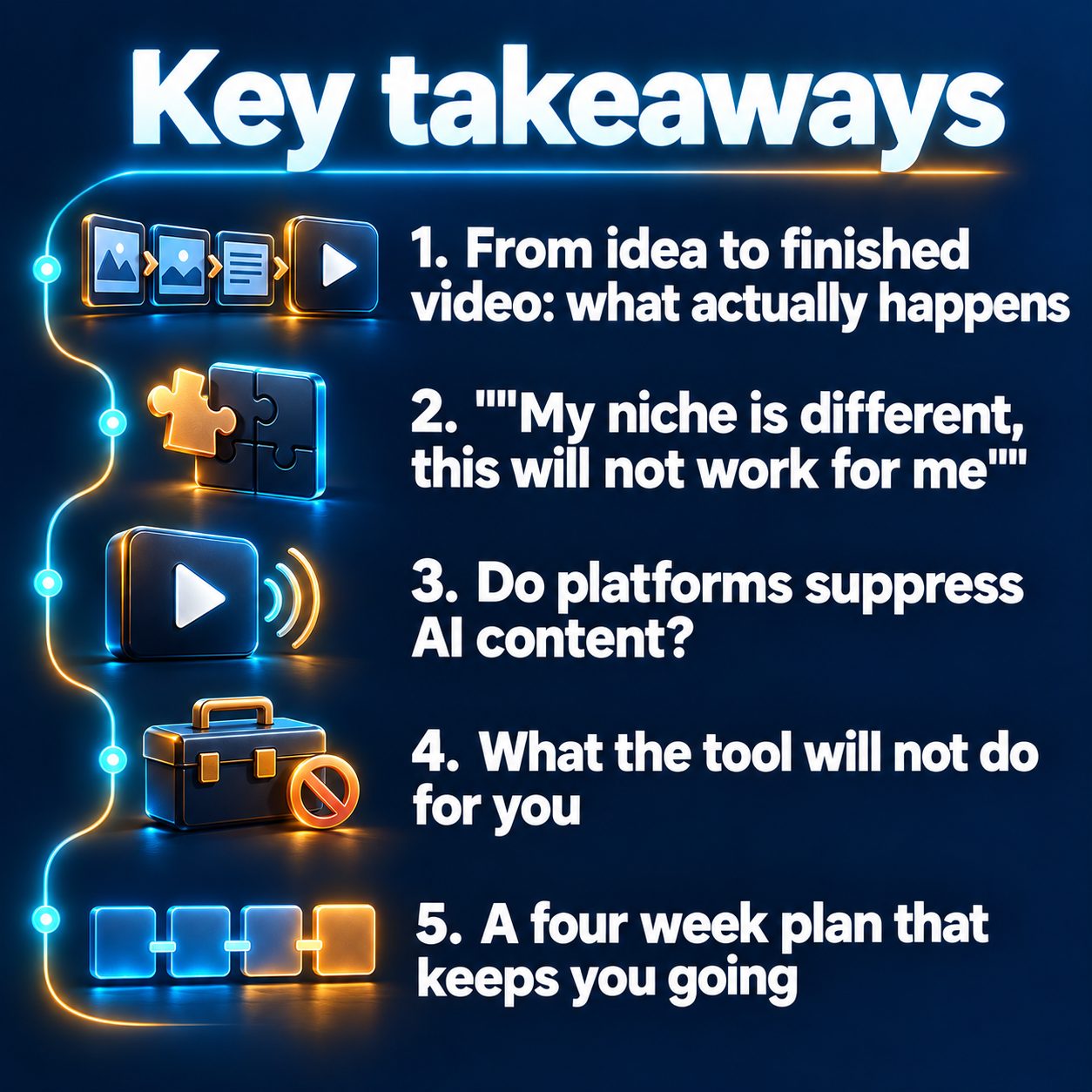
Do platforms suppress AI content?
No. No platform penalizes a video simply for being made with AI. TikTok, Instagram, YouTube, and Facebook rank shorts on viewer behavior: watch time, completion rate, likes, shares. How it was produced is not a ranking signal.
Three things do hurt you:
- Spam patterns. The same file across several accounts, or blasting out near identical copies.
- Weak opening seconds. If a viewer leaves at second two, nothing after that matters.
- Ignoring disclosure rules for realistic synthetic content. The label itself does not reduce distribution, but skipping it can get the video removed.
There is one detail specific to monetization: YouTube's inauthentic content policy pulls monetization from mass produced repetitive content. In other words, cloning the same template hundreds of times with no real variation is the problem, not using AI.
What the tool will not do for you
This is the part nobody puts on a sales page.
AI does not pick your niche. It does not know your local audience or what makes them laugh. It does not guarantee that the hook it wrote is the best one, so read it out loud and change it if it lands flat. And it does not fact check for you: if you are in history or true crime, verification is on you.
There are also platform limits worth knowing before they surprise you:
- TikTok: publishes directly and publicly, and you pick a visibility level before posting; Autopilot cannot post to TikTok on its own yet, so a TikTok destination waits in the approval queue.
- Instagram Reels: needs a Business or Creator account linked to a Facebook Page. Personal accounts cannot publish through the API.
- Facebook Reels: publishes to a Page you manage, not to your personal profile.
- YouTube Shorts: publishes directly, and any channel works.
Who does not need any of this? Anyone making one video a month. Automation buys you pace, and if you are not planning to publish regularly you will never feel the benefit.
A four week plan that keeps you going
Most people who quit, quit in week two, and not because the content failed. They quit because the process wore them out. So lock in the routine before you chase the numbers.
Week one: pick exactly one niche. Make three videos with three different angles inside that same niche. Do not switch niches no matter what.
Week two: publish daily. Build the whole week's videos in one sitting, and you will find that batching is far easier than trying to do it fresh every day.
Week three: look at which video held viewers longest, then repeat its hook pattern, not its topic.
Week four: keep what worked and cut anything you cannot see yourself sustaining.
This is where the practical part comes in: with MaqtAi you can build a topic list, or let Autopilot suggest a batch from your niche, and have it draft videos on a daily, three times a week, or weekly cadence, with an approval queue so every video waits on one tap from you before it goes out, if that is what you want. Scheduling and auto publishing details are here. Just note that Autopilot needs an active subscription, while creating videos manually is available from the start.
What waiting actually costs you
There is no deadline here, and no offer expiring tonight. But waiting has a real price: a channel that does not exist collects no data, the algorithm cannot learn from nothing, and the competitor who has been posting daily for two months now has dozens of videos and knows which ones worked, while you are still comparing tools.
The small step is not "build a channel." The small step is one video, today, in the niche you have been thinking about for weeks. Verifying your email gets you 450 free credits, enough for three or four still frame videos, or one with AI motion, watermarked and without a presenter, so you can judge the result for yourself instead of guessing. Credit and plan details are here.
If you do not like the result, you lost an evening. If you do like it, you have the first video of a channel.
Doing this by hand is the part most people quit at. MaqtAi writes the script, narrates it, generates the visuals and captions, and assembles the faceless short for you. Verify your email and you get 450 free credits: about 3 videos on the still-frame tier, or one with AI motion. Free renders carry a watermark.
Try it on your niche freeFrequently asked questions
Do I need editing experience to make an AI short? No. The process is a series of choices: topic, format, voice, music, captions, then a review before publishing. On a paid plan, edits to the text, voice, and captions are free for 7 days after the render, while regenerating scenes costs the usual credits.
Can I monetize AI generated videos? The videos you produce are yours, and you can publish and use them commercially on your channels. Each platform's rules still apply, and YouTube's inauthentic content policy targets mass produced repetitive content, so make every video genuinely different.
How long does one video take? The prep and the choices are the longest part the first time around, and a vertical video is usually ready in a few minutes from the moment you hit start. Once you settle into your style it gets much faster.
Can I make the same video in another language? Yes. You can generate a version with the same scenes and a voiceover and captions in another language, and supported languages include Arabic, Spanish, French, German, Hindi, Japanese, and more. Videos with a visible on camera presenter are not translated this way at the moment.
Results vary from channel to channel, and nothing in this article is a promise of income or a guarantee of any earnings.